A simple but powerful model
Unlike covalent bonding (localized sharing) or ionic bonding (electron transfer), the metallic bond is collective: valence electrons delocalize across the entire solid. A metal can be pictured as a lattice of positive metal ions immersed in a mobile electron sea.
This model, developed by Drude and Lorentz in the early 20th century, is qualitatively very effective at explaining the macroscopic properties of metals, even though it does not capture full quantum effects (that requires band theory).
Crystal structure of metals
Metal ions typically pack into close arrangements:
- Face-centred cubic (FCC): Cu, Ag, Au, Al — coordination number 12.
- Hexagonal close-packed (HCP): Mg, Ti, Zn — coordination number 12.
- Body-centred cubic (BCC): Fe (α), Cr, W — coordination number 8.
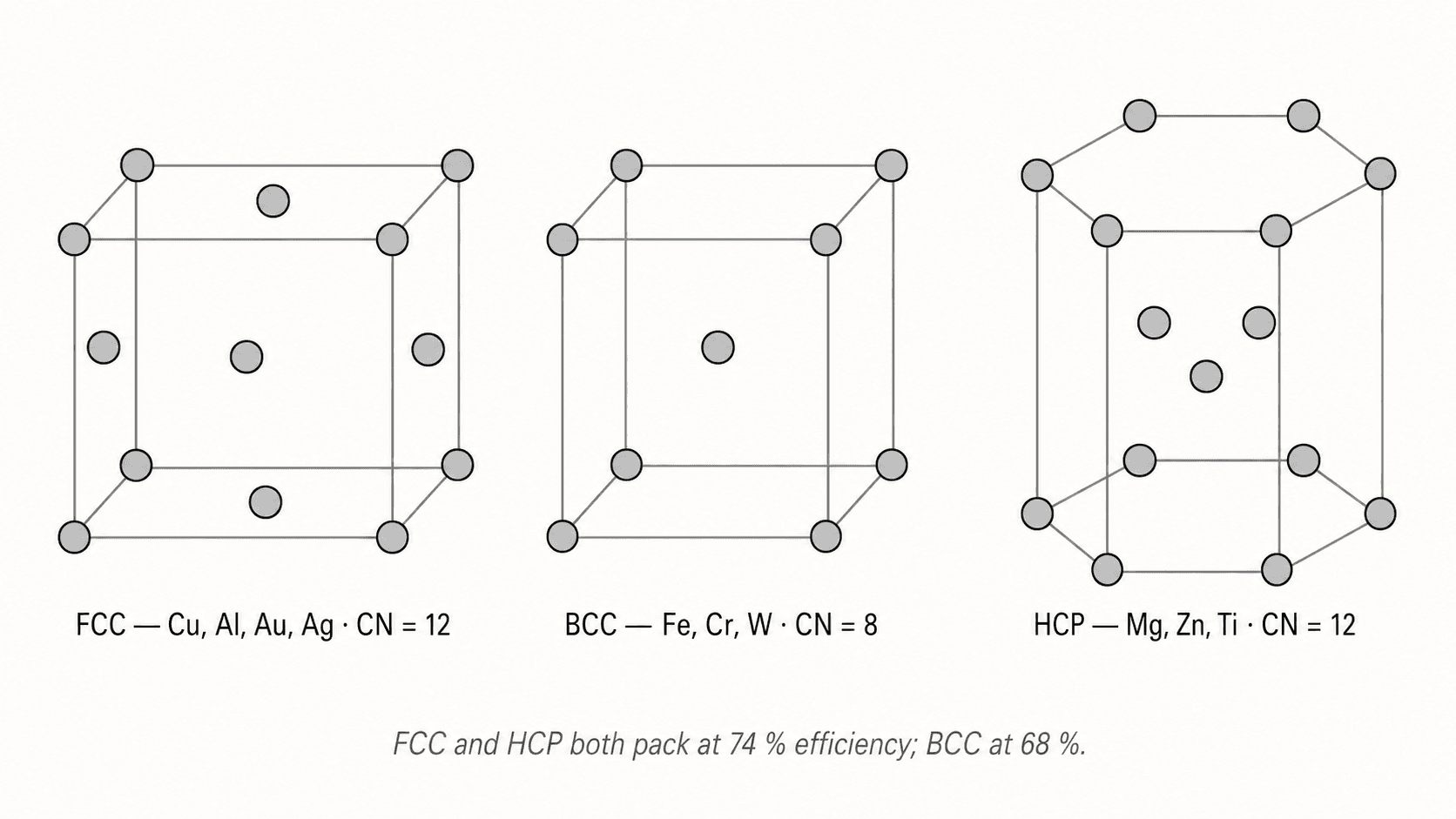
Packing efficiency is 74 % for FCC and HCP structures, and 68 % for BCC.
Properties explained by the model
Electrical conductivity: delocalized electrons move freely under an electric field — the property most directly explained by the Drude model.
Thermal conductivity: free electrons also transport thermal energy efficiently, giving metals high thermal conductivity.
Malleability and ductility: planes of ions can slide past each other (plastic deformation) without breaking the bond, because the electron sea adapts to the new geometry.
Metallic luster: free electrons absorb and re-emit visible photons non-selectively → bright, mirror-like reflection.
Melting points: vary with electron density and ion–electron interaction strength. Tungsten W (Tm = 3422 °C) has 6 valence electrons and exceptional cohesion; sodium Na (Tm = 98 °C) has only 1.
| Metal | Valence electrons | Tm (°C) | Electrical conductivity |
|---|---|---|---|
| Na | 1 | 98 | Good |
| Al | 3 | 660 | Very good |
| Fe | 2 (4s²) + partial d | 1538 | Good |
| W | 6 | 3422 | Moderate |
Limitations of the model
The free-electron model does not predict resistivity accurately (quantum collision theory is needed), does not explain magnetic properties (it ignores electron spin), and cannot account for superconductivity. Band theory (Brillouin zones, valence vs conduction bands) is the natural quantum extension.
Finished this lesson?