The VSEPR principle
VSEPR theory (Valence Shell Electron Pair Repulsion) states that all electron pairs — bonding and non-bonding — around a central atom repel each other and arrange themselves to minimize repulsions. The molecular shape follows directly from this arrangement.
Repulsion order (strongest to weakest): lone pair–lone pair > lone pair–bonding pair > bonding pair–bonding pair
Lone pairs therefore occupy more angular space and compress bond angles.
AXₙEₘ notation
Describe the central atom A by: - n = number of bonding pairs (X) - m = number of lone pairs (E)
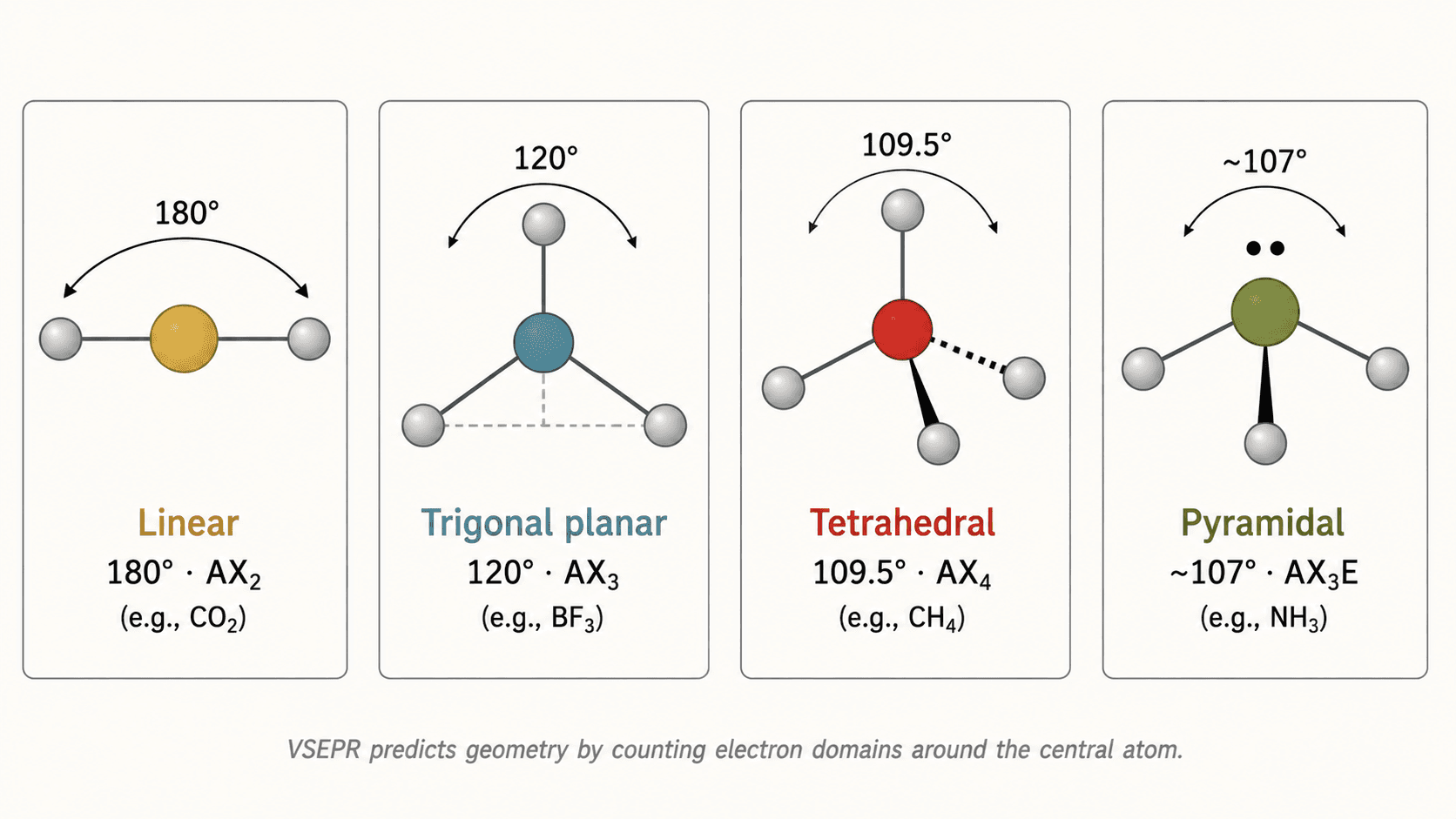
The electron-pair geometry (spatial arrangement of all pairs) gives the ideal angles; the molecular geometry (observed shape) counts bonds only.
| Notation | Total pairs | Electron-pair geometry | Molecular geometry | Ideal angle |
|---|---|---|---|---|
| AX₂ | 2 | Linear | Linear | 180° |
| AX₃ | 3 | Trigonal planar | Trigonal planar | 120° |
| AX₂E | 3 | Trigonal planar | Bent | < 120° |
| AX₄ | 4 | Tetrahedral | Tetrahedral | 109.5° |
| AX₃E | 4 | Tetrahedral | Trigonal pyramidal | < 109.5° |
| AX₂E₂ | 4 | Tetrahedral | Bent | < 109.5° |
| AX₅ | 5 | Trigonal bipyramidal | Trigonal bipyramidal | 90°/120° |
| AX₆ | 6 | Octahedral | Octahedral | 90° |
Worked examples
CO₂: AX₂ (2 double bonds on C, no lone pairs) → linear, O−C−O = 180°. Non-polar molecule.
[H₂O](/compounds/h2o): AX₂E₂ (O has 2 O−H bonds + 2 lone pairs) → bent, H−O−H = 104.5° (lone pairs compress the angle). Polar molecule.
[NH₃](/compounds/nh3): AX₃E (N has 3 bonds + 1 lone pair) → trigonal pyramidal, H−N−H = 107°. Polar molecule.
[CH₄](/compounds/ch4): AX₄ (C has 4 bonds, no lone pairs) → tetrahedral, H−C−H = 109.5°. Non-polar molecule.
PCl₅: AX₅ → trigonal bipyramidal (axial positions at 90° from equatorial, equatorial at 120° to each other).
Polarity and dipole moment
Molecular shape determines whether bond dipoles cancel:
- CO₂ is linear: the two C=O bond dipoles (equal magnitude, opposite direction) cancel → non-polar molecule.
- H₂O is bent: the two O−H dipoles do not cancel → polar molecule (μ ≠ 0).
This polarity governs intermolecular interactions (hydrogen bonds, van der Waals forces) and thus the physical properties of compounds.
Finished this lesson?