How the periodic table is organized
The periodic table arranges all 118 known elements in order of increasing atomic number Z. This arrangement reveals a striking periodicity of physical and chemical properties.
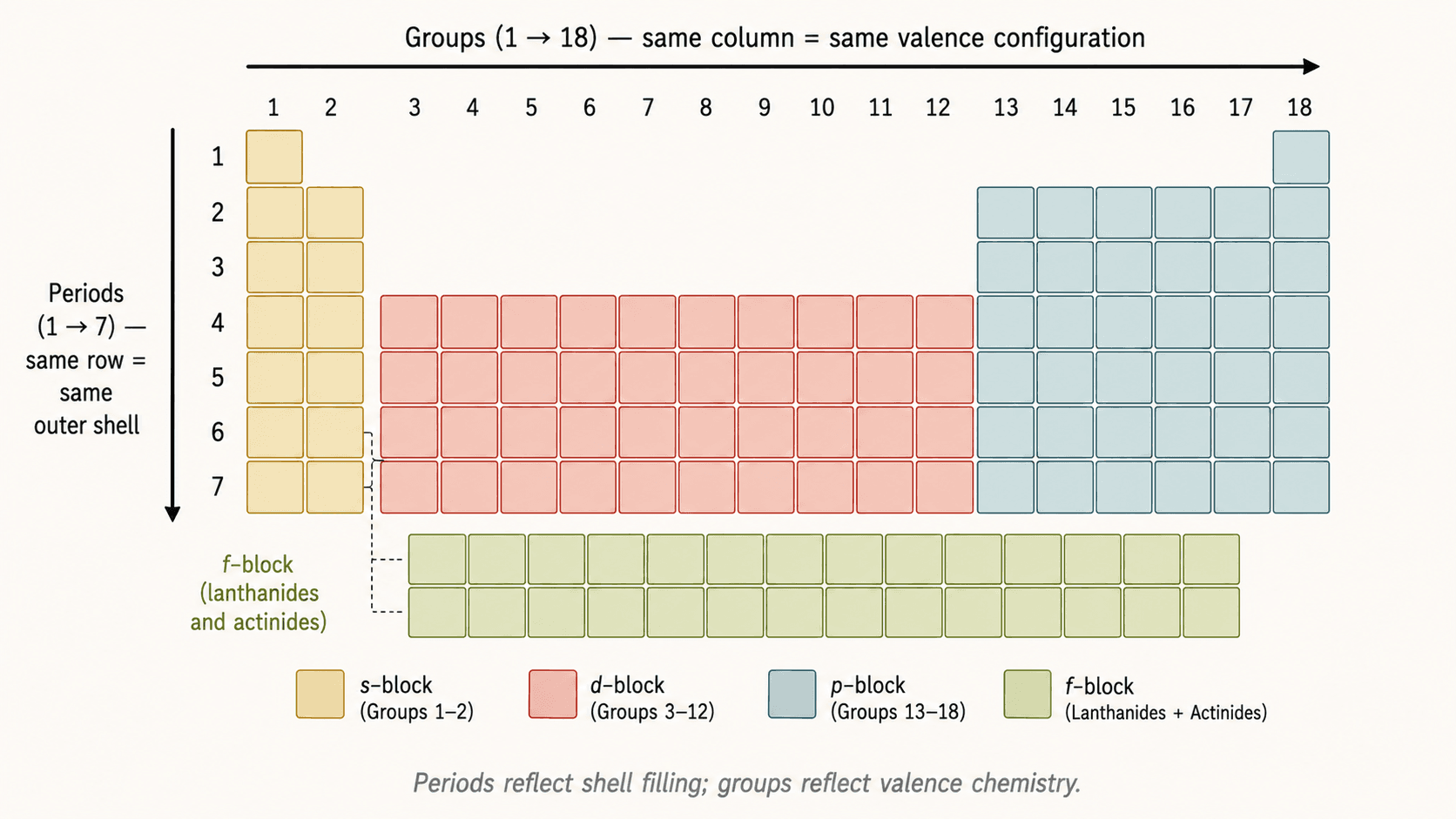
- A period (horizontal row) corresponds to a principal energy level n. Period 1 holds H and He (filling the 1s shell). Period 4 starts with K (4s filling) and includes the first row of transition metals (3d filling).
- A group (vertical column) groups elements with the same valence configuration and therefore similar chemical behavior. Groups are numbered 1–18.
The four blocks
The block an element belongs to is determined by which subshell is being filled last:
| Block | Subshell | Groups | Examples |
|---|---|---|---|
| s | ns | 1–2 | H, Li, Na, Mg, Ca |
| p | np | 13–18 | C, N, O, F, Cl, Ne |
| d | (n−1)d | 3–12 | Fe, Cu, Zn, Ti |
| f | (n−2)f | Lanthanides / Actinides | Ce, U |
Lanthanides (Z = 57–71) and actinides (Z = 89–103) are placed separately at the bottom of the table for practical layout reasons.
Key families
Several groups carry traditional names:
- Group 1 — Alkali metals: Li, Na, K, Rb, Cs, Fr. One valence electron (ns¹). Highly reactive; react vigorously with water.
- Group 2 — Alkaline-earth metals: Be, Mg, Ca, Sr, Ba, Ra. Configuration ns².
- Group 17 — Halogens: F, Cl, Br, I, At. Seven valence electrons (ns² np⁵). Readily form X⁻ anions.
- Group 18 — Noble gases: He, Ne, Ar, Kr, Xe, Rn. Full valence shell; very low reactivity.
Metals, non-metals, and metalloids
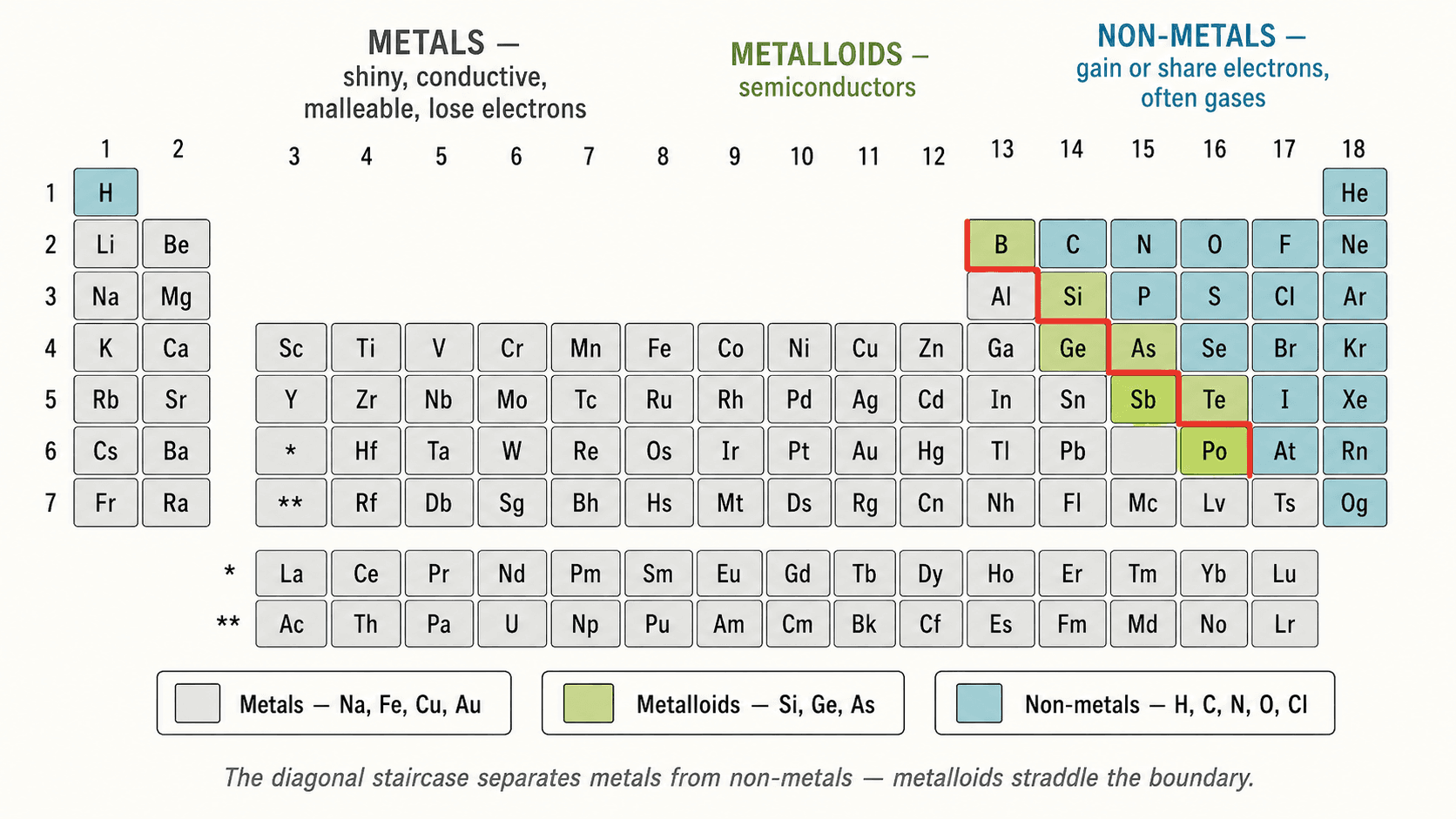
The table divides into three broad zones:
Metals (left and center): shiny, good conductors of heat and electricity, malleable. About 75 % of all elements are metals (e.g. Na, Fe, Au).
Non-metals (upper right): often gaseous at room temperature, poor conductors (e.g. H, C, N, O, S). They form covalent bonds with each other and with metals.
Metalloids (diagonal boundary): intermediate properties, often semiconductors (B, Si, Ge, As, Sb, Te). Critical in electronics.
Locating an element from Z
Given Z, you can identify the period and group without memorizing the whole table:
- Chlorine (Z = 17): [Ne] 3s² 3p⁵ → period 3, group 17 (halogen).
- Iron (Z = 26): [Ar] 4s² 3d⁶ → period 4, group 8 (transition metal).
- Germanium (Z = 32): [Ar] 4s² 3d¹⁰ 4p² → period 4, group 14 (metalloid).
Finished this lesson?