Why electron configuration matters
Electrons do not orbit a nucleus at random. They fill energy levels (shells) and subshells (s, p, d, f) according to well-defined rules. Knowing an element's electron configuration lets us predict its chemical behavior, its valence, and its position on the periodic table.
The three filling rules
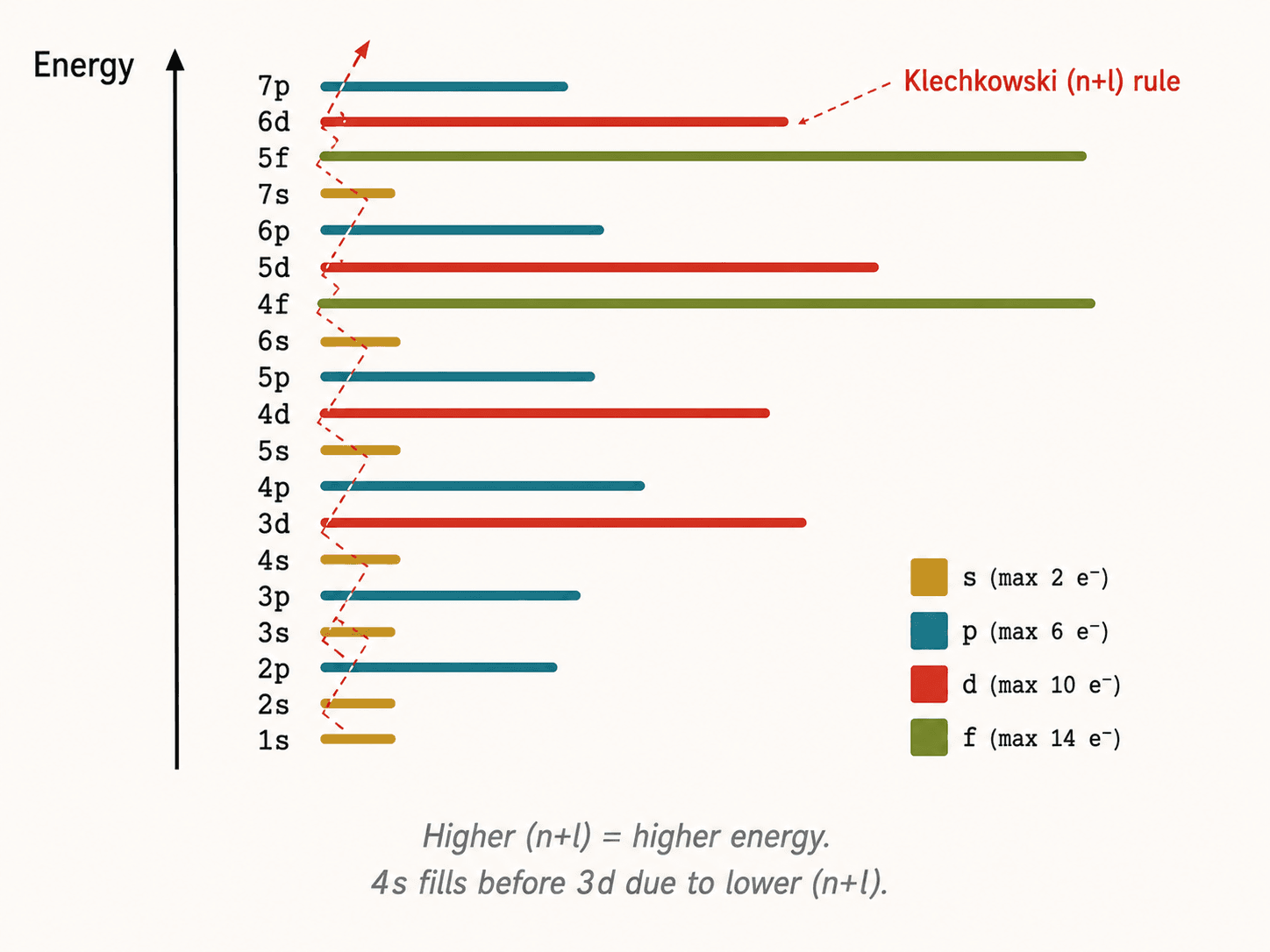
Aufbau principle (building-up): fill subshells in order of increasing energy. The Madelung rule (sometimes called the Klechkowski rule) orders them by increasing (n + l), then by increasing n for equal sums:
1s → 2s → 2p → 3s → 3p → 4s → 3d → 4p → 5s → 4d → 5p → 6s → 4f → 5d → …
Pauli exclusion principle: each orbital holds at most two electrons, and they must have opposite spins (↑↓). A full s subshell holds 2 electrons, p holds 6, d holds 10.
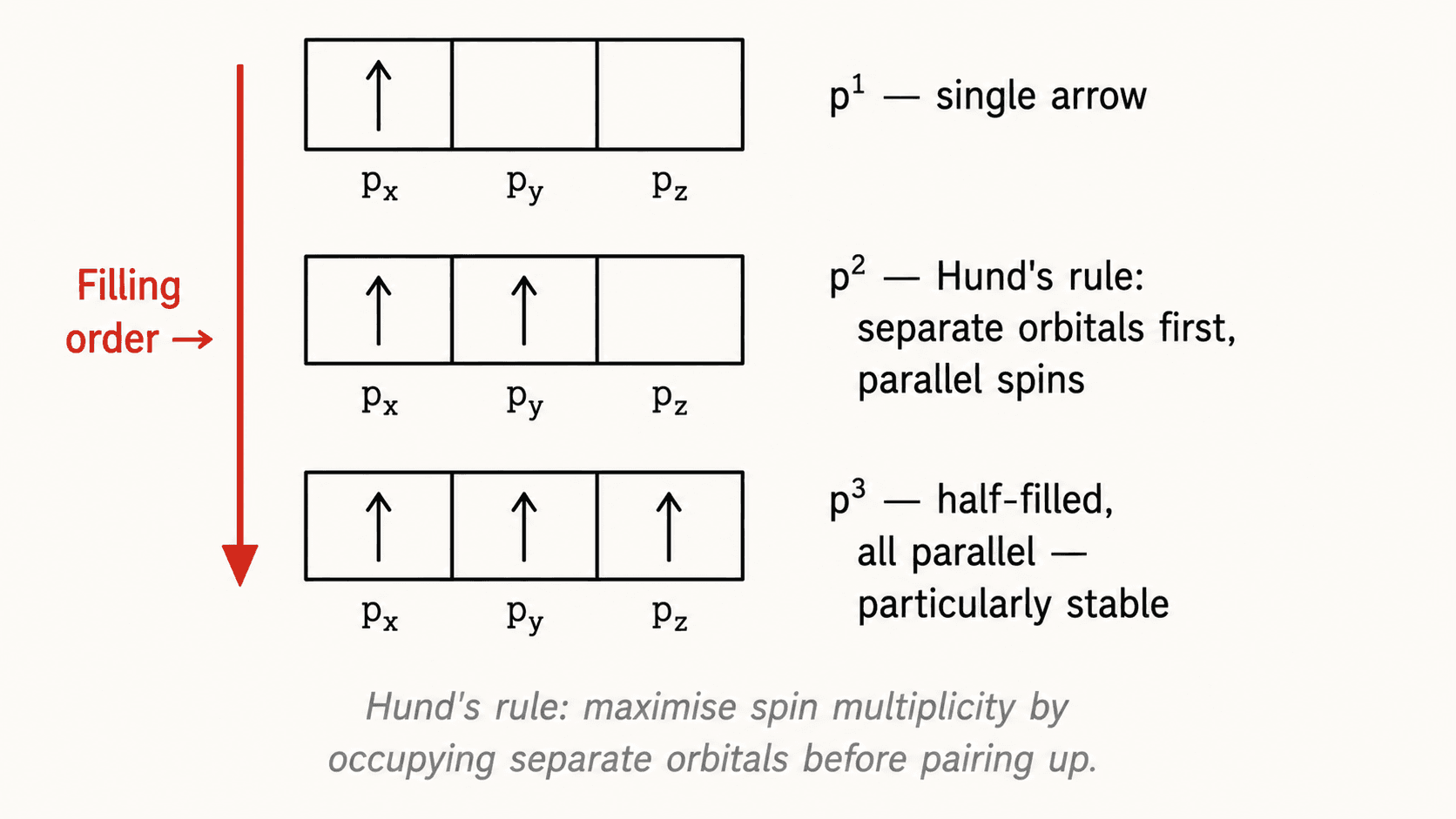
Hund's rule: within a subshell, electrons occupy empty orbitals one at a time, with parallel spins, before pairing up. This minimizes electron–electron repulsion.
Noble-gas shorthand notation
For heavier elements, write the preceding noble gas in brackets. Examples:
| Element | Z | Full configuration | Shorthand |
|---|---|---|---|
| Iron (Fe) | 26 | 1s² 2s² 2p⁶ 3s² 3p⁶ 4s² 3d⁶ | [Ar] 4s² 3d⁶ |
| Zinc (Zn) | 30 | … 4s² 3d¹⁰ | [Ar] 4s² 3d¹⁰ |
| Copper (Cu) | 29 | … | [Ar] 4s¹ 3d¹⁰ |
Copper is an anomaly: the predicted [Ar] 4s² 3d⁹ is less stable than [Ar] 4s¹ 3d¹⁰. A completely filled (or exactly half-filled) d subshell lowers the total energy. Chromium (Z = 24) behaves similarly: [Ar] 4s¹ 3d⁵.
Two orderings, not to be confused. Subshells are written here in filling order (4s before 3d), since that is what the Madelung rule gives. Many textbooks — and this site's element pages — instead write them in shell order: [Ar] 3d⁶ 4s² for iron. Both notations describe the same atom; only the writing convention differs.
Valence electrons
Valence electrons are those in the outermost shell (highest n) and, for transition metals, also the incompletely filled d subshell. They are the electrons involved in chemical bonding.
- Main-group elements (s and p blocks): valence electrons = electrons in the last period only.
- Transition metals (d block): (n)s + (n−1)d electrons that are not fully saturated.
Iron (Fe) with [Ar] 4s² 3d⁶ has 8 valence electrons, which explains its common oxidation states of +2 and +3.
Electrons removed during ionization
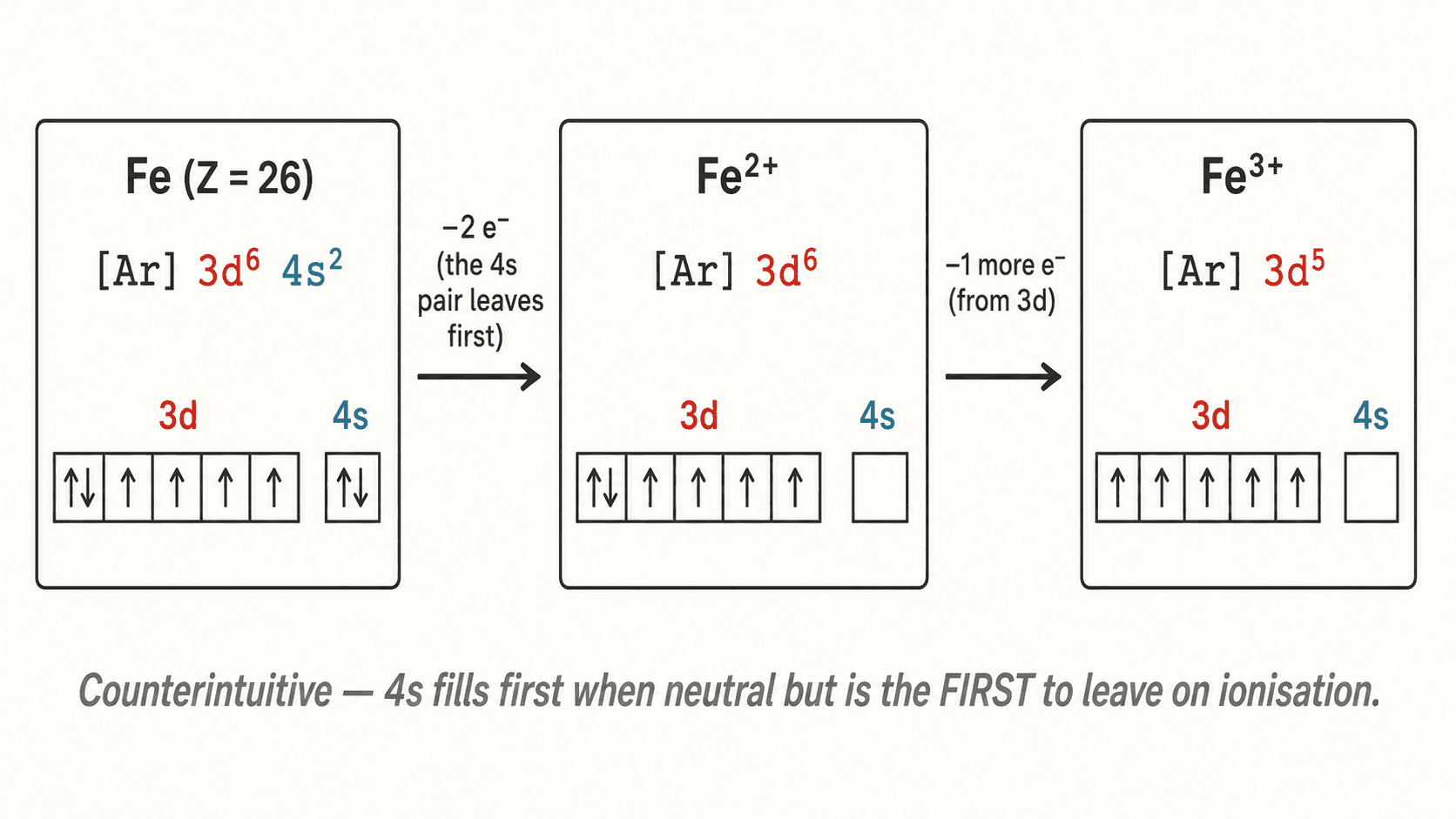
When an atom loses electrons to form a cation, it loses the s electrons first (last filled). Fe → Fe²⁺: remove both 4s electrons to get [Ar] 3d⁶. This counter-intuitive order — removing 4s before 3d — is confirmed by X-ray spectroscopy.
Finished this lesson?