Sharing electrons
When two non-metals (or a non-metal and a metalloid) bond, neither atom fully surrenders its electrons. Instead they share them: this is the covalent bond. Each bonding pair is shared between the two nuclei, and each atom typically contributes one electron to that pair.
The driving force is energy lowering: each atom aims for the electron configuration of a noble gas — the octet rule (8 valence electrons) or the duet rule for H, Li, Be (2 electrons).
Lewis structures
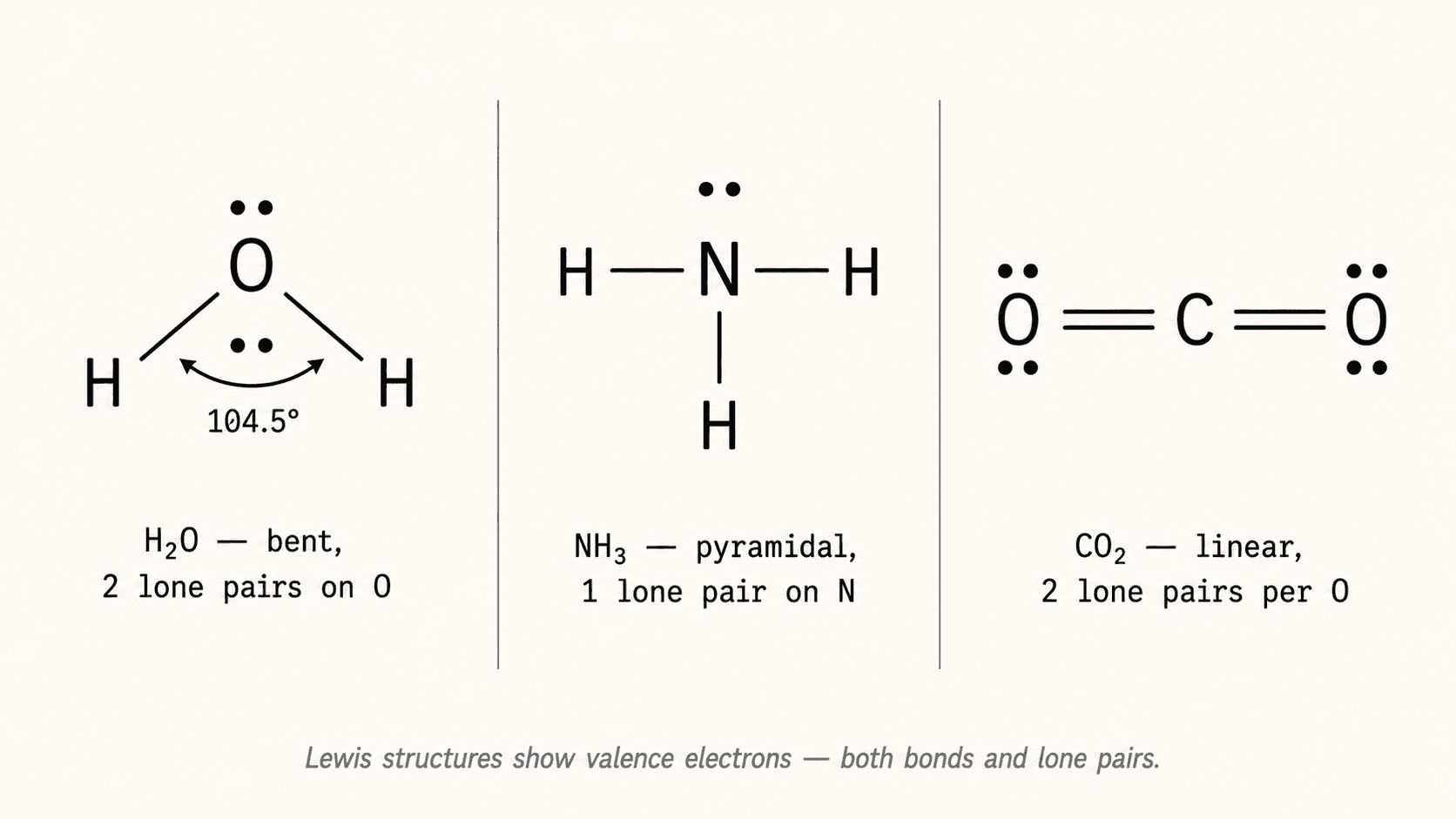
A Lewis structure (or Lewis dot diagram) shows: - bonding pairs (shared electrons) as dashes (—) or dot pairs; - lone pairs (non-bonding electrons) as dots on individual atoms.
Construction method: 1. Count the total number of valence electrons. 2. Connect all atoms with single bonds. 3. Complete octets on peripheral atoms with lone pairs. 4. Place remaining electrons on the central atom. 5. If the central atom's octet is incomplete, convert lone pairs on peripheral atoms into double or triple bonds.
Single, double, and triple bonds
| Bond type | Shared electrons | Examples |
|---|---|---|
| Single bond (σ) | 2 | H−H, H−Cl, H₂O |
| Double bond (σ + π) | 4 | O=O, C=O (CO₂) |
| Triple bond (σ + 2π) | 6 | N≡N, C≡O |
Bond order increases bond energy and decreases bond length: a C=O bond (~116 pm) is shorter and stronger than a C−O bond (~143 pm).
Water ([H₂O](/compounds/h2o)): oxygen (6 valence electrons) forms 2 O−H bonds and retains 2 lone pairs.
Ammonia ([NH₃](/compounds/nh3)): nitrogen forms 3 N−H bonds and keeps 1 lone pair.
Methane ([CH₄](/compounds/ch4)): carbon forms 4 C−H bonds with no lone pairs.
Resonance and formal charge
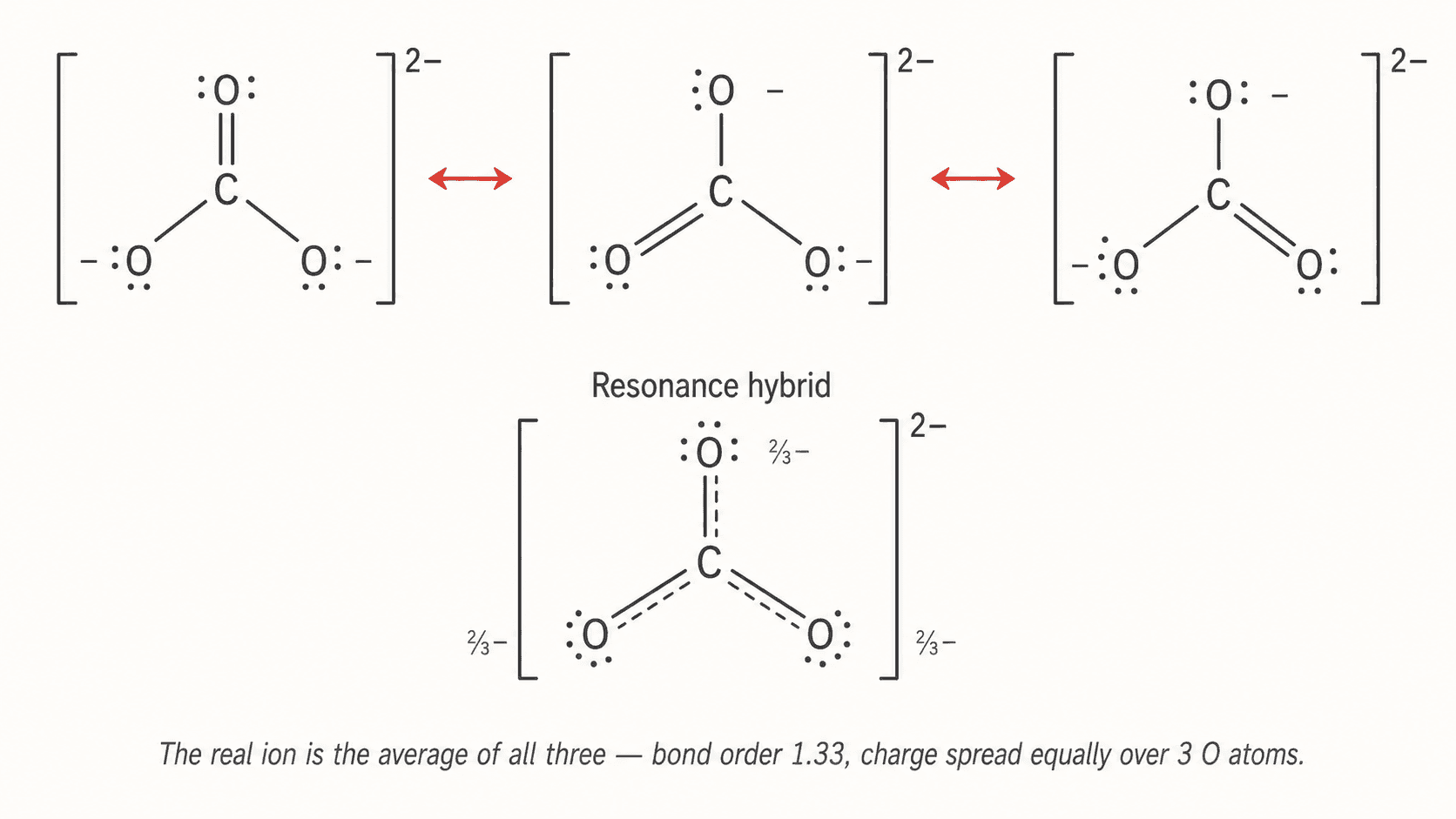
Some molecules cannot be adequately represented by a single Lewis structure (e.g. CO₃²⁻, benzene). The real structure is a resonance hybrid — a superposition of all valid contributing structures. The formal charge on an atom is:
formal charge = (valence electrons) − (lone-pair electrons) − (1/2) × (bonding electrons)
The most stable contributing structure is the one with the smallest formal charges, and negative formal charges reside on the most electronegative atoms.
Finished this lesson?