Electron transfer
An ionic bond forms when a metal donates one or more electrons to a non-metal. This transfer creates oppositely charged ions that attract each other electrostatically.
- The metal loses its valence electrons → cation (positive charge).
- The non-metal gains electrons → anion (negative charge).
Classic example: formation of sodium chloride ([NaCl](/compounds/nacl)):
Na(g) → Na⁺(g) + e⁻ (ionization energy IE₁ = 496 kJ/mol)
Cl(g) + e⁻ → Cl⁻(g) (electron affinity EA = −349 kJ/mol)
The net gas-phase process is endothermic (+147 kJ/mol). The formation of the crystal lattice makes the overall reaction exothermic.
Ionic crystal lattice
Ions do not remain isolated — they arrange into a three-dimensional crystal lattice where each cation is surrounded by anions and vice versa. In NaCl, each Na⁺ is surrounded by 6 Cl⁻ (coordination number 6). The energy released in building this lattice is the lattice energy U.
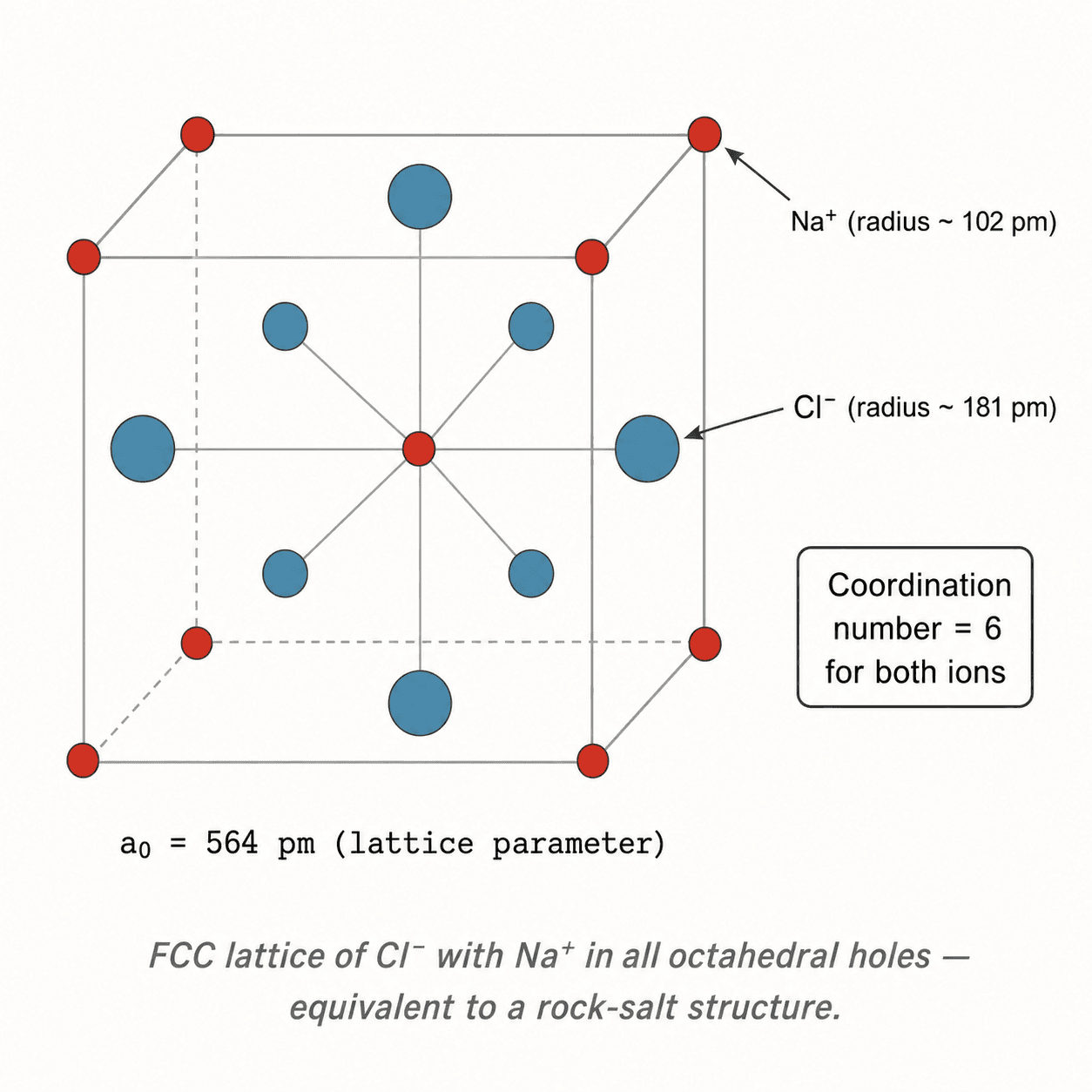
The lattice energy can be estimated via the Born-Haber cycle:
ΔH°f(NaCl) = IE₁(Na) + EA(Cl) + ΔH°sub(Na) + (1/2)ΔH°diss(Cl₂) + U
Qualitatively: |U| increases when ionic charges are larger and ions are smaller (shorter interionic distances). That is why MgO (Mg²⁺/O²⁻, charges +2/−2) has a far higher lattice energy and melting point (2852 °C) than NaCl (+1/−1, 801 °C).
Properties of ionic compounds
| Property | Explanation |
|---|---|
| Solid crystal at room temperature | Rigid lattice held by electrostatic forces |
| High melting point | Large energy needed to break the lattice |
| Conductor in solution or when molten | Ions move freely |
| Insulator in the solid state | Ions are fixed in the lattice |
| Often soluble in water | Polar water stabilizes ions in solution |
Ionic formula and electrical neutrality
An ionic formula must always be electrically neutral. To write CaCl₂:
Rule: cross-multiply charges to balance. For Al₂O₃: Al³⁺ and O²⁻ → 2 Al³⁺ + 3 O²⁻.
Finished this lesson?