What are periodic trends?
Moving through the periodic table in a given direction, certain atomic properties change predictably. These periodic trends should be understood — not just memorized — in terms of two competing effects: effective nuclear charge Z and electron shielding*.
Effective nuclear charge: a valence electron does not feel the full nuclear charge Z, because core electrons partially screen the nucleus. Approximately Z = Z − σ, where σ is the shielding constant. Across a period, Z increases while σ changes little, so Z increases from left to right.
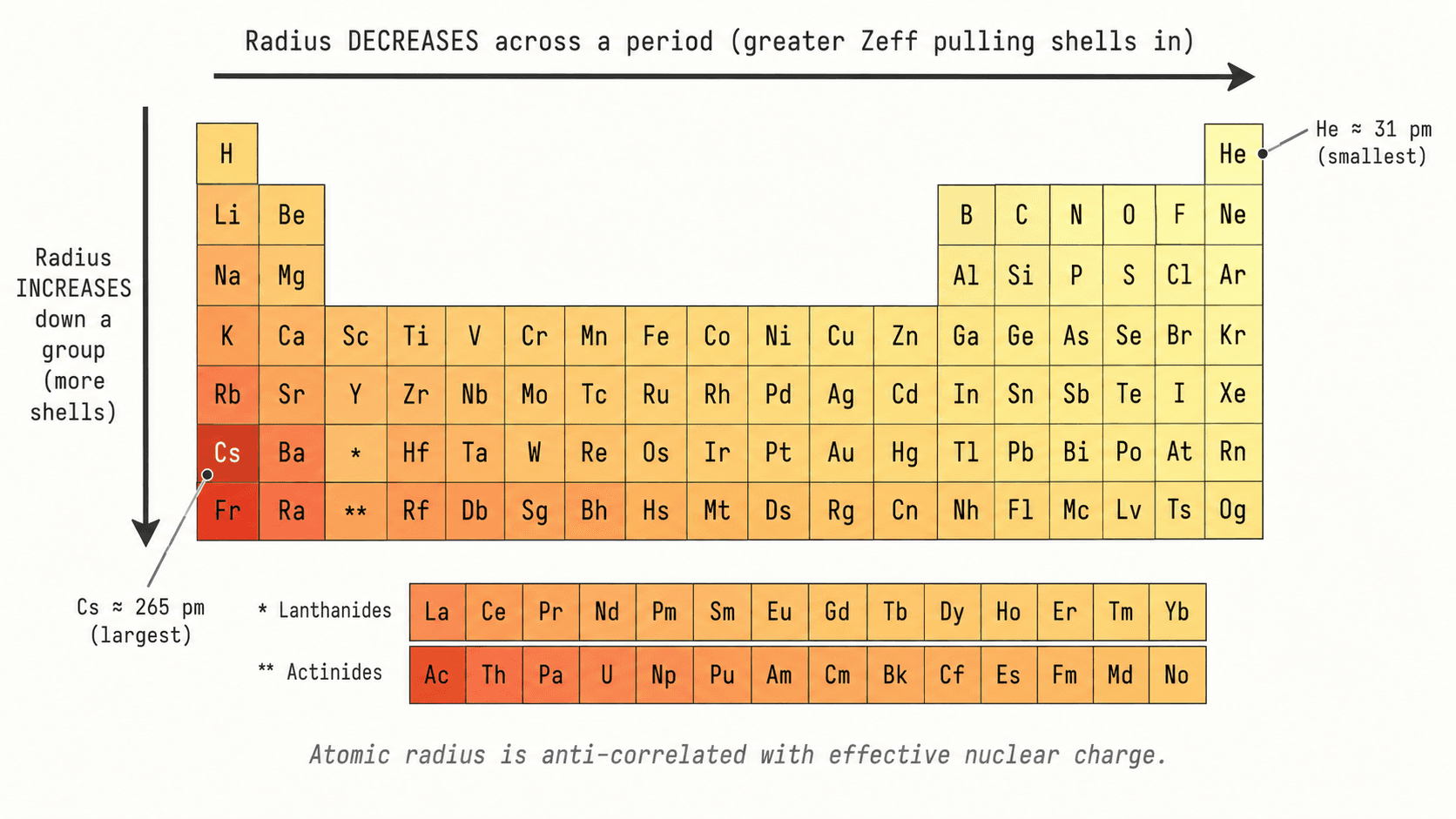
Atomic radius
Atomic radius is half the internuclear distance between two identical bonded atoms. Trends:
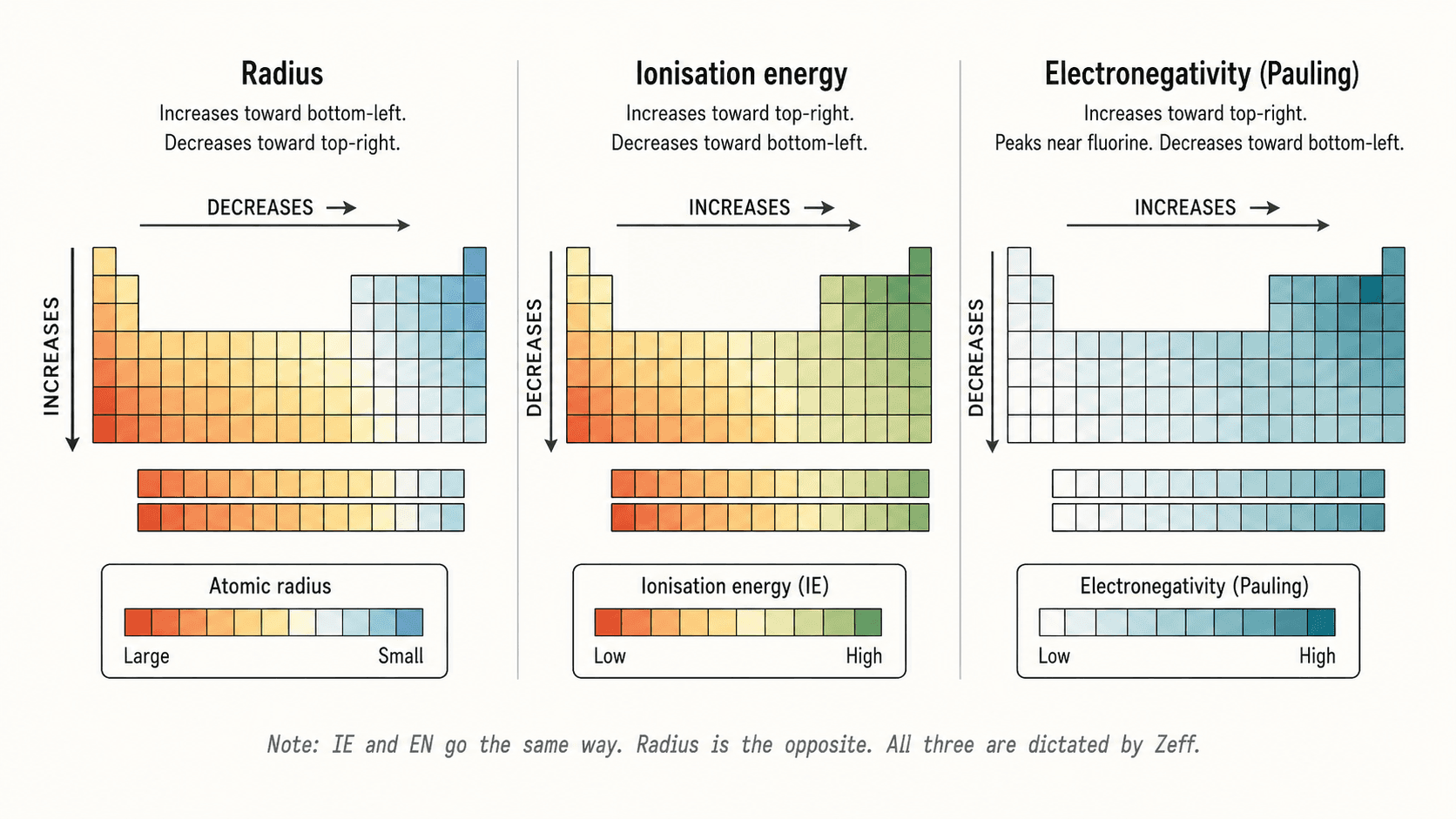
- Across a period (left → right): radius decreases. Higher Z* pulls electrons closer to the nucleus.
- Down a group (top → bottom): radius increases. A new shell is added, farther from the nucleus despite rising Z*.
Ions follow the same logic with a twist: a cation is smaller than its parent atom (lost shell or increased Z* per electron); an anion is larger (increased electron–electron repulsion).
Ionization energy
The first ionization energy (IE₁) is the minimum energy needed to remove one electron from a neutral gaseous atom:
X(g) → X⁺(g) + e⁻ ΔH = IE₁ > 0
- Across a period: IE₁ increases (higher Z*, harder to remove an electron). Notable exceptions: IE₁(B) < IE₁(Be) (2p vs 2s subshell); IE₁(O) < IE₁(N) (paired 2p electrons repel each other).
- Down a group: IE₁ decreases (outer shell farther away, easier to ionize).
Noble gases have the highest IE₁ in their period; alkali metals have the lowest.
Electronegativity
Electronegativity (χ, Pauling scale) measures an atom's ability within a molecule to attract shared electrons toward itself. Trends:
- Increases left to right across a period.
- Decreases top to bottom down a group.
Fluorine (χ = 3.98) is the most electronegative element; alkali and alkaline-earth metals are the least electronegative. This property determines bond polarity: a bond A−B is polar when |χ_A − χ_B| > 0.4 approximately.
Finished this lesson?