Precipitation reactions — overview
A precipitation reaction produces a precipitate: an insoluble (or sparingly soluble) ionic solid that forms when two ions in solution meet: A⁺(aq) + B⁻(aq) → AB(s)
Classic examples: - Ag⁺(aq) + Cl⁻(aq) → AgCl(s) (white precipitate) - Ba²⁺(aq) + SO₄²⁻(aq) → BaSO₄(s) (white precipitate) - Fe³⁺(aq) + 3 OH⁻(aq) → Fe(OH)₃(s) (rust-coloured precipitate)
These reactions are used in analytical chemistry to identify and quantify ions in solution.
Solubility product Ksp
For a sparingly soluble ionic solid MₐNᵦ in equilibrium with its ions in solution: MₐNᵦ(s) ⇌ a M^(p+)(aq) + b N^(q-)(aq)
The solubility product is: Ksp = [M^(p+)]ᵃ · [N^(q-)]ᵇ
The pure solid does not appear in the Ksp expression (activity = 1).
Examples at 25 °C: | Compound | Ksp | |---|---| | AgCl | 1.8 × 10⁻¹⁰ | | BaSO₄ | 1.1 × 10⁻¹⁰ | | CaCO₃ | 3.4 × 10⁻⁹ | | Fe(OH)₃ | 2.8 × 10⁻³⁹ |
The smaller Ksp, the more insoluble the compound.
The solubility s (mol·L⁻¹) is calculated from Ksp. For AgCl: s = sqrt(Ksp) = sqrt(1.8 × 10⁻¹⁰) ≈ 1.3 × 10⁻⁵ mol·L⁻¹
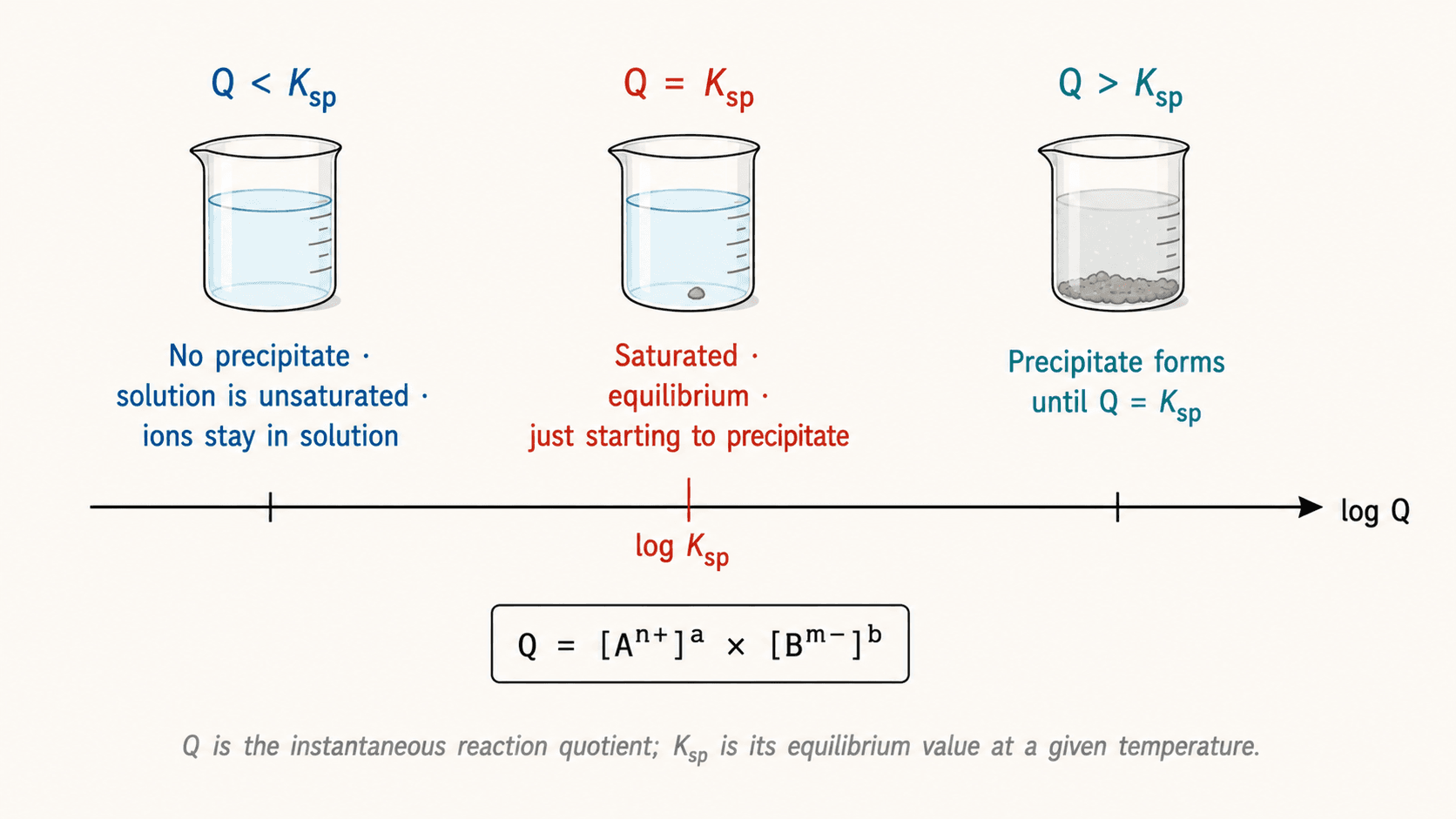
Precipitation conditions — reaction quotient Q
To decide whether a precipitate will form, compare the reaction quotient Q to Ksp:
- Q < Ksp: solution is undersaturated, no precipitate, dissolution favoured.
- Q = Ksp: equilibrium, the solution is saturated.
- Q > Ksp: solution is supersaturated, precipitate forms until Q = Ksp.
Example: mixing 50 mL of AgNO₃ at 2 × 10⁻³ mol·L⁻¹ with 50 mL of NaCl at 2 × 10⁻³ mol·L⁻¹. After mixing: [Ag⁺] = [Cl⁻] = 10⁻³ mol·L⁻¹. Q = [Ag⁺][Cl⁻] = 10⁻⁶ > Ksp(AgCl) = 1.8 × 10⁻¹⁰ → AgCl precipitates.
Common ion effect
The common ion effect reduces the solubility of a precipitate. If excess Cl⁻ is added to a saturated AgCl solution, the equilibrium: AgCl(s) ⇌ Ag⁺ + Cl⁻
shifts to the left (increased precipitation). The solubility of AgCl decreases.
Quantitatively, if [Cl⁻] = C₀ >> s, then: s' = Ksp / C₀
This principle is used to selectively precipitate one ion in the presence of others.
Precipitation titrations
A precipitation titration (e.g. Mohr's method) involves progressively adding a titrant that precipitates the target ion. The equivalence point is detected by: - Adsorption indicator (fluorescein): colour change of the precipitate. - Colour indicator (CrO₄²⁻ for Cl⁻ in Mohr's method): appearance of a secondary coloured precipitate (red Ag₂CrO₄).
At equivalence, amounts of substance are stoichiometric: n(Ag⁺) added = n(Cl⁻) initial
Finished this lesson?