Le Chatelier's principle
Le Chatelier's principle (1884) states:
When a system at equilibrium is subjected to a perturbation, it shifts in the direction that tends to oppose that perturbation.
This principle is qualitative: it indicates the direction of the equilibrium shift, not the new concentration values. To quantify them, Q and K must be calculated.
Possible perturbations are: concentration change, pressure change (gases), temperature change. Adding a catalyst does not shift the equilibrium (it merely speeds up reaching equilibrium).
Perturbation by concentration change
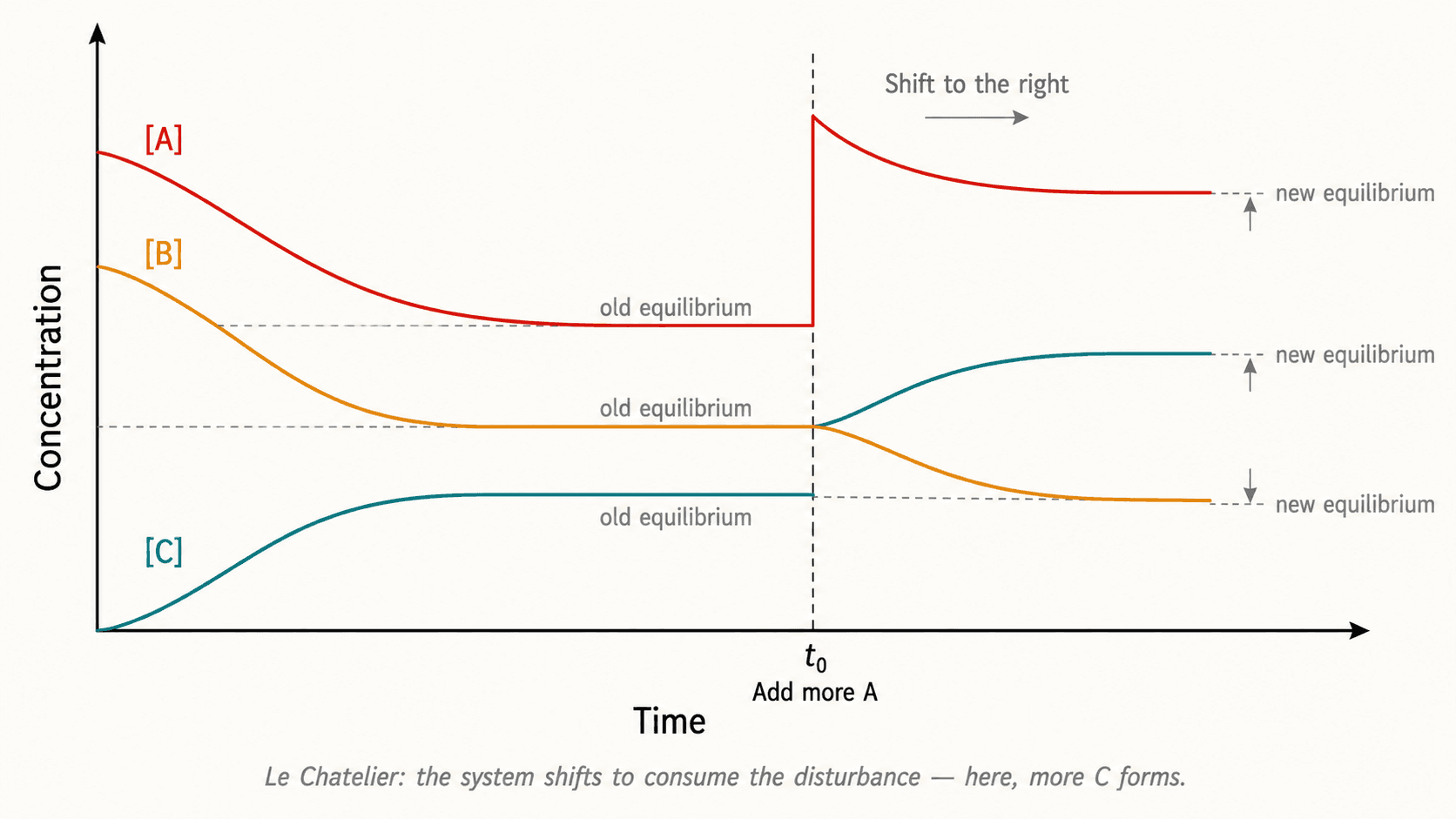
For the equilibrium A + B ⇌ C + D: - Adding a reactant (A or B): Q decreases below K → equilibrium shifts right (forward direction, consuming the added reactant). - Removing a product (C or D): Q decreases below K → equilibrium shifts right. - Adding a product: Q increases above K → equilibrium shifts left (reverse direction).
Application: in a pH-metric titration, adding base consumes H₃O⁺, shifting the weak acid dissociation equilibrium to the right.
Perturbation by pressure change
This perturbation applies only to equilibria involving gases. Compare the total moles of gaseous products vs reactants (Δn_gas):
- Increasing total pressure (compression): equilibrium shifts towards the side with fewer moles of gas (minimises pressure).
- Decreasing pressure (expansion): shifts towards the side with more moles of gas.
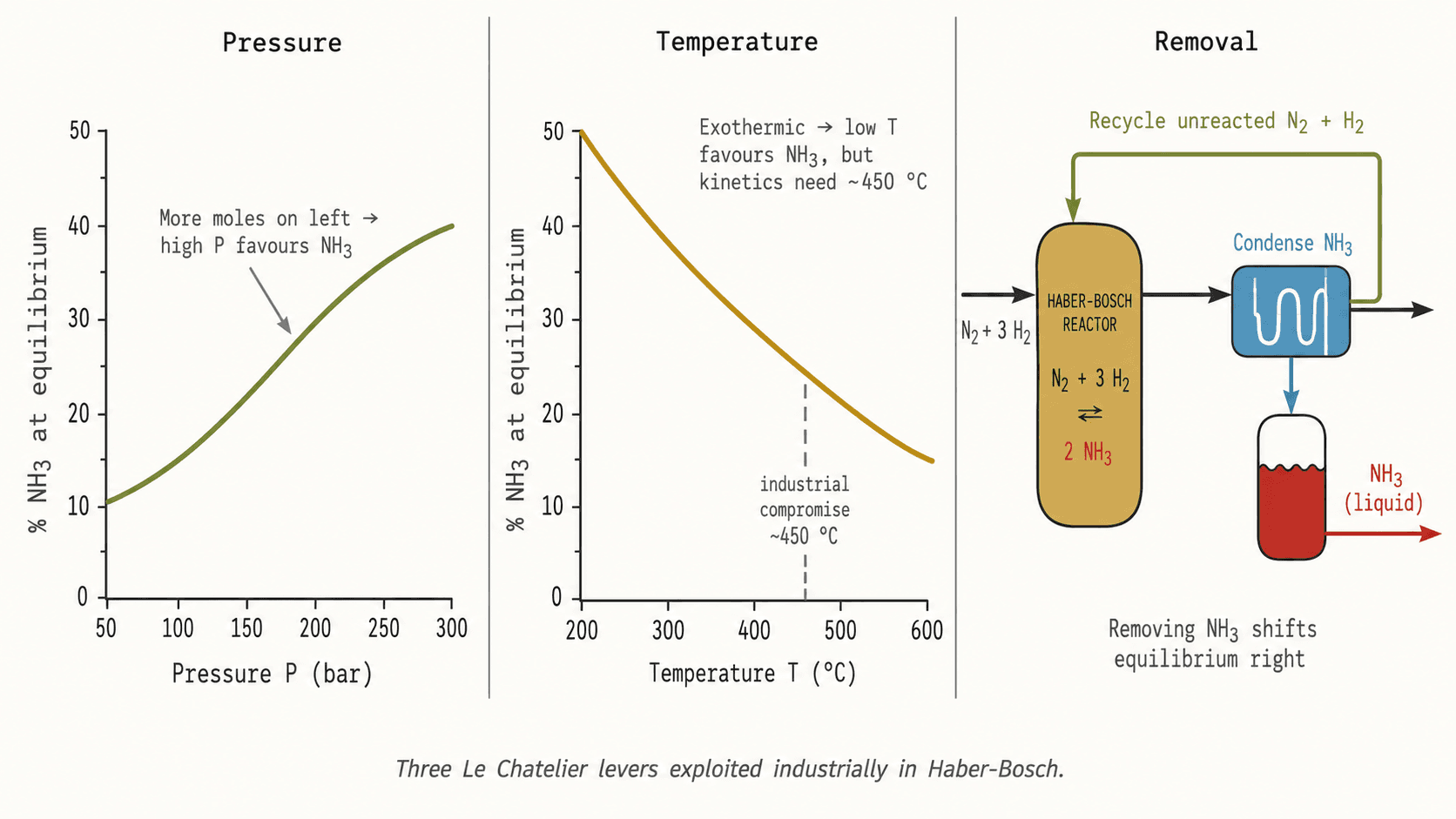
Example: N₂(g) + 3 H₂(g) ⇌ 2 NH₃(g) Δn_gas = 2 - (1+3) = -2. Increasing pressure favours NH₃ formation (2 moles side).
If Δn_gas = 0 (e.g. H₂ + I₂ ⇌ 2 HI), a change in total pressure has no effect on the equilibrium.
Perturbation by temperature change
Unlike the previous perturbations, temperature changes K.
- For an exothermic reaction (ΔH < 0): increasing T shifts equilibrium towards reactants (K decreases).
- For an endothermic reaction (ΔH > 0): increasing T shifts equilibrium towards products (K increases).
Van't Hoff equation: ln(K₂/K₁) = -ΔH°/R × (1/T₂ - 1/T₁)
Industrial application: Haber-Bosch process
Ammonia synthesis is the most celebrated application of Le Chatelier's principle: N₂(g) + 3 H₂(g) ⇌ 2 NH₃(g) ΔH° = -92 kJ·mol⁻¹
Industrial trade-offs: - Pressure: high pressure (150–300 bar) favours NH₃ (Δn_gas = -2). But technically costly. - Temperature: exothermic reaction → low temperature favours NH₃. But kinetics are too slow at 25 °C. Compromise: 400–500 °C with catalyst (Fe/Al₂O₃). - NH₃ removal: continuous condensation of liquid NH₃ → equilibrium shifts right.
This process produces ~150 million tonnes of ammonia per year, the basis of global fertiliser production.
Acid-base buffers and Le Chatelier
Buffer solutions perfectly illustrate the principle: a CH₃COOH / CH₃COO⁻ mixture (pKa = 4.8) resists pH changes.
- Adding H⁺: consumed by CH₃COO⁻ → CH₃COOH (equilibrium shifts left).
- Adding OH⁻: consumed by CH₃COOH → CH₃COO⁻ (equilibrium shifts right).
The pH stays close to pKa as long as the [CH₃COO⁻]/[CH₃COOH] ratio is not greatly perturbed.
Finished this lesson?