Definition and pH scale
pH (potential of hydrogen) measures the acidity of an aqueous solution. It is defined as: pH = -log([H₃O⁺])
where [H₃O⁺] is the concentration of oxonium ions in mol·L⁻¹.
The pH scale conventionally spans 0 to 14 at 25 °C: - pH < 7: acidic medium ([H₃O⁺] > 10⁻⁷ mol·L⁻¹) - pH = 7: neutral medium ([H₃O⁺] = [OH⁻]) - pH > 7: basic medium ([H₃O⁺] < 10⁻⁷ mol·L⁻¹)
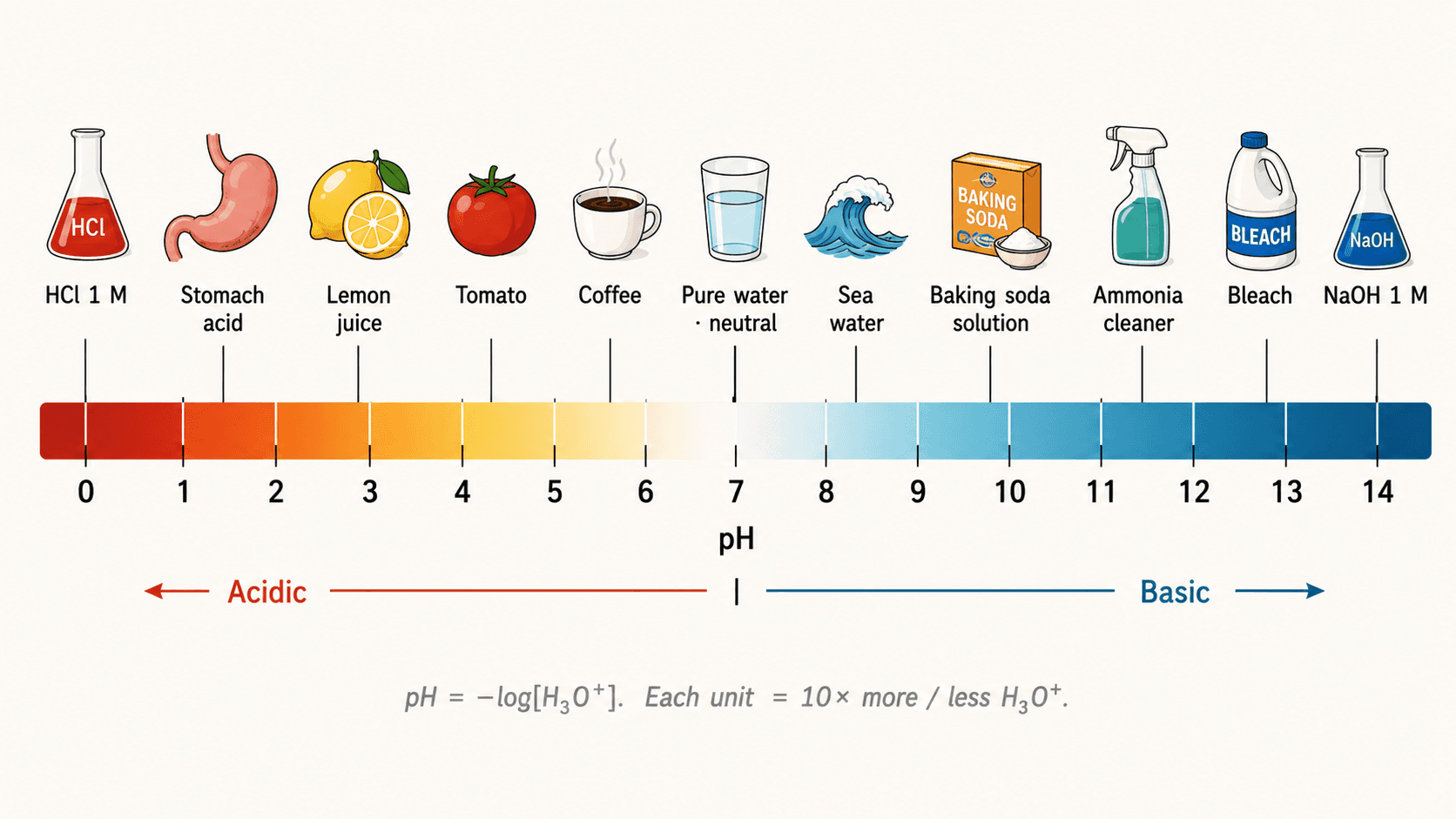
From the pH, we recover [H₃O⁺] = 10⁻ᵖᴴ mol·L⁻¹. Using Kw: [OH⁻] = Kw / [H₃O⁺] = 10^(pH-14) mol·L⁻¹
pH of a strong acid
A strong acid (pKa < 0) is completely dissociated in solution: HCl + H₂O → H₃O⁺ + Cl⁻
For a solution of concentration Ca of a monoprotic strong acid: [H₃O⁺] = Ca → pH = -log(Ca)
Examples: - Ca = 0.1 mol·L⁻¹ → pH = 1.0 - Ca = 10⁻³ mol·L⁻¹ → pH = 3.0
Note: this relation is only valid when Ca >> 10⁻⁷ mol·L⁻¹ (otherwise the contribution of water autoprotolysis is non-negligible).
pH of a weak acid
A weak acid (0 < pKa < 14) is partially dissociated: AH + H₂O ⇌ A⁻ + H₃O⁺ (Ka)
Setting x = [H₃O⁺] at equilibrium and assuming x << Ca (low dissociation hypothesis): Ka ≈ x² / Ca → x = sqrt(Ka × Ca) → pH = ½(pKa - log Ca)
This approximation is valid when the degree of dissociation τ = x/Ca < 5%.
For acetic acid (pKa = 4.8) at Ca = 0.1 mol·L⁻¹: pH = ½(4.8 - (-1)) = ½ × 5.8 = 2.9
Compare: HCl at the same concentration gives pH = 1. A weak acid is less acidic than a strong acid at equal concentration.
pH of a strong base and a weak base
For a strong base (NaOH) of concentration Cb: [OH⁻] = Cb → pOH = -log(Cb) → pH = 14 + log(Cb)
For a weak base B (using pKa of the conjugate pair BH⁺/B): [OH⁻] = sqrt(Kb × Cb) → pH = ½(14 + pKa + log Cb)
Predominance diagrams and titrations
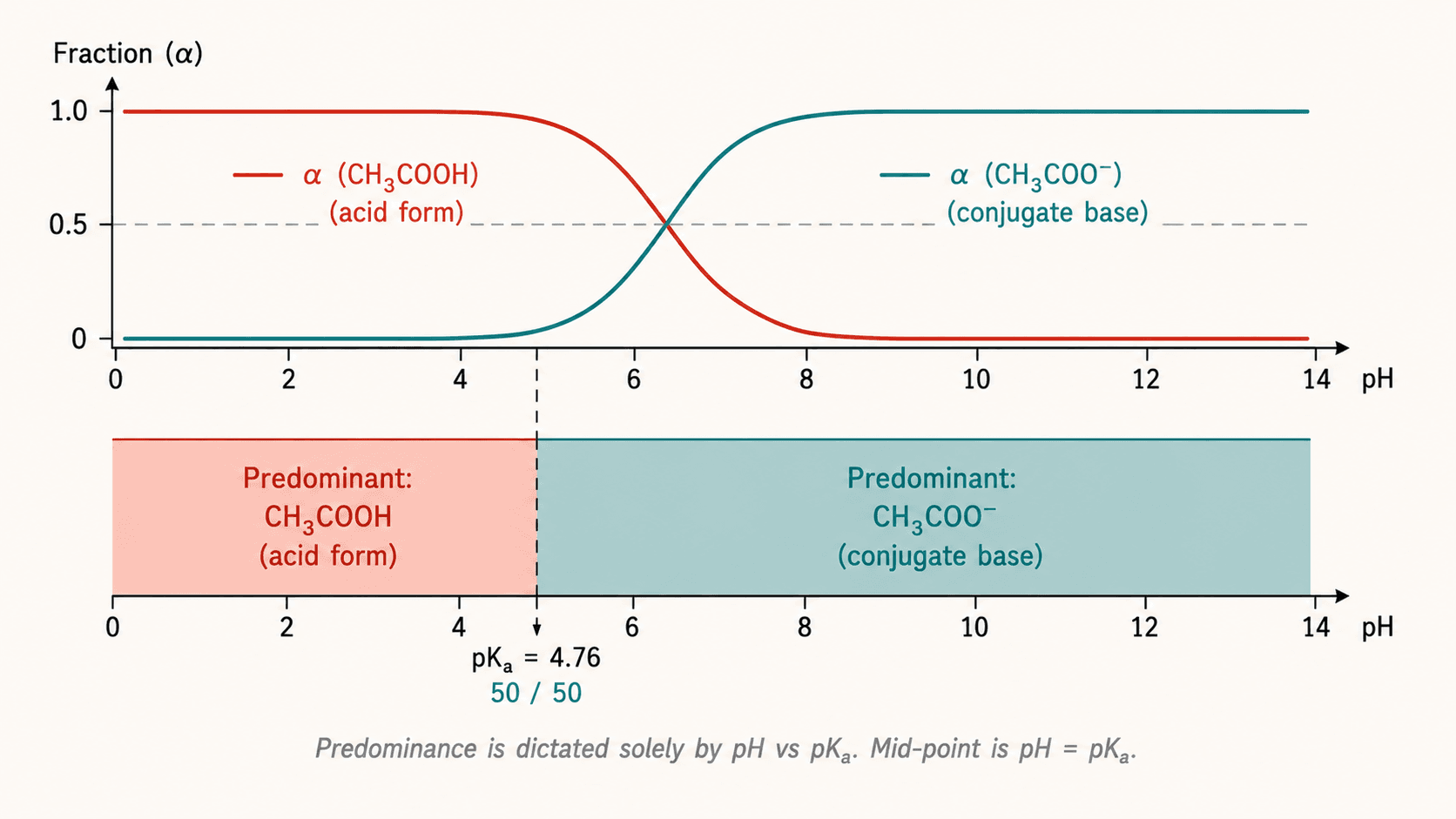
A predominance diagram shows on a pH axis the zones where each species of a couple is majority. For the pair CH₃COOH/CH₃COO⁻ (pKa = 4.8): - pH < 4.8: CH₃COOH predominates - pH > 4.8: CH₃COO⁻ predominates
These diagrams are essential for interpreting pH-metric titration curves. At the equivalence point of a strong acid / strong base titration, pH = 7. For a weak acid / strong base titration, the equivalence pH is above 7.
Experimental pH measurement
- pH paper or indicator strip: approximate colorimetry (precision ±1).
- pH meter: glass electrode, precision ±0.01 pH unit. Requires calibration with known buffer solutions (commonly pH 4.0 and 7.0).
- Colour indicators: phenolphthalein (colourless → pink, transition 8.2–10.0), bromothymol blue (yellow → blue, transition 6.0–7.6).
Finished this lesson?