The Brønsted-Lowry model
In 1923, Johannes Brønsted and Thomas Lowry proposed a broader definition of acids and bases, based on the transfer of a proton H⁺ (hydrogen ion). This view extends beyond Arrhenius's model, which was limited to aqueous solutions.
Brønsted acid: any species capable of donating a proton H⁺. Brønsted base: any species capable of accepting a proton H⁺.
Example: hydrochloric acid HCl donates a proton to water: HCl + H₂O → H₃O⁺ + Cl⁻
Here, HCl is the acid and H₂O is the base. After the reaction, H₃O⁺ (oxonium ion) can in turn donate a proton — it is the conjugate acid of H₂O.
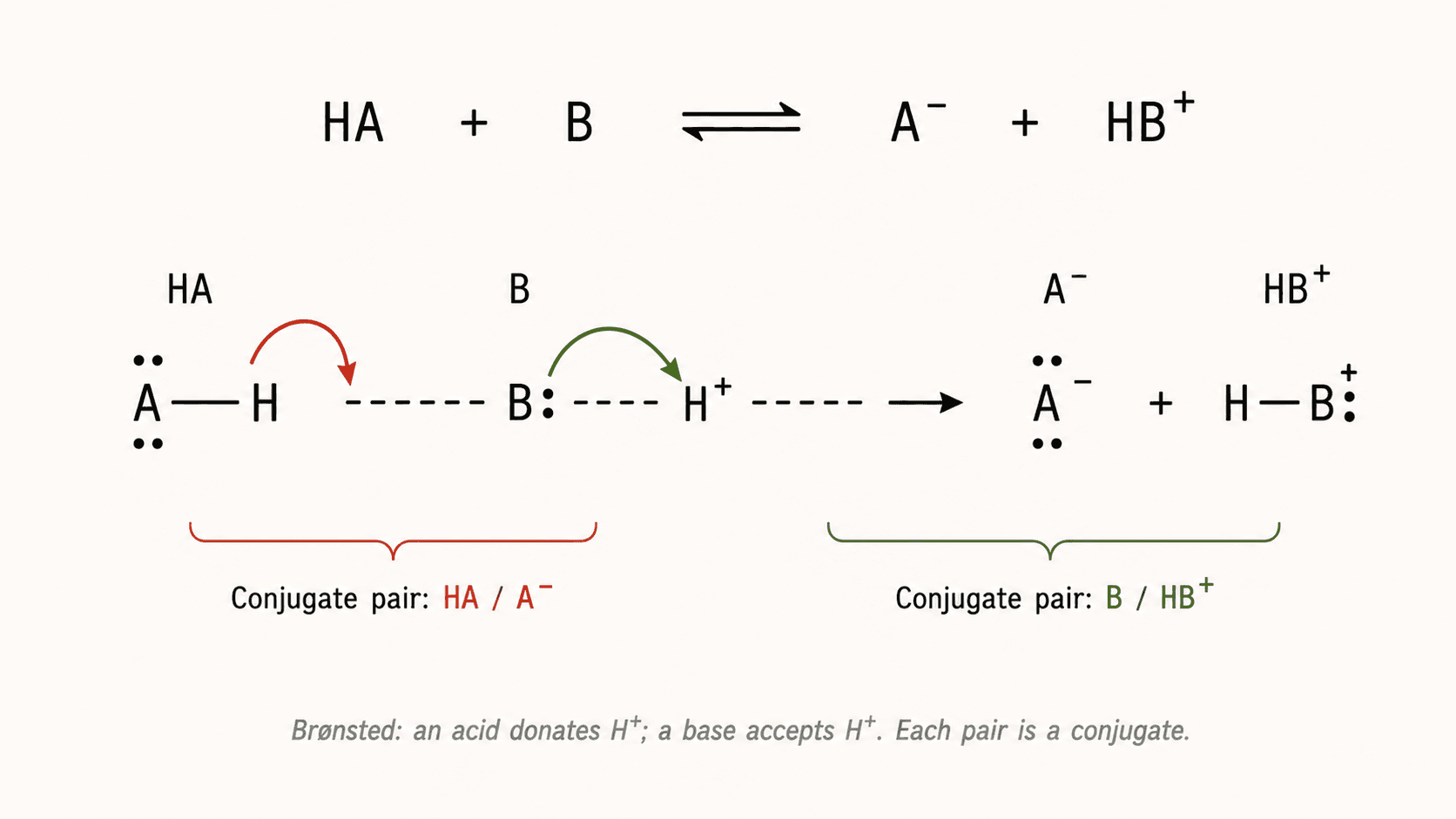
Conjugate acid-base pairs
A conjugate acid/base pair is written AH/A⁻ (or AH⁺/A). The two species differ by only one proton:
- Pair HCl / Cl⁻: acid HCl donates H⁺, conjugate base Cl⁻ can accept it back.
- Pair CH₃COOH / CH₃COO⁻: acetic acid and acetate ion.
- Pair H₃O⁺ / H₂O: the oxonium ion is the conjugate acid of water.
- Pair H₂O / OH⁻: water is also the conjugate acid of hydroxide ion.
Water is amphoteric (ampholyte): it can act as either an acid or a base depending on its reaction partner.
Autoprotolysis of water
Water reacts with itself in an equilibrium called autoprotolysis: H₂O + H₂O ⇌ H₃O⁺ + OH⁻
The equilibrium constant at 25 °C is the ionic product of water: Kw = [H₃O⁺] · [OH⁻] = 1.0 × 10⁻¹⁴
Taking the logarithm: pKw = 14 at 25 °C.
In pure water: [H₃O⁺] = [OH⁻] = 1.0 × 10⁻⁷ mol·L⁻¹ — the medium is neutral.
Acid dissociation constant Ka and acid strength
For an acid AH in aqueous solution: AH + H₂O ⇌ A⁻ + H₃O⁺
The acid dissociation constant is: Ka = [A⁻] · [H₃O⁺] / [AH]
We define pKa = -log(Ka).
- Strong acid (HCl, HNO₃, H₂SO₄): Ka → ∞, complete reaction, very negative pKa. In solution, the acid form AH no longer exists.
- Weak acid (CH₃COOH, HF, NH₄⁺): small Ka, equilibrium favours AH, pKa between 0 and 14.
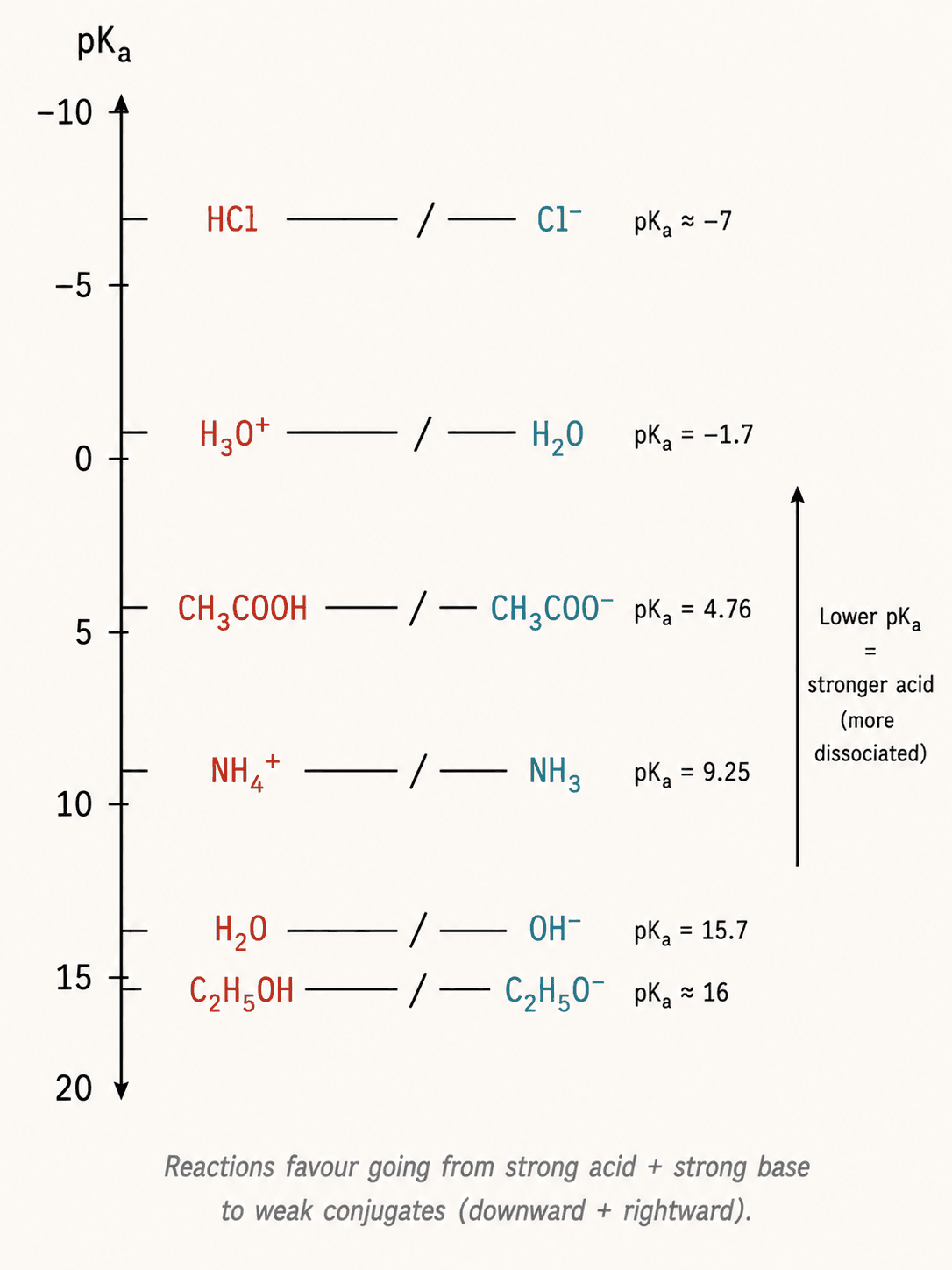
The smaller the pKa, the stronger the acid. Two couples AH/A⁻ and BH⁺/B can be compared: the acid of the pair with the smaller pKa will donate its proton to the base of the other pair.
Relative strengths and acid-base reactions
The predominance rule: for two couples (pKa1 < pKa2), the spontaneous reaction goes from the acid of pKa1 (smaller) to the base of pKa2 (larger).
Example with NH₃ / NH₄⁺ (pKa = 9.2) and H₂O / OH⁻ (pKa = 15.7): NH₄⁺ + OH⁻ ⇌ NH₃ + H₂O
This reaction is favoured because pKa(NH₄⁺/NH₃) < pKa(H₂O/OH⁻).
Predominant species — predominance diagrams
For a couple AH/A⁻ with a given pKa, the majority species depends on pH: - pH < pKa: AH predominates. - pH > pKa: A⁻ predominates. - pH = pKa: [AH] = [A⁻].
These diagrams allow prediction of the speciation of an acid as a function of solution pH — crucial in biochemistry (blood pH, buffers) and analytical chemistry.
Finished this lesson?