The balanced equation: foundation of stoichiometry
A balanced chemical equation provides the stoichiometric coefficients of each reactant and product. These coefficients give the molar ratios in which species react and form.
Example: synthesis of ammonia (NH₃)
N₂ + 3 H₂ → 2 NH₃
Molar interpretation: 1 mol of N₂ reacts with 3 mol of H₂ to produce 2 mol of NH₃.
Before any calculation: 1. Write and balance the equation correctly. 2. Convert data to moles (masses → moles via n = m/M; gas volumes → moles via n = PV/RT or at STP n = V/22.4).
The reaction-progress (ICE) table
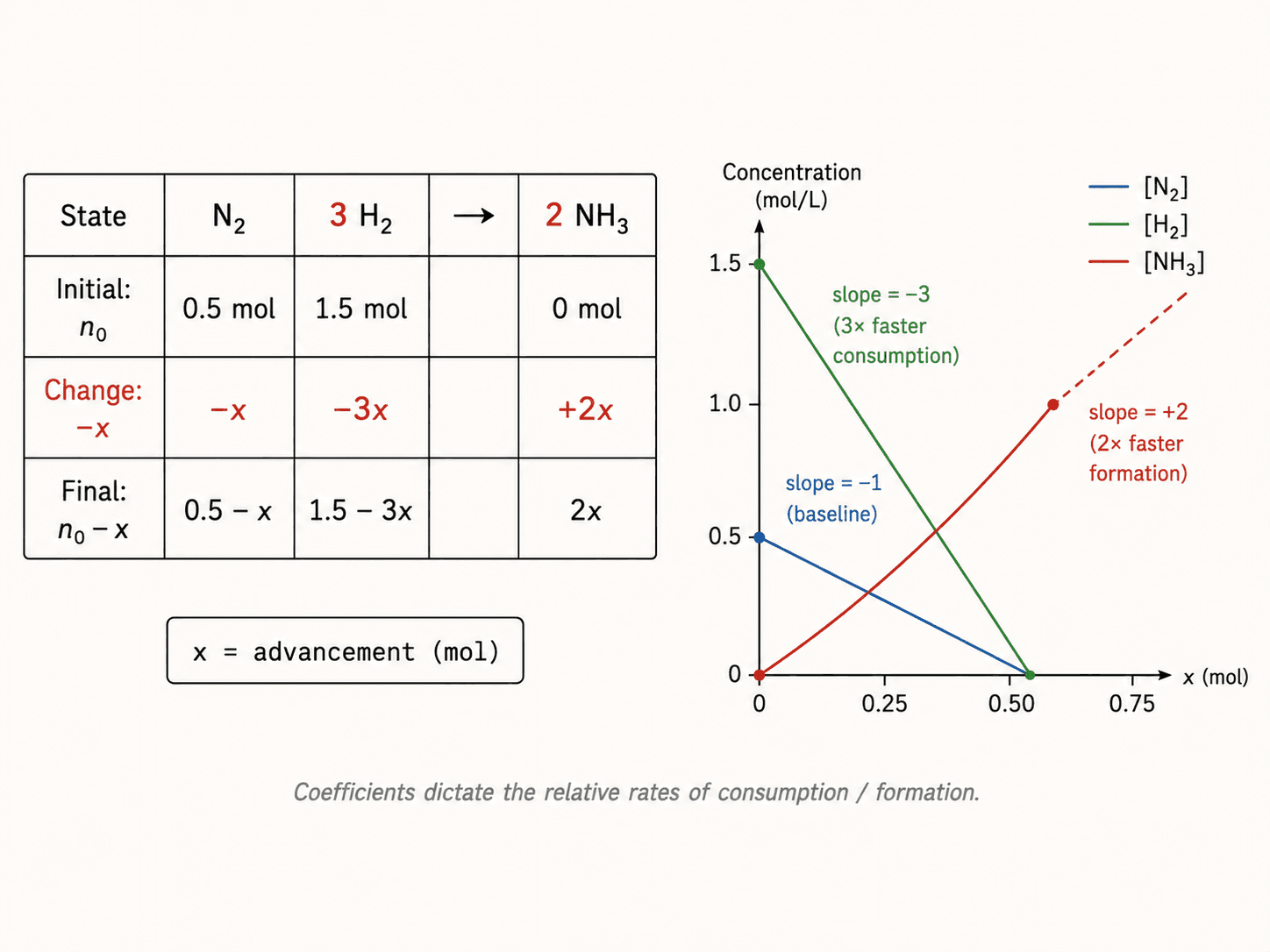
A reaction-progress table (or ICE table: Initial–Change–Equilibrium) tracks molar amounts as a function of the extent of reaction x (in mol):
| Species | Initial (mol) | Change (mol) | Final (mol) |
|---|---|---|---|
| N₂ | n₀(N₂) | −x | n₀(N₂) − x_max |
| H₂ | n₀(H₂) | −3x | n₀(H₂) − 3x_max |
| NH₃ | 0 | +2x | 2x_max |
x_max is the maximum extent, reached when at least one reactant is fully consumed.
Limiting reactant
The limiting reactant is the one consumed first and which stops the reaction. To identify it, compare n₀/stoichiometric coefficient for each reactant. The reactant with the smallest ratio is the limiting one.
Example: 5.00 mol of N₂ reacts with 12.0 mol of H₂. - For N₂: 5.00 / 1 = 5.00 - For H₂: 12.0 / 3 = 4.00
H₂ is the limiting reactant (smallest ratio). x_max = 4.00 mol.
Amount of NH₃ formed: n(NH₃) = 2 × x_max = 8.00 mol.
Remaining N₂: n(N₂) = 5.00 − 4.00 = 1.00 mol (excess reactant).
Reaction yield
The reaction may not reach its theoretical maximum (reversible reaction, side reactions, losses). The yield η is:
η = x_eff / x_max = n_product(actual) / n_product(theoretical)
If 7.20 mol of NH₃ is obtained instead of the theoretical 8.00 mol: η = 7.20 / 8.00 = 0.900 = 90 %.
Mass and volume calculations
Mass: m = n × M. Always check unit consistency (g/mol × mol = g).
Gas volume at STP (0 °C, 1 atm): V = n × 22.4 L/mol. At non-standard conditions, use the ideal gas law PV = nRT (R = 8.314 J·mol⁻¹·K⁻¹).
Full example: what mass of NH₃ is produced when 14.0 g of N₂ reacts with excess H₂ (yield 85 %)?
1. n(N₂) = 14.0 / 28.0 = 0.500 mol 2. n(NH₃) theoretical = 2 × 0.500 = 1.00 mol 3. n(NH₃) actual = 1.00 × 0.85 = 0.850 mol 4. m(NH₃) = 0.850 × 17.0 = 14.5 g
Finished this lesson?