Complex ions and ligands
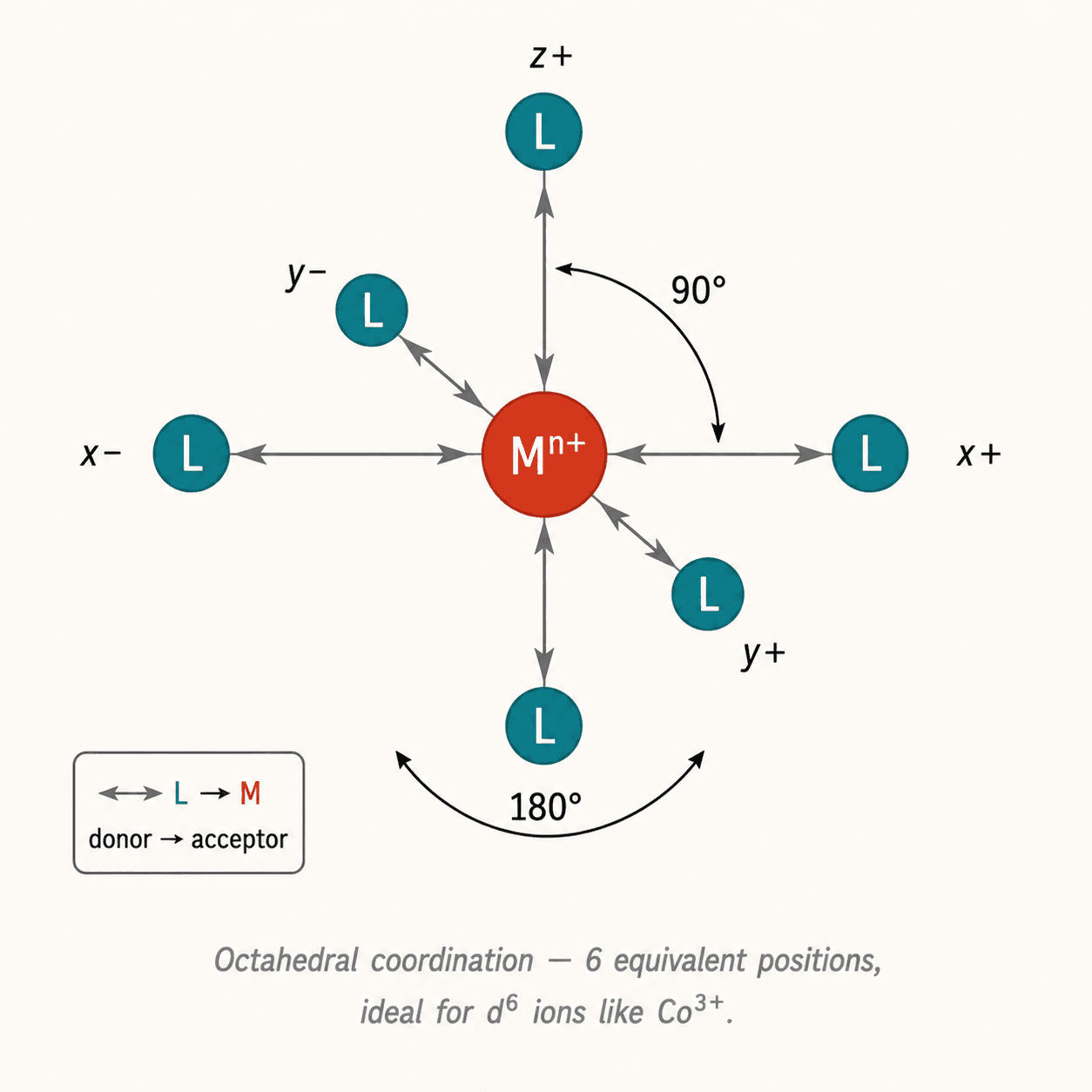
A complex ion forms when a central metal ion (usually a transition metal ion) is surrounded by ligands — molecules or ions that donate one or more electron pairs to it (coordinate bonds).
Definitions: - Ligand: electron pair donor (Lewis base). Examples: H₂O, NH₃, Cl⁻, CN⁻, SCN⁻. - Coordination number: number of donor-acceptor bonds around the central metal. Common values: 2, 4, 6. - Complex: central entity + ligands. E.g. [Cu(NH₃)₄]²⁺, [Fe(SCN)]²⁺.
Standard notation: [M(L)ₙ]^(charge), where M is the metal and L the ligand.
Iconic examples
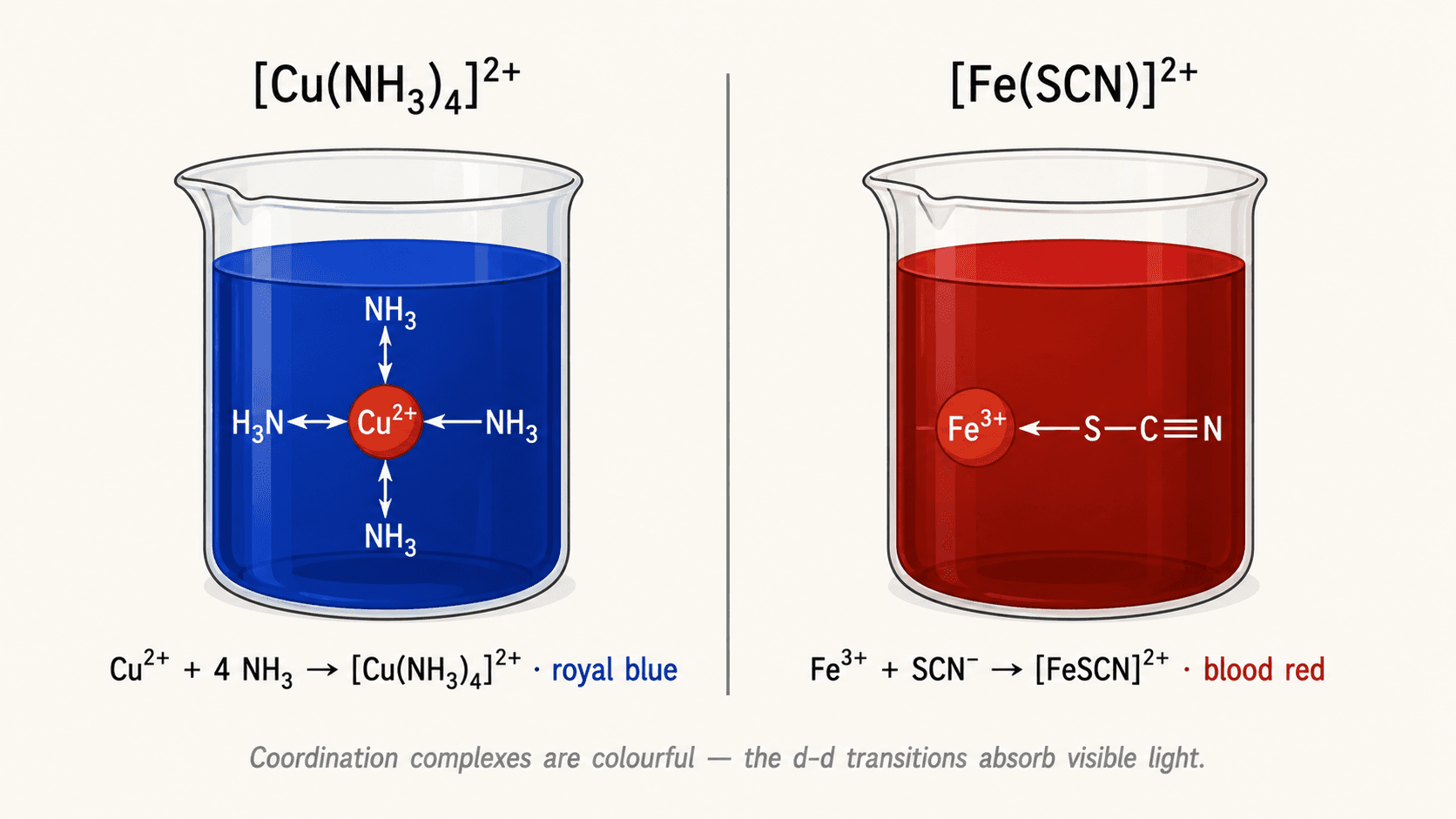
[Cu(NH₃)₄]²⁺ — tetraamminecopper(II): Copper (Cu) in aqueous solution forms a blue precipitate Cu(OH)₂ with NaOH. In the presence of excess ammonia, this precipitate redissolves to form an intensely blue complex: Cu²⁺ + 4 NH₃ ⇌ [Cu(NH₃)₄]²⁺ (deep blue)
This test identifies copper(II) ions.
[Fe(SCN)]²⁺ — iron(III) thiocyanate: Iron (Fe) in oxidation state +III reacts with thiocyanate ion SCN⁻ to form an intense blood-red complex, widely used in colorimetric assays: Fe³⁺ + SCN⁻ ⇌ [Fe(SCN)]²⁺ (red)
This test is characteristic of Fe³⁺ ions.
Formation constant
For the complexation reaction: M^(n+) + p L ⇌ [ML_p]^(n-p)
The formation constant (stability constant) is: Kf = [[ML_p]] / ([M^(n+)] · [L]^p)
The larger Kf, the more stable the complex. Values are often expressed as log Kf (log β).
Examples: | Complex | log Kf | |---|---| | [Cu(NH₃)₄]²⁺ | 12.0 | | [Fe(SCN)]²⁺ | 3.0 | | [Fe(CN)₆]³⁻ | 43.6 | | [Ag(NH₃)₂]⁺ | 7.2 |
A complex with high log Kf is difficult to dissociate; its formation strongly shifts the equilibrium.
Competition between complexation and precipitation
Complexation can dissolve a precipitate. Classic example: the zinc hydroxide precipitate Zn(OH)₂ dissolves in excess NaOH because Zn²⁺ forms the zincate complex [Zn(OH)₄]²⁻: Zn(OH)₂(s) + 2 OH⁻ ⇌ [Zn(OH)₄]²⁻
Similarly, AgCl(s) dissolves in concentrated NH₃: AgCl(s) + 2 NH₃ ⇌ [Ag(NH₃)₂]⁺ + Cl⁻
The competition between precipitation (Ksp) and complexation (Kf) determines metal speciation in solution.
Industrial and biological applications
- EDTA (ethylenediaminetetraacetic acid): hexadentate ligand used as a chelating agent in medicine (heavy metal poisoning treatment) and in analysis (complexometry, water hardness determination).
- Haemoglobin: iron(II) complex with porphyrin (planar tetradentate ligand); O₂ is an axial ligand.
- Industrial cyanides: gold extraction by complexation as Au(CN)₂⁻.
Finished this lesson?