Exothermic and endothermic reactions
Every chemical reaction involves an exchange of energy with the surroundings, mainly as heat (at constant pressure). We distinguish:
- Exothermic reaction: releases energy to the surroundings (Q < 0 for the system). The temperature of the surroundings increases. Examples: combustion, acid-base neutralisation, hydration of CaO.
- Endothermic reaction: absorbs energy from the surroundings (Q > 0 for the system). The temperature of the surroundings decreases. Examples: dissolution of NH₄NO₃, electrolysis, photosynthesis.
The sign of the heat exchange is an intrinsic property of the reaction (at given T and P).
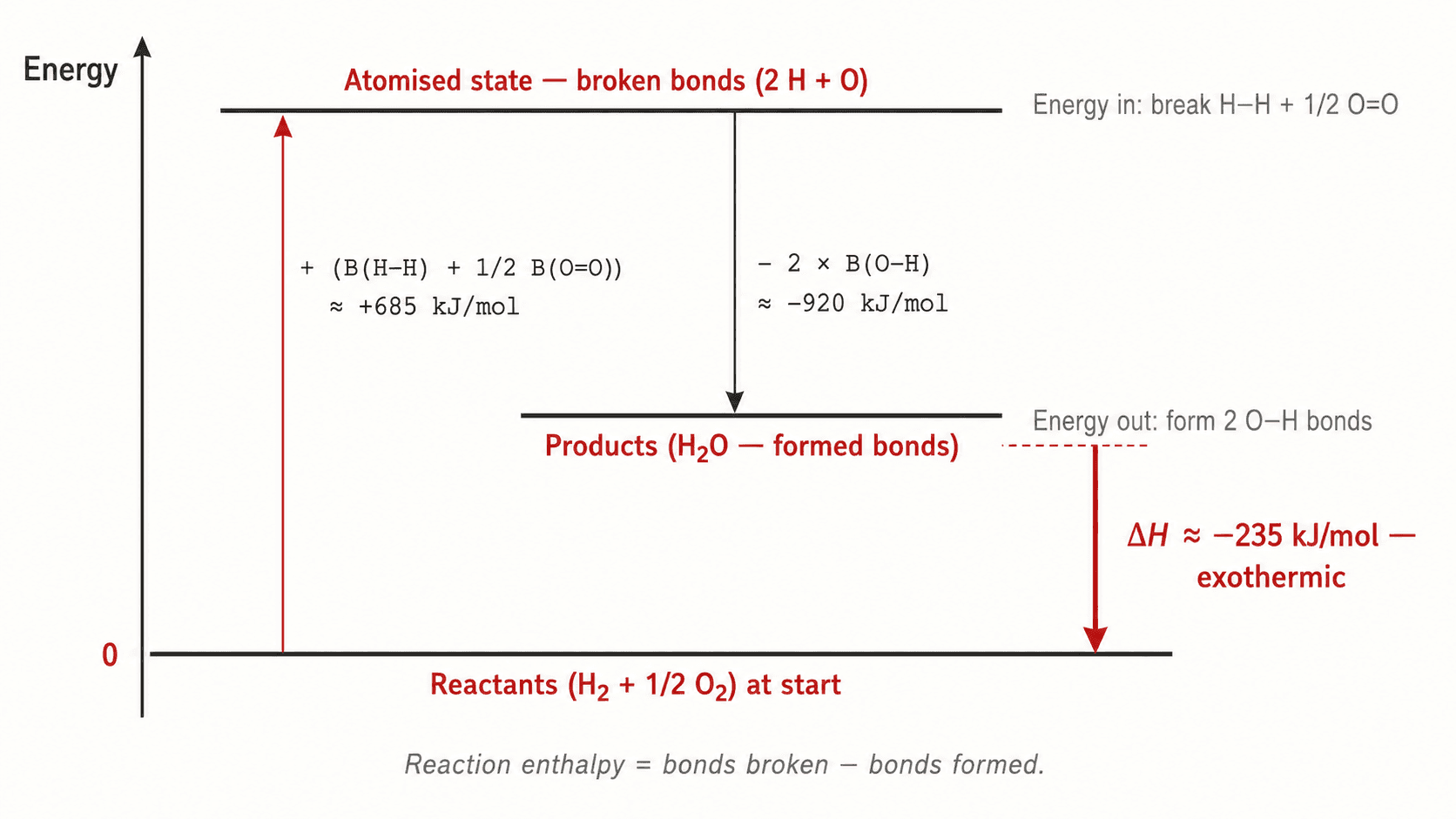
Bond energy
Chemical bonds are maintained by electrostatic forces. Breaking a bond requires energy; forming a bond releases energy. The bond dissociation energy D(A-B) is the energy required (in kJ·mol⁻¹) to homolytically break the A-B bond in the gas phase.
Bond energies: | Bond | D (kJ·mol⁻¹) | |---|---| | H-H | 436 | | O=O | 498 | | H-O | 463 | | C-H | 412 | | C=O | 745 |
The energy balance of a reaction is estimated by: ΔH ≈ Σ D(bonds broken) - Σ D(bonds formed)
If bonds broken require more energy than bonds formed → ΔH > 0 (endothermic).
Application to combustion
The complete combustion of a hydrocarbon releases a large amount of energy. For methane CH₄: CH₄(g) + 2 O₂(g) → CO₂(g) + 2 H₂O(l) ΔH° = -890 kJ·mol⁻¹
Bond energy calculation (gas phase, approximate values): - Bonds broken: 4 × C-H + 2 × O=O = 4×412 + 2×498 = 2644 kJ - Bonds formed: 2 × C=O + 4 × H-O = 2×745 + 4×463 = 3342 kJ - ΔH ≈ 2644 - 3342 = -698 kJ·mol⁻¹
The gap with the tabulated -890 kJ·mol⁻¹ has two causes. First, the bond-energy method deals with gas-phase species: it therefore yields the enthalpy towards H₂O(g), whereas the equation above produces H₂O(l) — condensing 2 mol of water alone releases about 2 × 44 = 88 kJ. Second, tabulated bond energies are averages over many molecules, which accounts for the remainder.
Bond energy is a qualitative tool; for precise values, use standard enthalpies of formation (see next lesson).
Electrochemical cells — chemical energy to electrical energy
In a cell, a spontaneous redox reaction produces electrical energy. The anode is the site of oxidation (electron loss), the cathode of reduction (electron gain).
Example — Daniell cell: - Anode (oxidation): Zn(s) → Zn²⁺(aq) + 2 e⁻ - Cathode (reduction): Cu²⁺(aq) + 2 e⁻ → Cu(s) - Overall reaction: Zn(s) + Cu²⁺(aq) → Zn²⁺(aq) + Cu(s) ΔG < 0
The energy released can be calculated from the open-circuit voltage E = E°cathode - E°anode (standard electrode potentials).
Maximum electrical energy: W_elec = n × F × E (F = 96 485 C·mol⁻¹, Faraday constant).
Conservation of energy
The first law of thermodynamics states that energy is conserved: it can neither be created nor destroyed, only converted from one form to another.
For a chemical system at constant pressure: ΔU = Q + W (U = internal energy, Q = heat, W = work) At constant pressure, the work done by pressure forces is W = -P ΔV, giving: Q_p = ΔH = ΔU + P ΔV
Finished this lesson?