Enthalpy and reaction heat at constant pressure
Enthalpy H is a thermodynamic state function defined by: H = U + P V
At constant pressure (standard laboratory conditions), the heat exchanged by the system is: Q_p = ΔH = H_products - H_reactants
- ΔH < 0: exothermic reaction (heat given to the surroundings).
- ΔH > 0: endothermic reaction (heat taken from the surroundings).
The standard reaction enthalpy ΔH° is defined at T = 298 K (25 °C) and P = 1 bar, for stoichiometric quantities as written in the balanced equation.
The unit is kJ·mol⁻¹ (per mole of reaction as written).
Standard enthalpies of formation ΔfH°
The standard enthalpy of formation ΔfH°(X) of a substance X is the enthalpy change for forming 1 mol of X from its elements in their standard reference states (most stable form at 298 K, 1 bar).
Conventions: - ΔfH°(reference element) = 0 (e.g. H₂(g), O₂(g), C(graphite), Na(s)). - Examples: ΔfH°(H₂O, l) = -285.8 kJ·mol⁻¹; ΔfH°(CO₂, g) = -393.5 kJ·mol⁻¹.
For reaction a A + b B → c C + d D: ΔH°rxn = c ΔfH°(C) + d ΔfH°(D) - a ΔfH°(A) - b ΔfH°(B)
Example — methane combustion: CH₄(g) + 2 O₂(g) → CO₂(g) + 2 H₂O(l) ΔH° = ΔfH°(CO₂) + 2 ΔfH°(H₂O) - ΔfH°(CH₄) - 2 ΔfH°(O₂) ΔH° = (-393.5) + 2(-285.8) - (-74.8) - 0 = -890.3 kJ·mol⁻¹
Hess's law
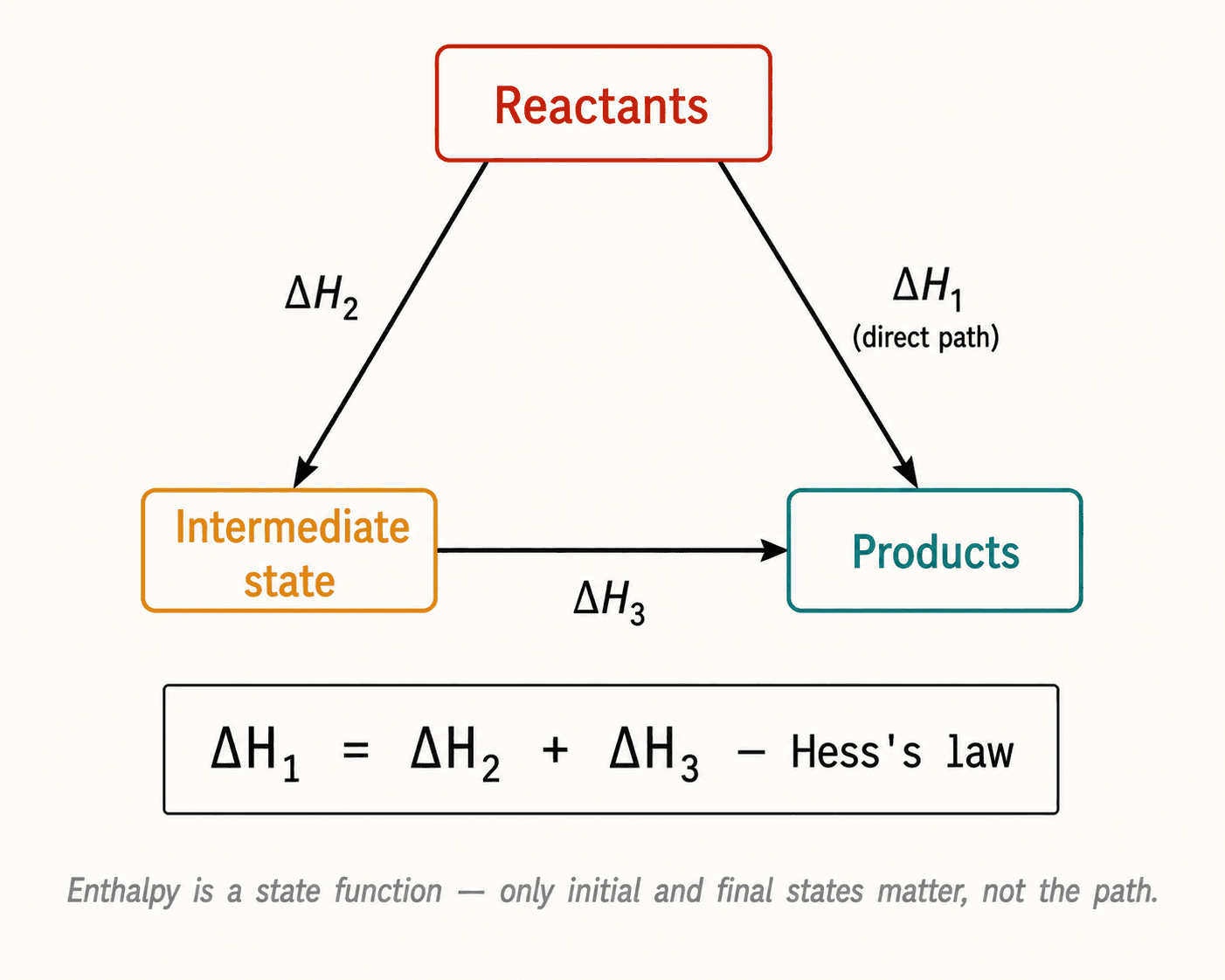
Hess's law (1840) states that the enthalpy change of a reaction is independent of the pathway followed: it depends only on the initial and final states.
Practical consequence: balanced equations with known ΔH values can be algebraically combined to obtain ΔH for an unknown reaction.
Example: finding ΔH° for C(s) + ½ O₂(g) → CO(g) Known: 1) C(s) + O₂(g) → CO₂(g) ΔH₁° = -393.5 kJ·mol⁻¹ 2) CO(g) + ½ O₂(g) → CO₂(g) ΔH₂° = -283.0 kJ·mol⁻¹
Target = (1) - (2): ΔH° = ΔH₁° - ΔH₂° = -393.5 - (-283.0) = -110.5 kJ·mol⁻¹
Calorimetry
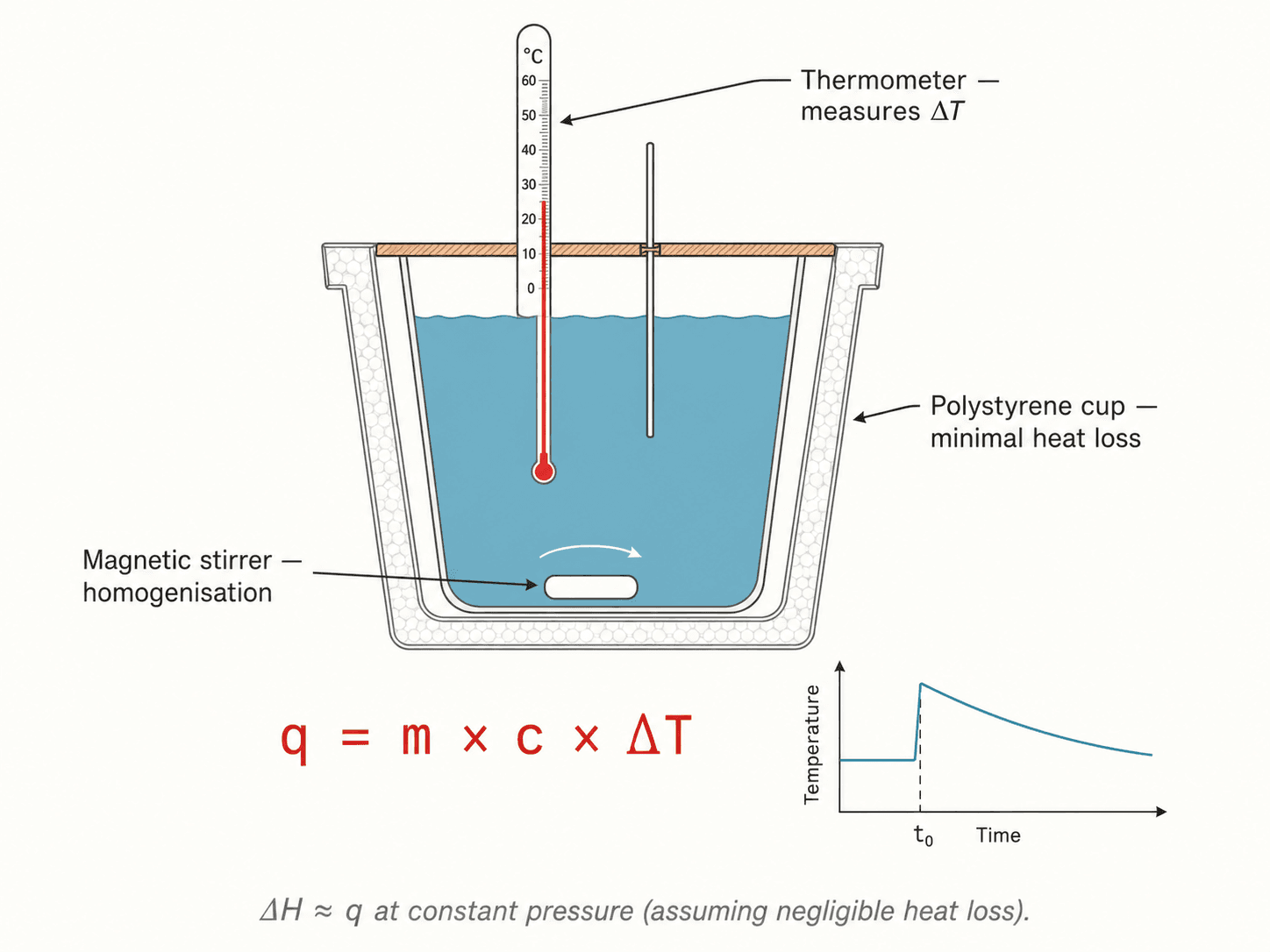
Calorimetry measures ΔH experimentally. A calorimeter is a thermally insulated container holding the reaction medium and a thermometer.
Principle: heat released by the reaction is entirely absorbed by the calorimeter and its contents: Q_rxn = -(m · c · ΔT + C_cal · ΔT)
where: - m is the mass of liquid (g), c its specific heat capacity (J·g⁻¹·K⁻¹) - C_cal is the heat capacity of the calorimeter (J·K⁻¹) - ΔT = T_final - T_initial
The calorimeter's heat capacity is determined by calibration (reference neutralisation reaction, or electrical resistance heating).
ΔH = Q_rxn / n_rxn (kJ·mol⁻¹)
First law — global energy balance
The first law relates work, heat and internal energy: ΔU = Q + W
At constant pressure, W = -P ΔV (pressure-volume work). For reactions in solution (ΔV ≈ 0) or not involving gases, W ≈ 0 and ΔU ≈ ΔH.
For gas-phase reactions: ΔH = ΔU + Δn_gas · R · T
where Δn_gas is the change in moles of gas.
Finished this lesson?