Definition and role of the catalyst
A catalyst is a substance that increases the rate of a chemical reaction without being consumed overall (it is regenerated at the end of the cycle). It does not appear in the overall reaction equation.
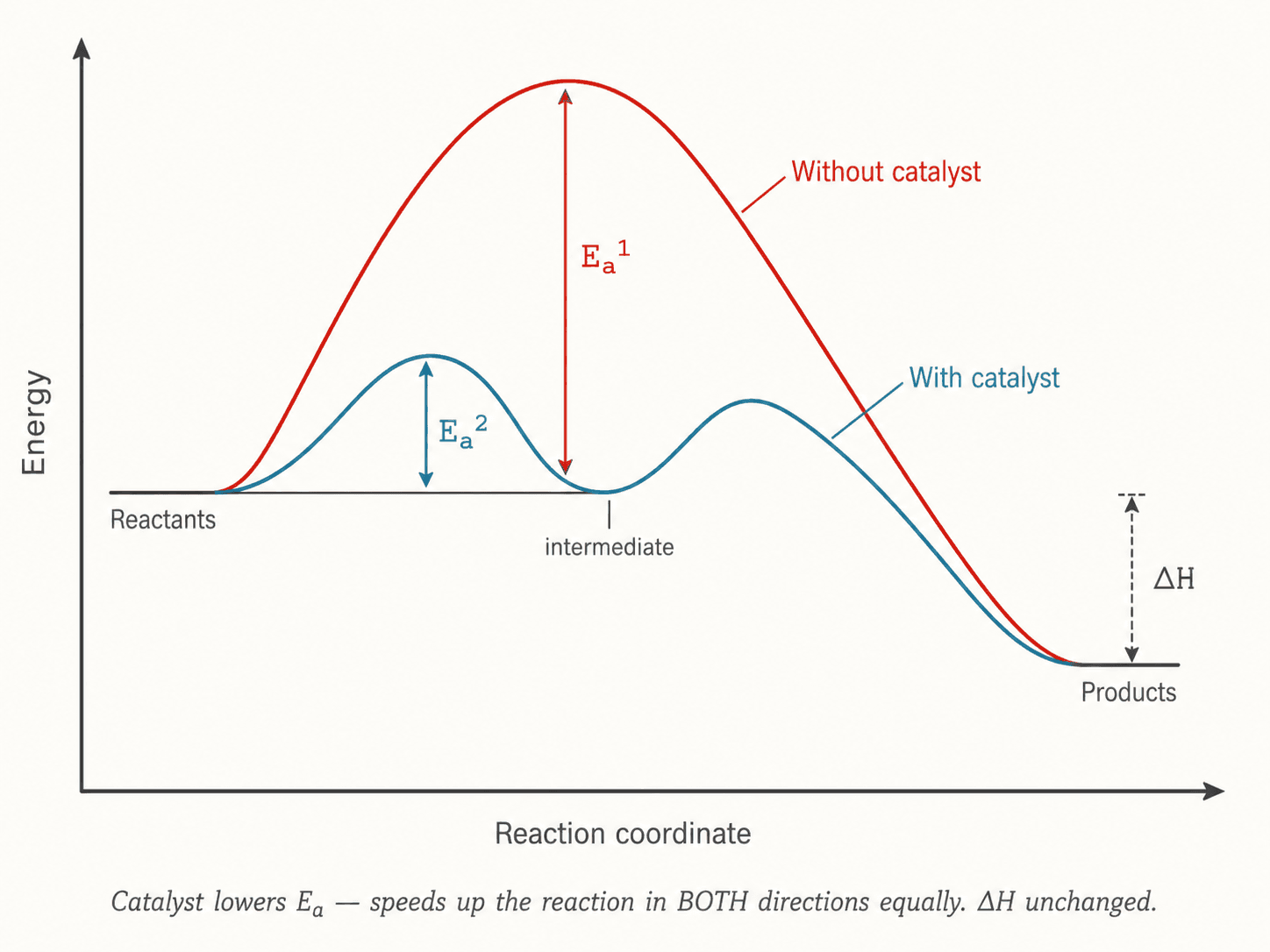
Fundamental properties: - Does not appear in the overall equation (it is consumed then regenerated). - Does not affect equilibrium: the equilibrium constant K is not modified by the catalyst. - Lowers the activation energy Ea: it provides an alternative reaction pathway of lower energy.
Consequence: at the same temperature, the fraction of effective collisions is larger → increased rate.
Energy profile and activation energy
The energy profile shows potential energy along the reaction coordinate. The activated complex (or transition state ‡) is the highest-energy point on the reaction pathway.
For an uncatalysed reaction: - Ea (uncatalysed) = height of the energy barrier between reactants and transition state ‡.
For the catalysed reaction: - Ea (cat.) < Ea (uncat.): the catalyst stabilises the transition state or provides a multi-step mechanism with lower barriers.
The ΔH of the reaction is unchanged: the energy levels of reactants and products remain identical.
Homogeneous catalysis
In homogeneous catalysis, the catalyst is in the same phase as the reactants (e.g. catalyst and reactants both in aqueous solution).
Classic example — oxidation of iodide ions I⁻ by hydrogen peroxide H₂O₂: H₂O₂ + 2 I⁻ + 2 H⁺ → 2 H₂O + I₂ (slow without catalyst)
In the presence of Fe³⁺ (homogeneous catalyst): - Step 1: 2 Fe³⁺ + 2 I⁻ → 2 Fe²⁺ + I₂ (fast) - Step 2: 2 Fe²⁺ + H₂O₂ + 2 H⁺ → 2 Fe³⁺ + 2 H₂O (fast)
Iron (Fe) is regenerated: it is indeed a catalyst.
Other example: acid-base catalysis (protonation of an intermediate to lower the barrier).
Heterogeneous catalysis
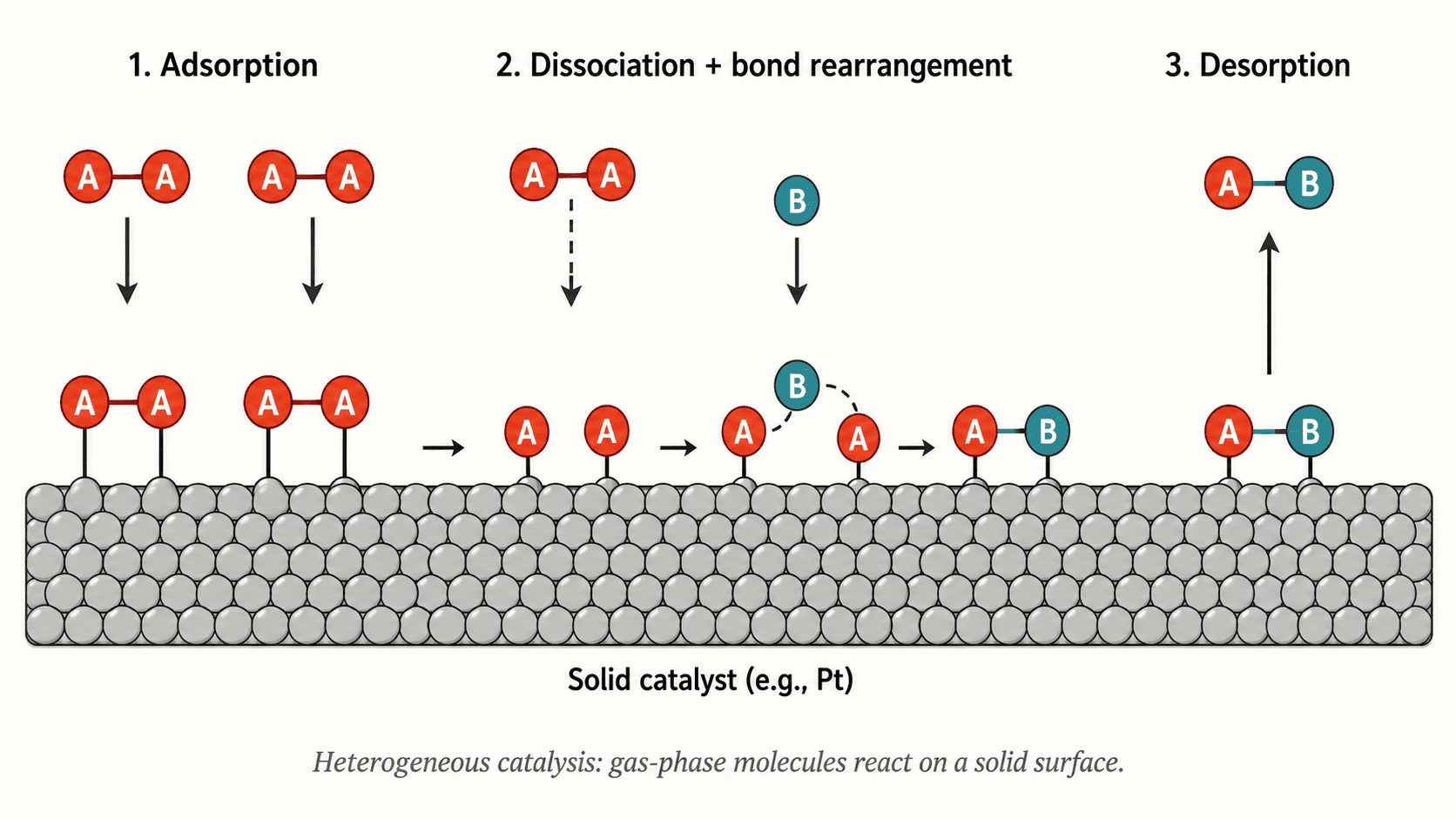
In heterogeneous catalysis, the catalyst is in a different phase from the reactants (usually a solid in contact with gaseous or solution-phase reactants).
General mechanism (4 steps): 1. Adsorption of reactants onto the catalyst surface. 2. Diffusion across the surface to active sites. 3. Reaction at active sites (activated bonds, lowered Ea barrier). 4. Desorption of products.
Major industrial examples: - Fe/Al₂O₃ catalyst in the Haber-Bosch process (NH₃ synthesis). - Pt/Pd/Rh in catalytic converters (CO oxidation, HC combustion, NOₓ reduction). - V₂O₅ in the contact process (SO₂ → SO₃ oxidation for H₂SO₄ production).
Enzymatic catalysis
Enzymes are proteins that catalyse biochemical reactions in cells. They are biological catalysts of remarkable efficiency and specificity.
Characteristics: - Substrate specificity: each enzyme catalyses a specific reaction (lock-and-key, or induced-fit model). - Active site: three-dimensional pocket of the enzyme where substrate S binds to form the enzyme-substrate complex ES. - Michaelis-Menten kinetics: v = Vmax [S] / (Km + [S]), where Km is the Michaelis constant (concentration at which v = Vmax/2).
Examples: - Amylase: hydrolysis of starch to maltose (saliva, pancreas). - Catalase: decomposition of H₂O₂ → H₂O + ½ O₂ (kcat ~ 10⁷ s⁻¹ — one of the fastest enzymes). - Horseradish peroxidase (HRP): oxidation of chromogenic substrates (used in analytical biology).
Industrial and environmental applications
- Catalytic cracking (refinery): zeolites convert heavy hydrocarbons into petrol.
- Hydrogenation of fats: solid [Ni] converts unsaturated oils to saturated fats.
- Atmospheric depollution: catalytic converters reduce CO, NOₓ and HC by over 90%.
- Industrial biocatalysis: synthesis of amino acids and pharmaceuticals (semi-synthetic antibiotics) by enzymatic routes.
Finished this lesson?