Carbon, the architect of life
Carbon (C) is the central element of all organic chemistry. With its four covalent bonds, it can assemble into chains, rings, and branched structures of remarkable complexity. This self-assembly capacity is what makes the diversity of the living world possible.
Saturated and unsaturated chains
A saturated carbon chain contains only C–C single bonds. Alkanes are the prime example: methane (CH₄), ethane (CH₃-CH₃), propane, etc. The general formula is CₙH₂ₙ₊₂.
An unsaturated chain contains at least one C=C double bond (alkenes, CₙH₂ₙ) or a C≡C triple bond (alkynes, CₙH₂ₙ₋₂). A double bond makes the molecule more reactive and prevents free rotation around that bond.
- Saturated: CH₃-CH₂-CH₂-CH₃ (butane)
- Mono-unsaturated: CH₂=CH-CH₂-CH₃ (but-1-ene)
- Di-unsaturated: CH₂=C=CH₂ (propadiene)
Branched and cyclic chains
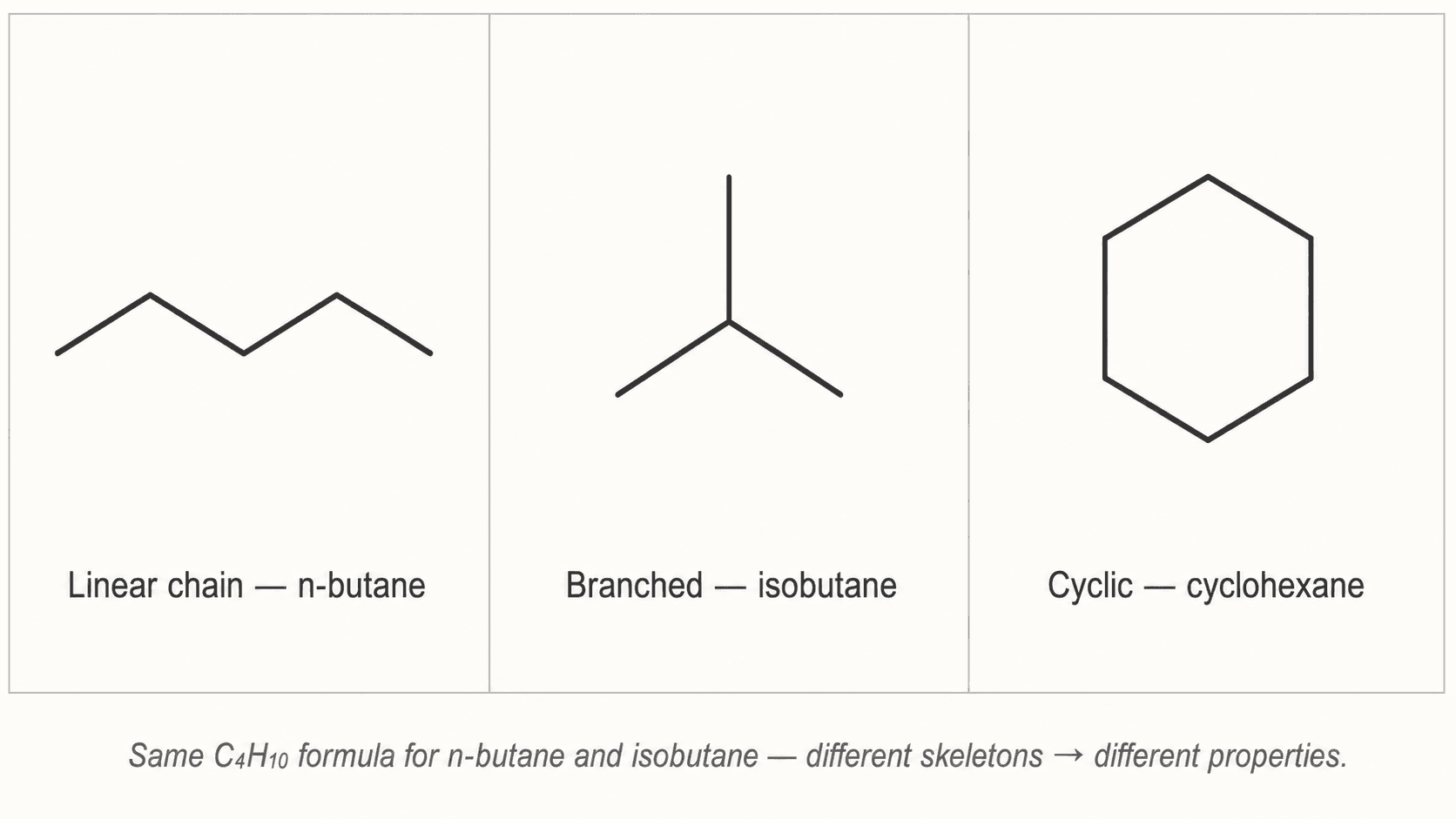
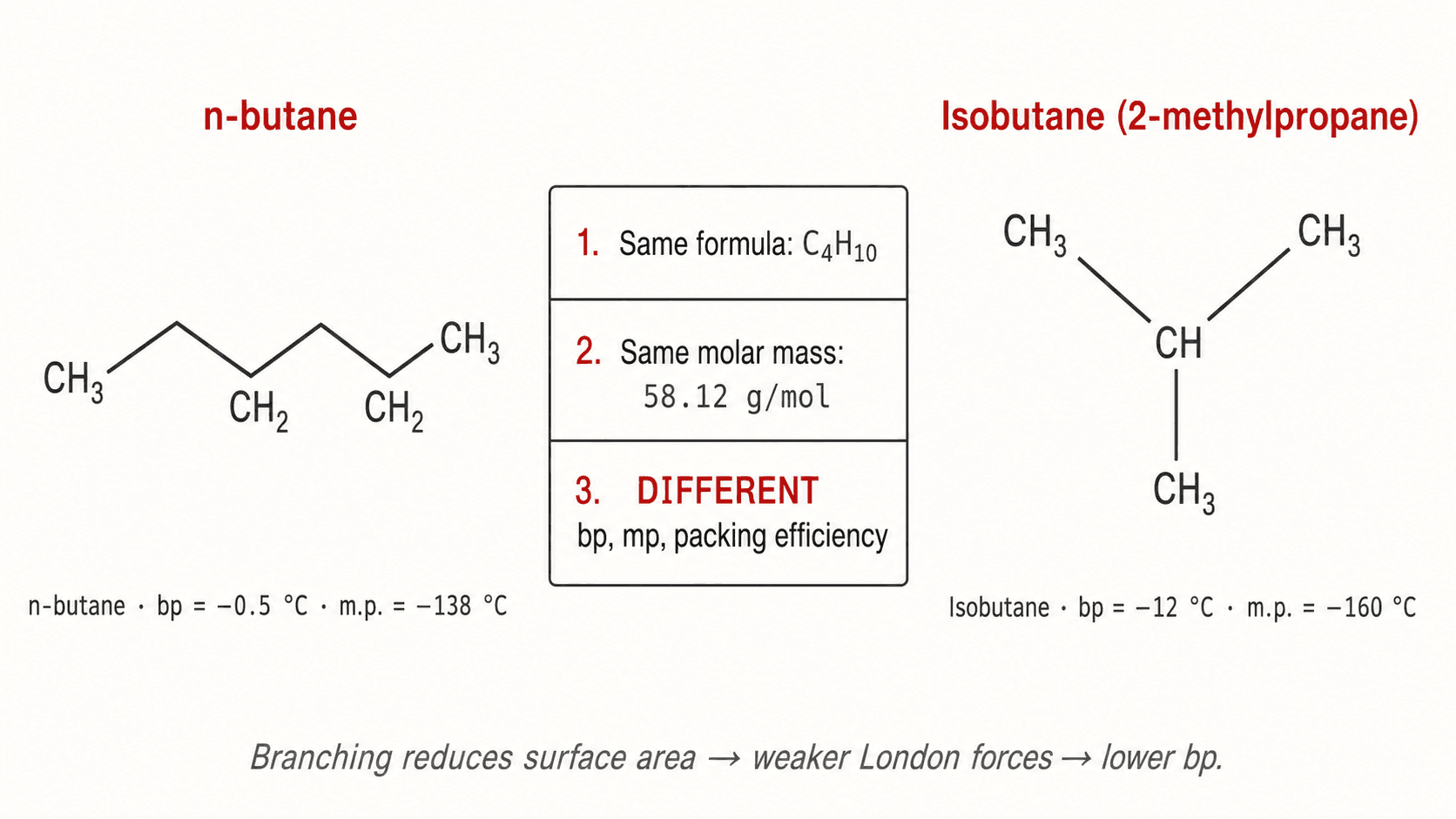
A chain is linear if all carbons follow in sequence without branching. It is branched when a carbon bears at least three carbon neighbours. These branches deeply affect physical properties: 2-methylpropane (isobutane) boils much lower than linear butane.
A cyclic chain closes on itself. Cyclohexane (C₆H₁₂) and benzene (C₆H₆) are essential examples. Aromatic rings, with delocalized π electrons, have a special stability explored in upper-level courses.
IUPAC nomenclature
IUPAC nomenclature follows precise rules:
1. Identify the parent chain: the longest one containing the maximum number of double bonds. 2. Number from the end that gives the lowest locants to substituents or unsaturations. 3. Name substituents: methyl- (–CH₃), ethyl- (–C₂H₅), propyl- (–C₃H₇)… 4. Assemble: [locant-substituent(s)]-[root]-[suffix]
| C count | Root | Alkane | Alkene |
|---|---|---|---|
| 1 | meth- | methane | — |
| 2 | eth- | ethane | ethene |
| 3 | prop- | propane | propene |
| 4 | but- | butane | butene |
| 5 | pent- | pentane | pentene |
| 6 | hex- | hexane | hexene |
Example: CH₃-CH(CH₃)-CH₂-CH₃ → 2-methylbutane.
Structural isomerism
Two molecules are structural isomers (constitutional isomers) if they share the same molecular formula but differ in the way their atoms are connected. For C₄H₁₀, we distinguish butane (linear chain) and 2-methylpropane (branched): same formula, different properties.
Three subtypes exist: - Chain isomerism: the parent chain differs (branched vs linear). - Position isomerism: same functional group, different locant (but-1-ene vs but-2-ene). - Functional-group isomerism: different functional groups (ethanol vs methoxymethane).
Configurational isomerism (cis/trans, R/S) is covered in the stereoisomerism lesson.
Physical properties and trends
Boiling point rises with chain length (more van der Waals contacts). Branching lowers it (more compact molecule, reduced contact surface). Pure hydrocarbons have very low water solubility: their non-polar character makes them miscible with each other but immiscible with water.
Finished this lesson?