Carboxylic acids
A carboxylic acid is an organic compound bearing the –COOH group (also written –CO₂H). This group combines a carbonyl (C=O) and a hydroxyl (–OH) on the same carbon. The general formula is R–COOH.
Carboxylic acids are weak acids: they partially donate a proton H⁺ in aqueous solution according to the equilibrium:
R-COOH + H₂O ⇌ R-COO⁻ + H₃O⁺
Ka is small (pKa ~ 4–5 for most), meaning the equilibrium lies far to the left. Ethanoic acid (acetic acid, CH₃-COOH) is the reference example at this level.
Esterification and hydrolysis
The reaction between a carboxylic acid and an alcohol produces an ester and water. This is the esterification reaction:
R-COOH + R'-OH ⇌ R-COO-R' + H₂O
It is slow, limited, and athermal (no significant heat change). Without a catalyst, the reaction is heated under reflux for several hours. Concentrated sulfuric acid (catalyst) speeds it up but does not shift the equilibrium.
At equilibrium, with stoichiometric proportions, roughly 2/3 ester and 1/3 acid+alcohol remain.
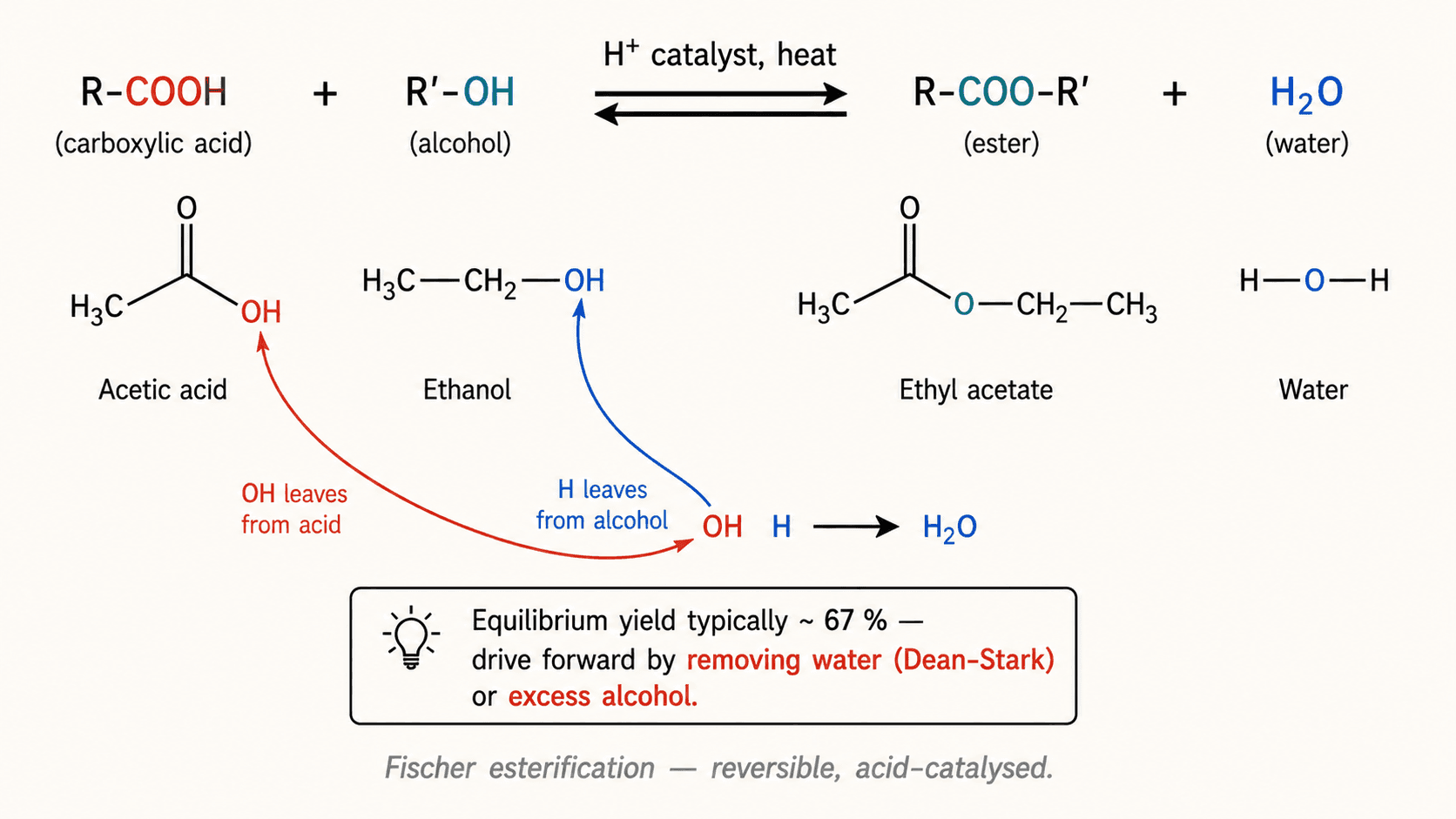
The reverse reaction — hydrolysis — breaks the ester into acid and alcohol in the presence of water.
To shift the equilibrium toward ester formation (Le Chatelier's principle): - Use an excess of one reactant. - Remove a product as it forms (distil off the water or the ester).
Properties of esters
Esters are often volatile liquids with a pleasant, fruity odour. They are responsible for the aroma of many fruits:
| Ester | Odour |
|---|---|
| Ethyl acetate (CH₃-COO-CH₂CH₃) | Nail polish, glue |
| Isoamyl acetate | Banana |
| Benzyl acetate | Jasmine |
| Ethyl butyrate | Pineapple |
Esters are poorly soluble in water (no –OH group for hydrogen bonding) but soluble in organic solvents.
Soaps: saponification
Saponification is the hydrolysis of an ester (usually a fat, glycerol ester) in alkaline conditions (NaOH or KOH). It is complete (irreversible), unlike acid hydrolysis.
A fat (glycerol triester) + sodium hydroxide → glycerol + 3 sodium carboxylates (soap).
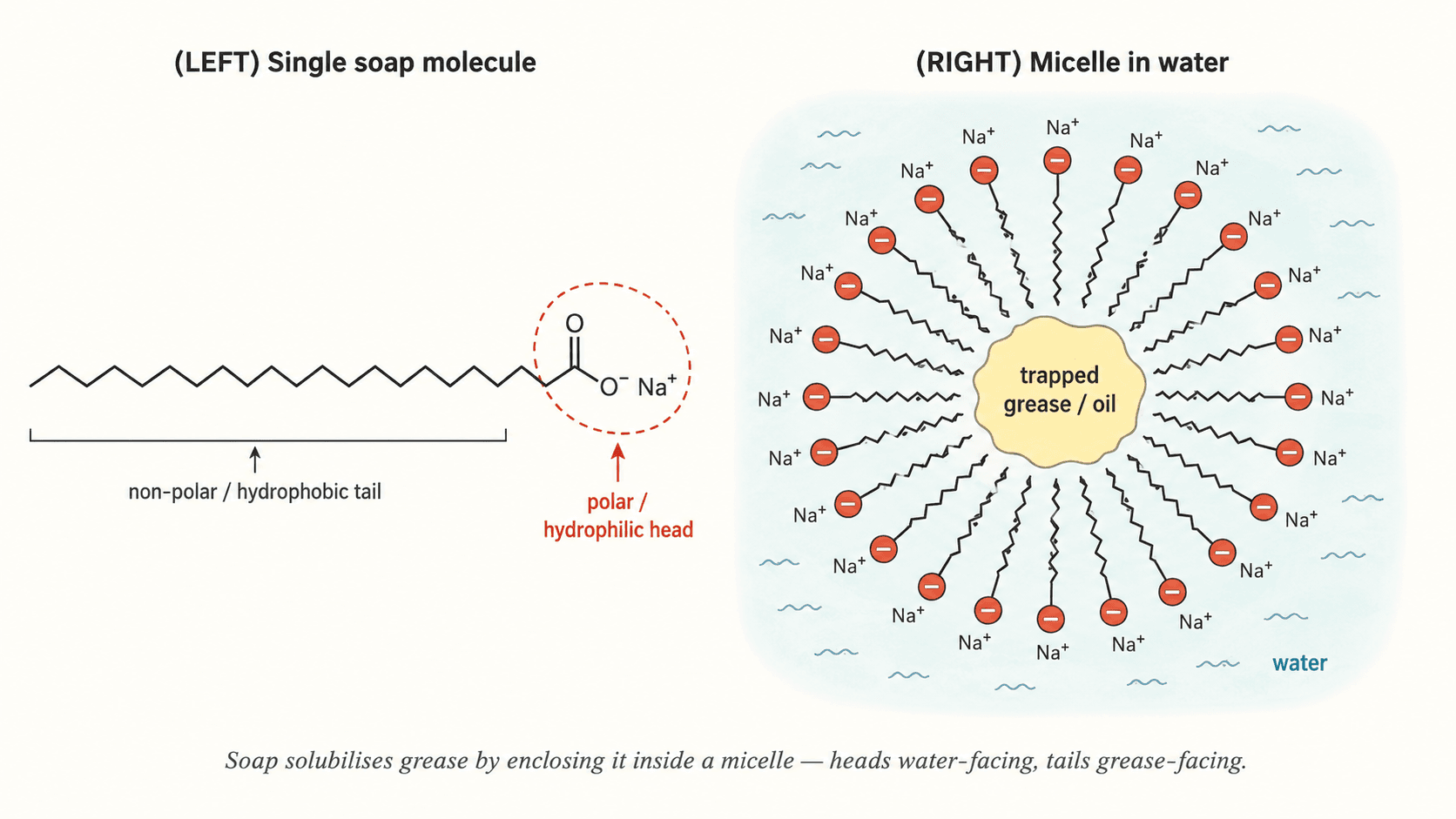
Sodium carboxylates (R–COO⁻ Na⁺) are surfactants: their long carbon chain is hydrophobic (lipophilic) while the carboxylate head is hydrophilic. This duality allows them to emulsify fats in water.
Aspirin: a pharmaceutical ester
Aspirin (acetylsalicylic acid) is the ester of salicylic acid and acetic acid. Its synthesis is a classic esterification reaction at this level: salicylic acid reacts with acetic anhydride (or acetic acid) to give aspirin. Its hydrolysis in the body releases salicylic acid, the active anti-inflammatory compound.
Finished this lesson?