The three major categories of organic reactions
Organic chemistry might seem like a long list of isolated reactions. In reality, the vast majority of transformations fall into three general categories: addition, substitution, and elimination. Mastering these three types gives you a universal framework for any organic reaction.
Addition
In an addition reaction, two reactants combine to form a single product by saturating an unsaturation (double or triple bond).
Example: addition to a C=C double bond (alkenes)
CH₂=CH₂ + HBr → CH₃-CH₂-Br (bromoethane)
A molecule of hydrogen or hydrogen halide (HX) adds across the double bond. The π bond breaks; two new σ bonds form.
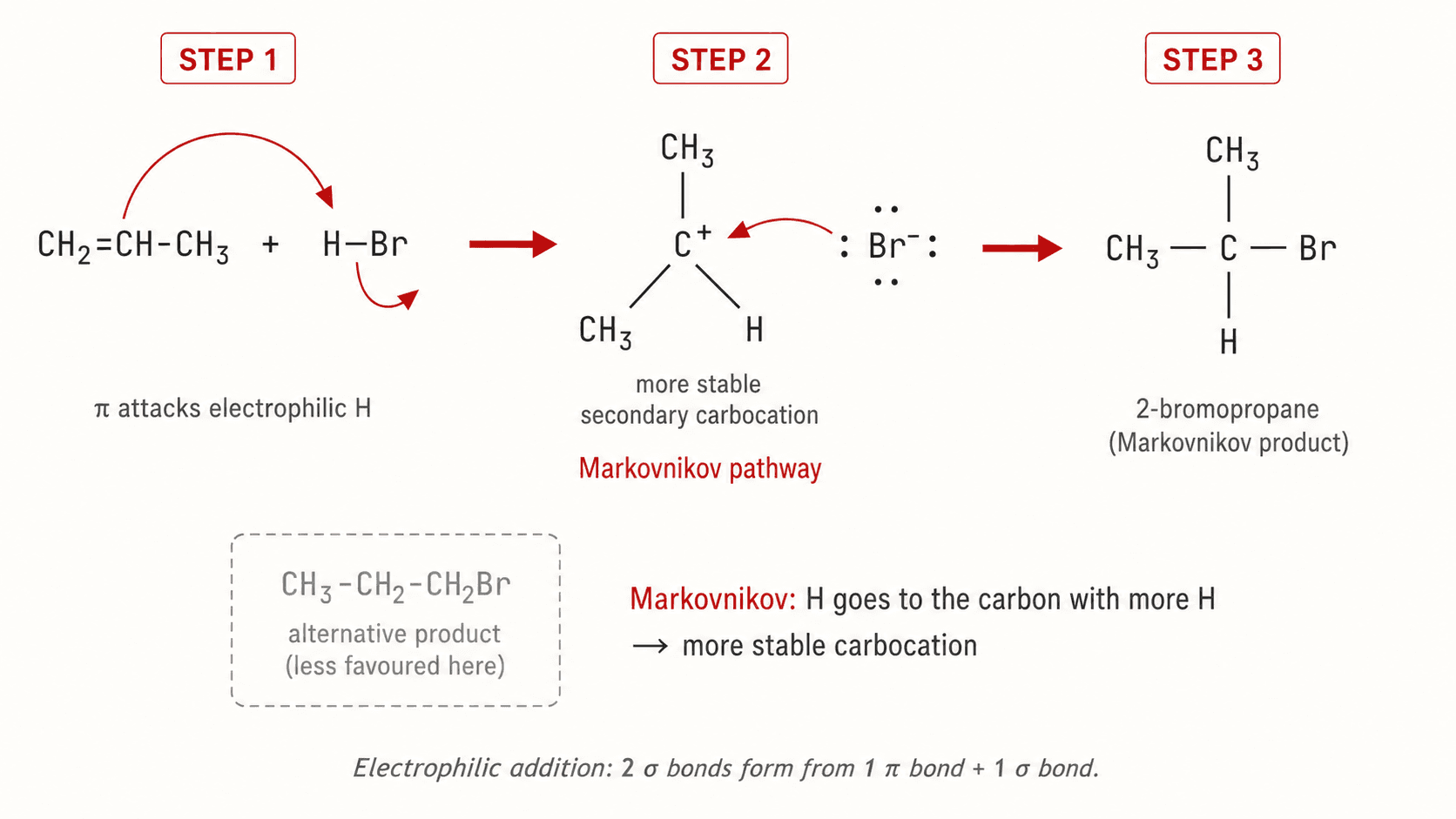
Markovnikov's rule: when HX adds to an unsymmetrical alkene, the proton H⁺ adds to the more hydrogenated carbon (an empirical rule — explained by carbocation stability in advanced courses). On ethene above, both carbons are equivalent, so the rule discriminates nothing; on propene, however:
CH₃-CH=CH₂ + HBr → CH₃-CHBr-CH₃ (2-bromopropane, major product)
rather than CH₃-CH₂-CH₂Br.
Catalytic hydrogenation: addition of H₂ in the presence of palladium or platinum (Pd/C or Pt) — converts an alkene to an alkane.
CH₂=CH₂ + H₂ → CH₃-CH₃ (Pd, Δ)
Substitution
In a substitution reaction, one atom (or group of atoms) is replaced by another without changing the degree of saturation of the carbon skeleton.
Halogenation of alkanes (radical substitution):
CH₄ + Cl₂ → CH₃-Cl + HCl (UV light or heat)
UV light initiates the formation of Cl· radicals. This chain reaction is not very selective: if several hydrogens are available, a mixture of mono-, di-, and polysubstituted products forms. It requires initiation (UV or Δ), propagation, and termination steps.
Nucleophilic substitution (SN): a nucleophile (electron-rich species: Nu⁻, OH⁻, CN⁻…) attacks an electrophilic carbon bearing a good leaving group (halide, tosylate…). Two variants exist: SN1 (two steps, via carbocation) and SN2 (one step, Walden inversion). The SN2 mechanism is covered in the reaction mechanisms lesson.
Elimination
In an elimination reaction, atoms or groups of atoms are removed from the molecule, creating a new unsaturation (most often a C=C double bond).
Dehydration of alcohols (loss of water, E1 or E2):
CH₃-CH₂-OH → CH₂=CH₂ + H₂O (conc. H₂SO₄, Δ)
H and OH are removed from adjacent carbons, forming a double bond. The reaction is favoured at high temperature in the presence of concentrated sulfuric acid. Zaitsev's rule (beyond standard curriculum) states that the most substituted alkene is preferentially formed.
Dehydrohalogenation: elimination of HX (halogen + hydrogen) from an alkyl halide in the presence of a strong base (e.g., alcoholic KOH) → alkene.
Summary table
| Category | Principle | Example | Product |
|---|---|---|---|
| Addition | Unsaturation + reactant → saturated product | CH₂=CH₂ + Br₂ | CH₂Br-CH₂Br |
| Substitution | One substituent replaces another | CH₄ + Cl₂ | CH₃Cl + HCl |
| Elimination | Atoms removed → unsaturation | CH₃CH₂OH → | CH₂=CH₂ + H₂O |
Addition vs substitution: how to choose?
The nature of the starting molecule guides the reaction type: - An unsaturated molecule (alkene, alkyne) typically reacts by addition. - A saturated molecule with a good leaving group (halide, activated alcohol) reacts by substitution or elimination depending on conditions.
Reaction conditions (temperature, solvent, nature of base or nucleophile) often allow one pathway to be favoured over the other.
Finished this lesson?