Alcohols: structure and properties
An alcohol is an organic compound bearing an –OH group bonded to an sp³ carbon (tetrahedral, no double bond). Three classes exist: - Primary alcohol: the –OH-bearing carbon is bonded to one other carbon (e.g., ethanol CH₃-CH₂-OH). - Secondary alcohol: bonded to two other carbons (e.g., propan-2-ol). - Tertiary alcohol: bonded to three carbons (e.g., 2-methylpropan-2-ol).
This classification is critical because it determines whether the alcohol can be oxidised, and into which product.
Oxidation of alcohols
Controlled oxidation (mild oxidant, e.g., dilute permanganate, dichromate) converts: - A primary alcohol → aldehyde (R–CHO) first, then carboxylic acid (R–COOH) if oxidation continues. - A secondary alcohol → ketone (R–CO–R'). - A tertiary alcohol → no oxidation possible (no hydrogen on the –OH-bearing carbon).
Overall pathway:
R-CH₂-OH → [ox] → R-CHO → [ox] → R-COOH
R-CHOH-R' → [ox] → R-CO-R' (and stops there)
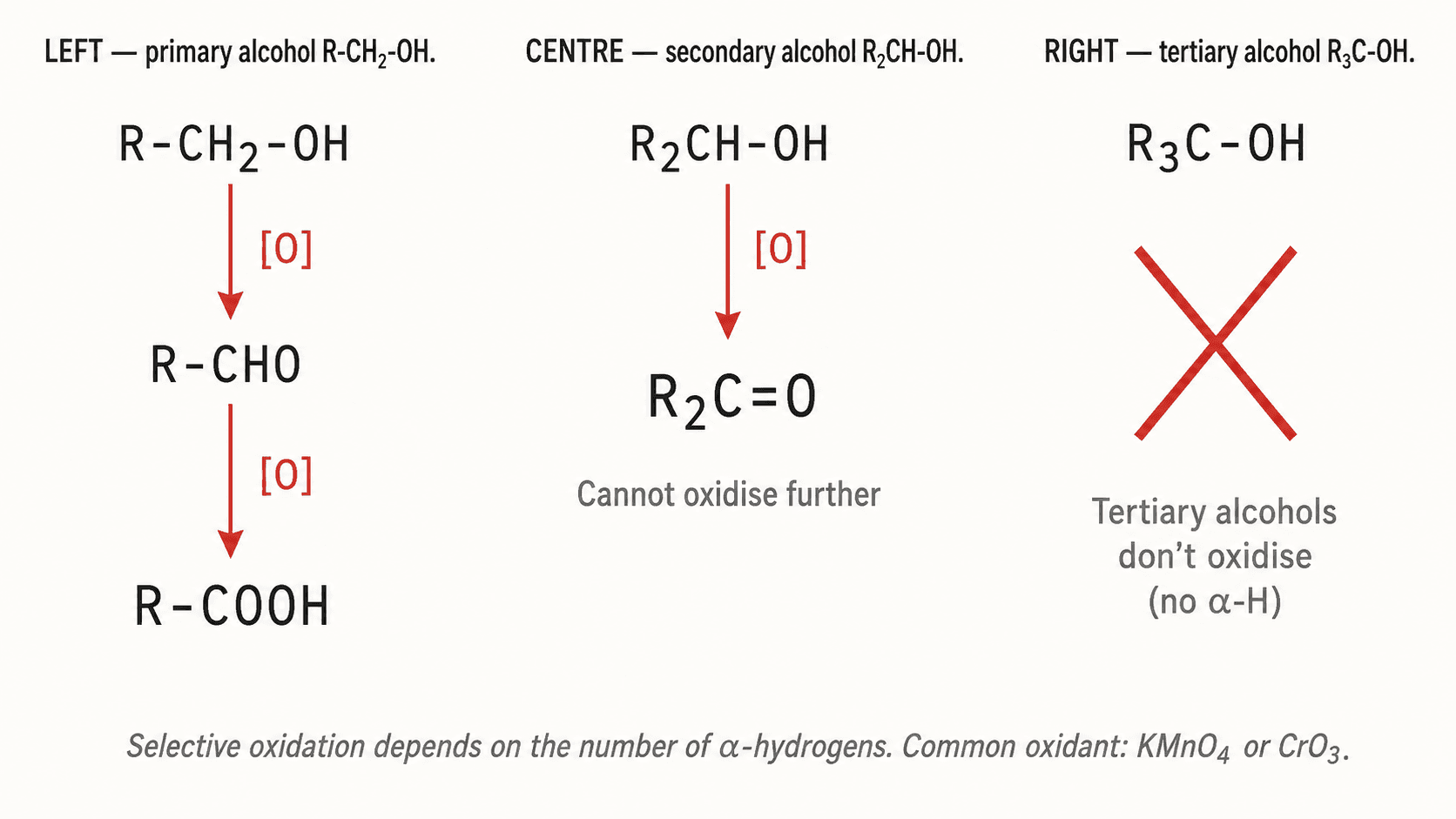
To obtain the aldehyde from a primary alcohol without reaching the acid, a milder oxidant is used (e.g., pyridinium chlorochromate, PCC) and the aldehyde is distilled off as it forms.
Aldehydes and ketones
An aldehyde has the –CHO group (terminal carbon bonded to H and to oxygen via a double bond). A ketone has the >C=O group with carbon substituents on both sides. Both belong to the carbonyl compound family.
| Property | Aldehyde | Ketone |
|---|---|---|
| Group | –CHO | >C=O |
| Position | chain end | mid-chain |
| Oxidisable? | Yes → acid | No (without drastic conditions) |
| Fehling test | Positive (Cu²⁺ → red Cu₂O↓) | Negative |
| Schiff test | Positive (pink/violet) | Negative |
Characteristic tests
Two tests distinguish aldehydes from ketones in the lab:
Fehling's reagent: blue Cu²⁺ solution in alkaline medium. In the presence of an aldehyde, Cu²⁺ is reduced to copper(I) oxide Cu₂O, a brick-red precipitate. Ketones do not react.
Schiff's reagent: fuchsin decolourised by SO₂. Aldehydes restore the pink/violet colour; ketones do not react.
Both tests are aldehyde-specific (with the exception of the iodoform test for methyl ketones — outside standard curriculum).
Concrete examples
- Methanal (formaldehyde): the simplest aldehyde, used as a disinfectant and in resin manufacture. Toxic.
- Ethanal (acetaldehyde) CH₃-CHO: an intermediate in alcoholic fermentation and in the body's metabolism of ethanol.
- Propanone (acetone) CH₃-CO-CH₃: common solvent, produced during prolonged fasting or in poorly controlled diabetes (ketone bodies).
Finished this lesson?