Why functional groups?
Organic chemistry would consist of millions of isolated molecules if we could not group them by behaviour. Functional groups — small sets of atoms with characteristic chemical properties — let us predict a molecule's reactions without studying each case separately. The molecule thus divides into two parts: the functional group (the reactive site) and the carbon chain (the "rest", written R).
Table of main functional groups
| Family | Group | Notation | Example |
|---|---|---|---|
| Alcohol | –OH | R–OH | ethanol CH₃-CH₂-OH |
| Aldehyde | –CHO | R–CHO | ethanal CH₃-CHO |
| Ketone | >C=O | R–CO–R' | propanone CH₃-CO-CH₃ |
| Carboxylic acid | –COOH | R–COOH | ethanoic acid CH₃-COOH |
| Amine | –NH₂ | R–NH₂ | methylamine CH₃-NH₂ |
| Ester | –COO– | R–COO–R' | ethyl acetate CH₃-COO-CH₂CH₃ |
| Ether | –O– | R–O–R' | diethyl ether CH₃CH₂-O-CH₂CH₃ |
| Alkyl halide | –X | R–X | chloroethane CH₃-CH₂-Cl |
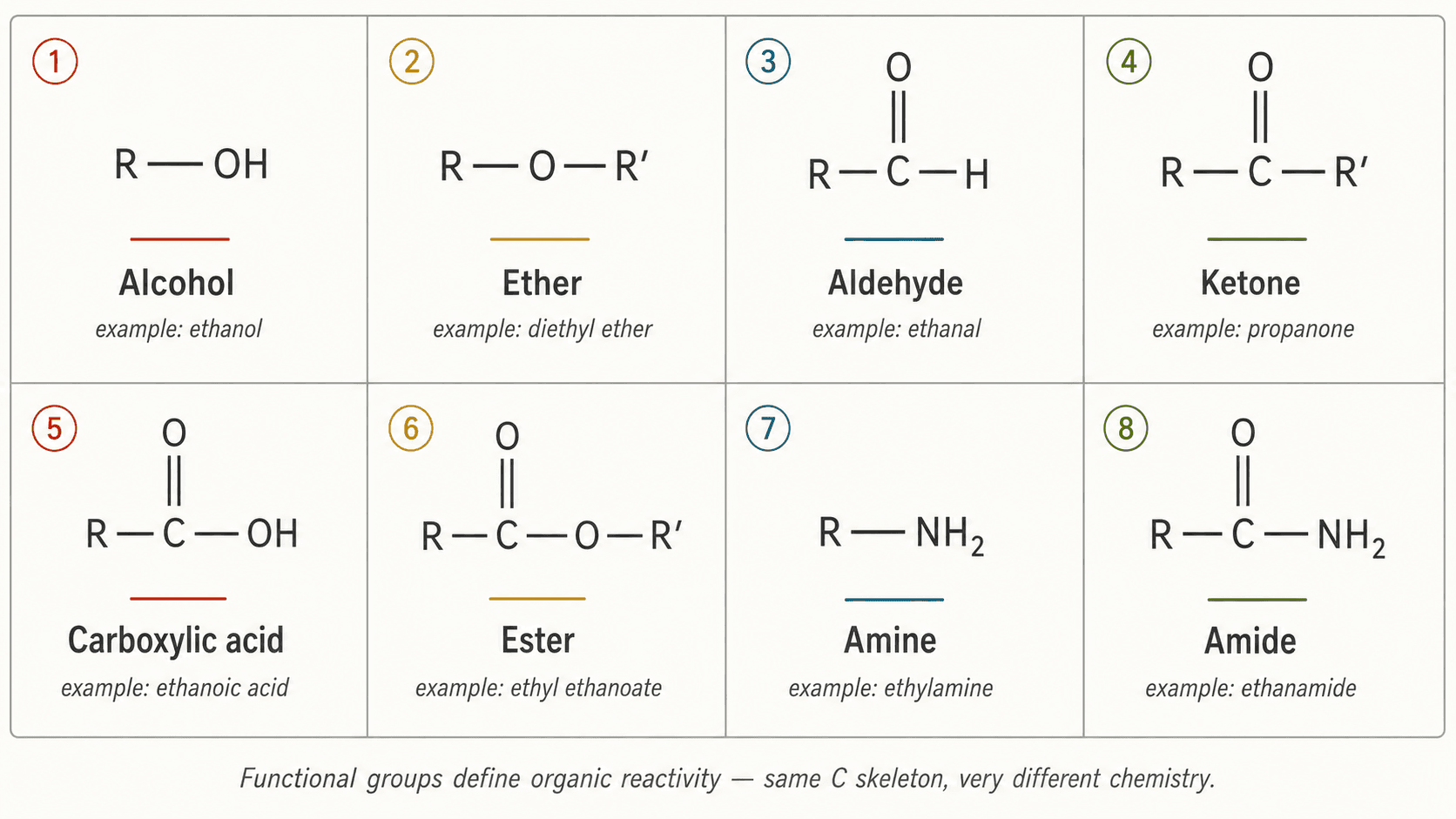
Recognizing a functional group
To identify a functional group, look for heteroatoms (O, N, halogen) or multiple bonds between C and O/N.
- An –OH on an sp³ carbon → alcohol.
- A C=O at the end of the chain (terminal carbon) → aldehyde (–CHO).
- A C=O in the middle of the chain → ketone (>C=O).
- A –COOH → carboxylic acid (C=O and –OH simultaneously).
- A –COO– without free –OH → ester.
- A –NH₂ → primary amine.
- An –O– without C=O → ether.
- A halogen bonded to a carbon → alkyl halide (–Cl, –Br, –I, –F).
Note: a single compound can carry multiple functional groups (e.g., alanine has both –NH₂ and –COOH).
Naming organic compounds
Nomenclature builds on the parent carbon chain, to which a suffix or prefix is added depending on the functional group:
| Family | Suffix | Prefix |
|---|---|---|
| Alcohol | -ol | hydroxy- |
| Aldehyde | -al | formyl- |
| Ketone | -one | oxo- |
| Carboxylic acid | …-oic acid | carboxy- |
| Amine | -amine | amino- |
| Ester | …-oate | — |
| Ether | … oxide | alkoxy- |
| Alkyl halide | — | chloro-, bromo-… |
Example: CH₃-CH(OH)-CH₃ → propan-2-ol (propane chain, –OH at position 2).
Properties and reactivity linked to the functional group
Alcohols and carboxylic acids are hydrophilic: their –OH or –COOH groups form hydrogen bonds with water, increasing their solubility. Ethers and alkyl halides are far less polar.
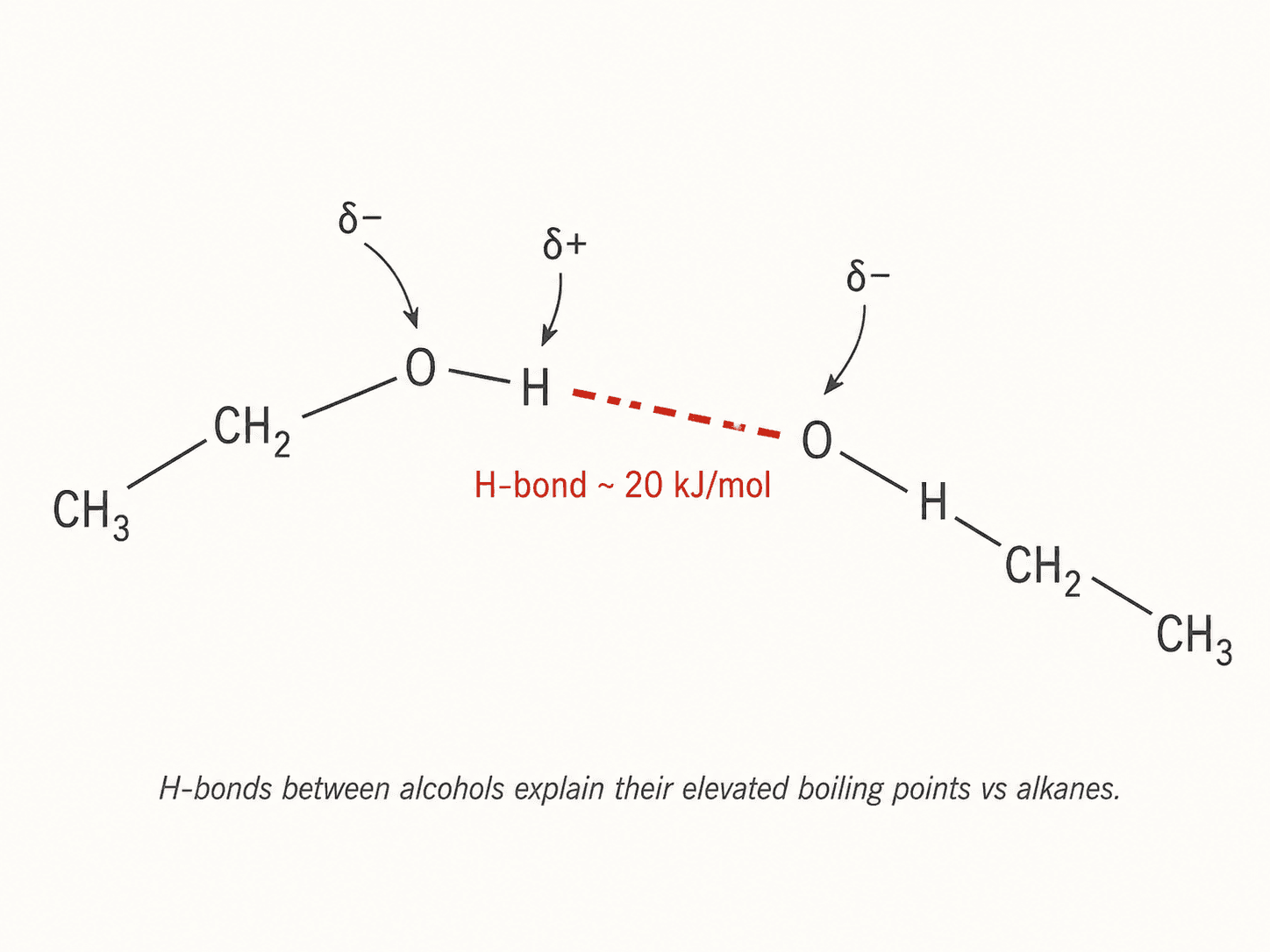
Carboxylic acids are weak acids (they donate a proton H⁺ in aqueous solution, releasing the carboxylate ion R–COO⁻). Amines are weak bases (they accept a proton). The reactivity of each group will be detailed in subsequent lessons.
Finished this lesson?