Beyond the molecular formula: molecular geometry
Two molecules can share the same molecular formula and the same connectivity (same bonds) while being distinct objects in space. These molecules are stereoisomers. Understanding stereoisomerism is essential in biochemistry: enzymes and biological receptors often distinguish the two "mirror images" of a molecule with absolute precision.
Conformational isomers
Conformers arise from rotation about a single C–C bond. They are not different molecules: rotation is free at room temperature and conformers interconvert continuously. They cannot be isolated separately.
For butane, the staggered conformers — anti (bulkiest groups opposite at 180°, most stable) and gauche (at 60°, moderately strained) — are distinguished from the eclipsed ones (at 0° and 120°, higher energy). Newman projections facilitate their visualisation.
cis/trans (Z/E) isomerism
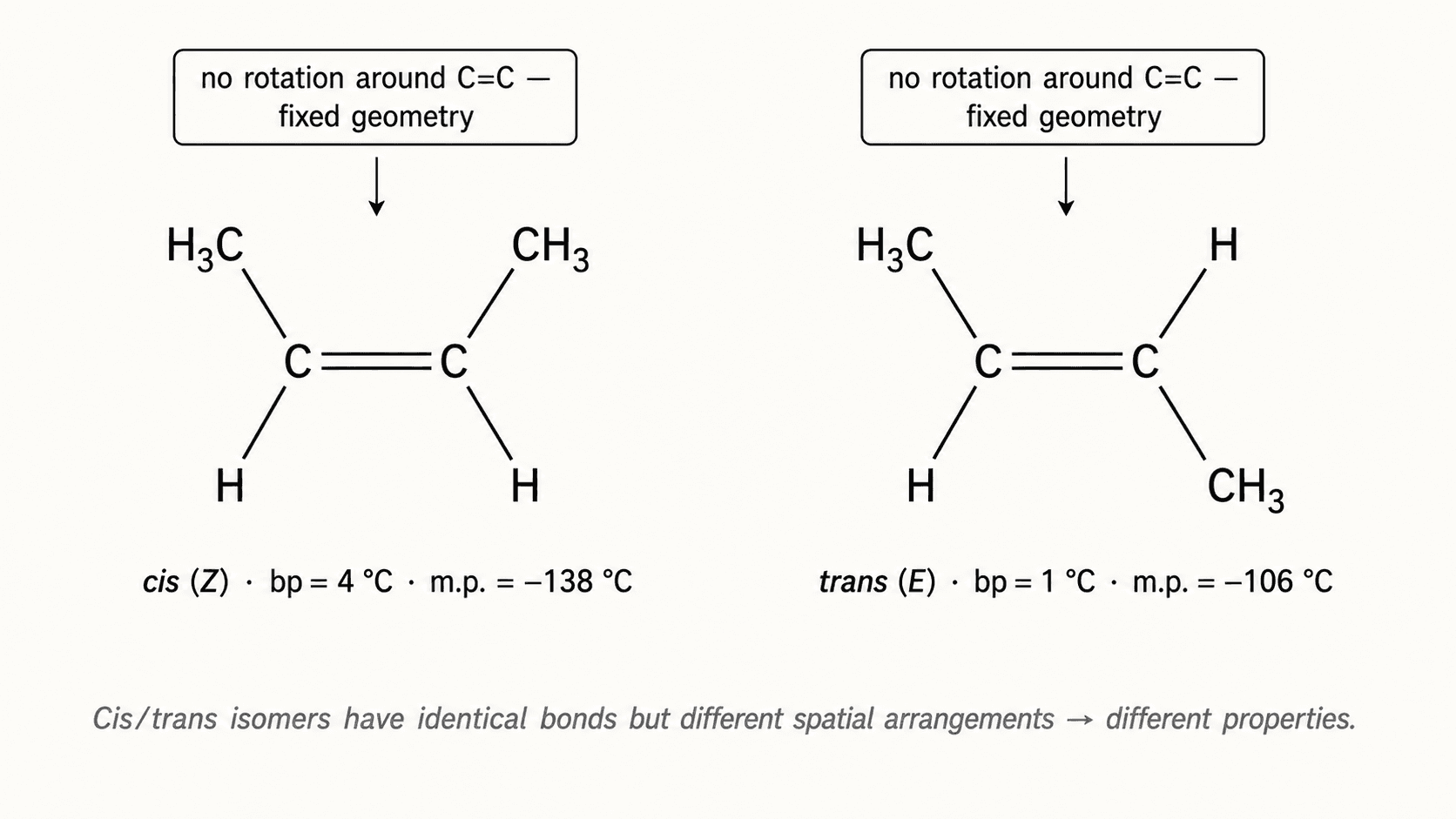
cis/trans (or Z/E in modern nomenclature) isomerism occurs in alkenes and rings: free rotation about the double bond or around the ring is impossible, "freezing" the geometry.
- cis (or Z, zusammen = together): two identical or higher-priority substituents on the same side of the double bond.
- trans (or E, entgegen = opposite): priority substituents on opposite sides.
To assign Z or E, use the Cahn-Ingold-Prelog (CIP) rules: compare the atoms attached to each double-bond carbon by atomic number. The substituent with the higher atomic number is "higher priority."
Asymmetric carbon and enantiomers
An asymmetric carbon (or stereocentre, denoted C) is an sp³ carbon bonded to four different substituents. It can adopt two non-superimposable spatial configurations — mirror images of each other: these are enantiomers*.
Enantiomers have the same physical properties (melting point, boiling point, solubility) and the same chemical properties towards achiral reagents. They differ only in optical activity: they rotate the plane of polarised light in opposite directions (+ and −, or d and l).
In biology, natural amino acids are all L configuration; natural sugars are D configuration. The body generally uses only one enantiomer.
R and S configuration
The CIP rule also applies to the asymmetric carbon to assign R (rectus = right) or S (sinister = left) configuration:
1. Assign priorities 1–4 to the substituents of C (by atomic number, then hierarchical rules). 2. Orient the molecule so that the priority-4 substituent (lowest priority) points away from you. 3. Read the 1→2→3 sequence: clockwise → R; counter-clockwise → S*.
Diastereomers
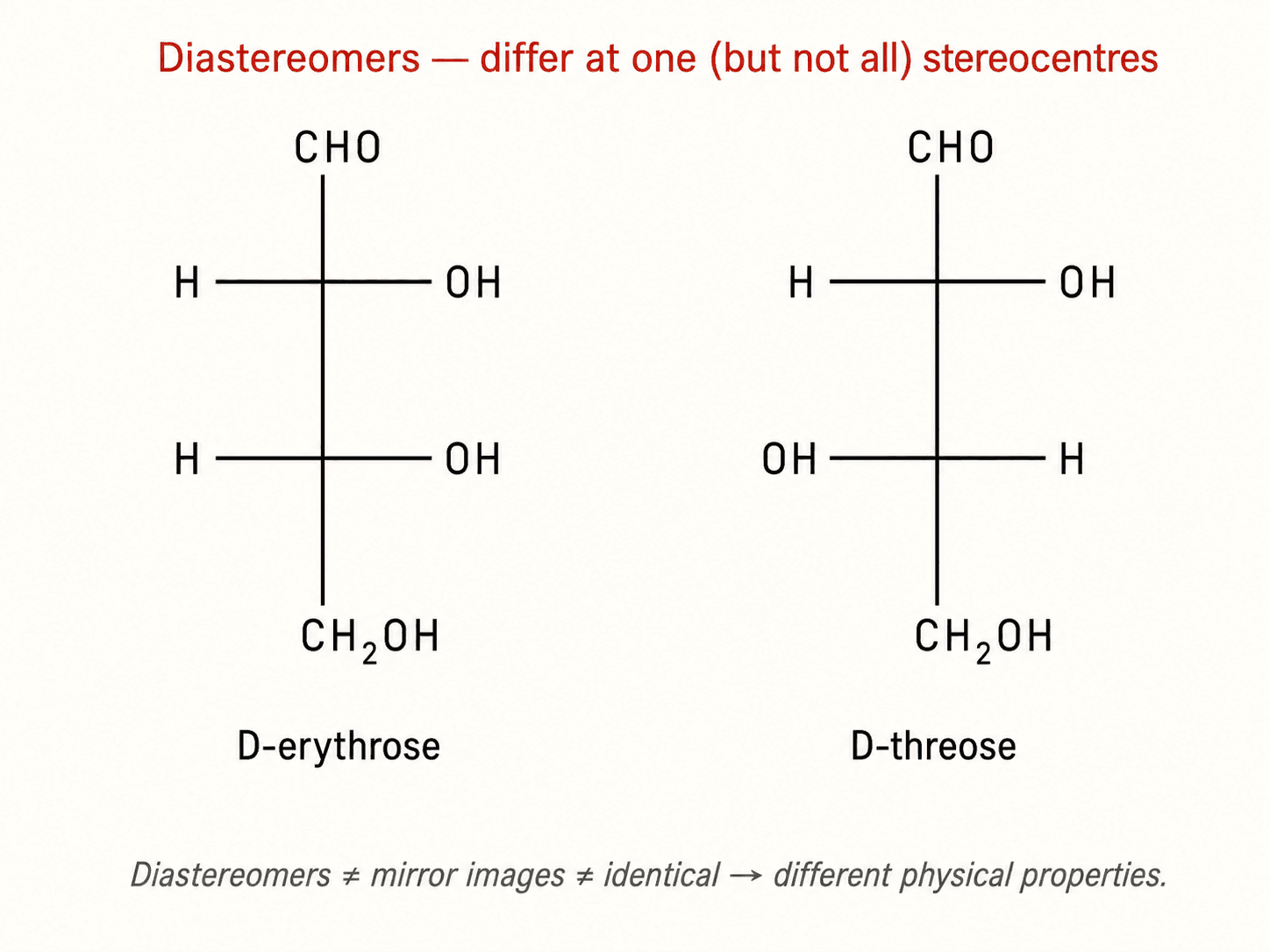
When a molecule has two or more asymmetric carbons, the number of stereoisomers can reach 2ⁿ (n = number of C). Stereoisomers that are not mirror images of each other are diastereomers. Unlike enantiomers, they have different physical properties* (melting points, polarimetry, chromatography…).
A special case: a meso compound has two C* but is superimposable on its mirror image (internal plane of symmetry) → optically inactive.
Finished this lesson?