Why orbitals? Limits of the Bohr model
At school level, atoms are described by the Bohr model: electrons on circular orbits of fixed energy. This model explains hydrogen's spectral lines but fails for multi-electron atoms and cannot predict molecular geometry. Quantum mechanics replaces orbits with atomic orbitals: wave functions ψ whose |ψ|² describes the probability of finding the electron at each point in space.
In preparatory classes and first-year university, you will encounter Schrödinger's equations. For now, note that each orbital is described by three quantum numbers (n, l, m_l) and a fourth (m_s = ±½) describes the electron's spin.
Quantum numbers
| Number | Symbol | Values | Meaning |
|---|---|---|---|
| Principal | n | 1, 2, 3… | Shell (main energy, size) |
| Azimuthal | l | 0 to n−1 | Subshell, shape |
| Magnetic | m_l | −l to +l | Spatial orientation |
| Spin | m_s | +½ or −½ | Electron spin |
Subshell l = 0 → s orbitals; l = 1 → p orbitals; l = 2 → d orbitals (important for transition metals).
Geometric shapes of orbitals
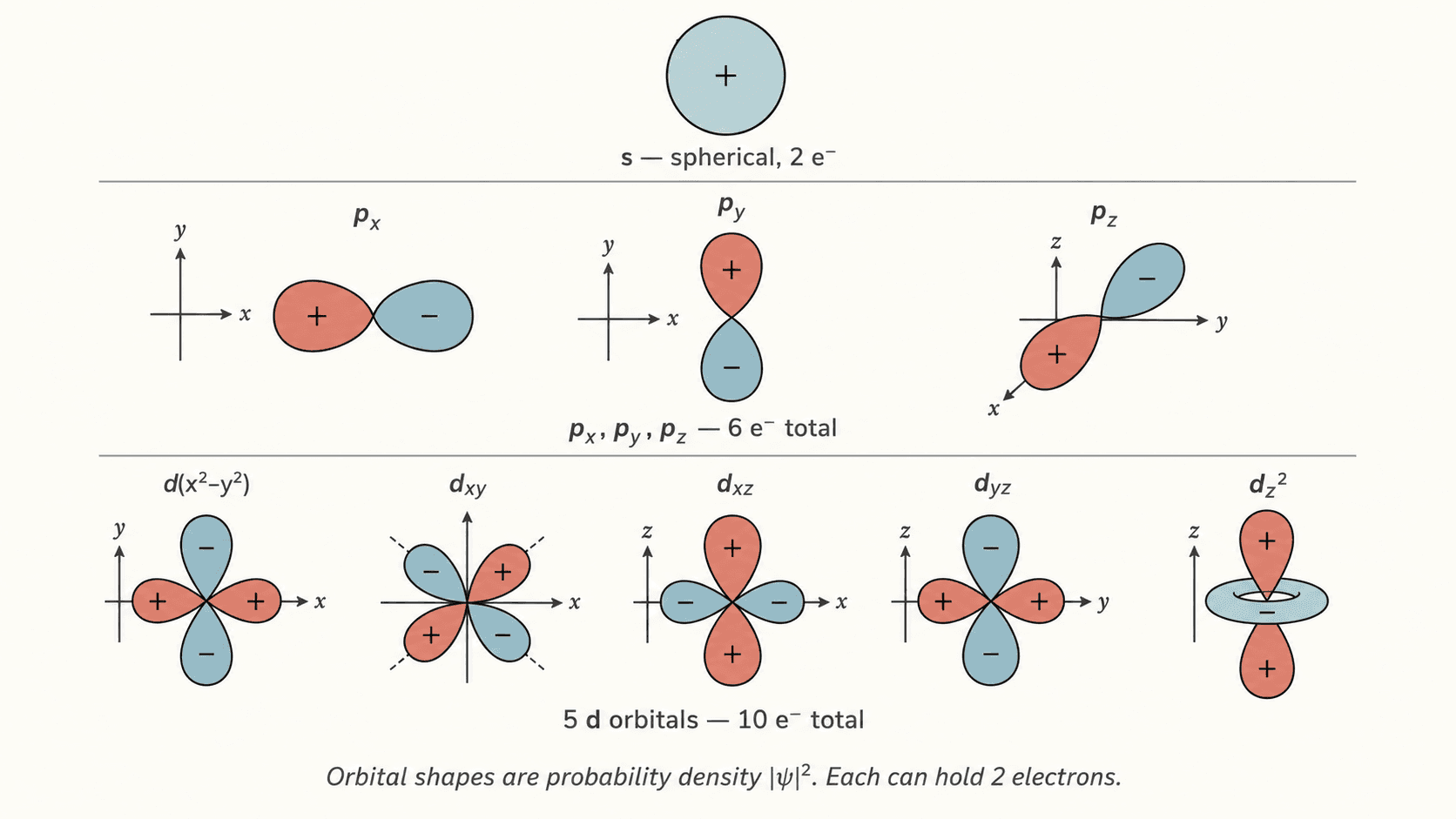
s orbital: spherical symmetry. All points equidistant from the nucleus have equal probability. One s orbital per subshell.
p orbitals: bilobed shape (two opposite lobes separated by a node at the nucleus). Three p orbitals per subshell (px, py, pz), oriented along the three spatial axes. Higher energy than the s orbital in the same shell.
d orbitals: more complex shapes — four orbitals with a 4-lobed cross (dxy, dxz, dyz, dx²-y²) plus a fifth, dz², with two lobes along z surrounded by an equatorial torus. Five d orbitals per subshell. Important for transition metals but not deeply explored at this level.
Filling rules
To fill the orbitals of a multi-electron atom, three rules apply:
1. Aufbau principle: fill orbitals in order of increasing energy (1s → 2s → 2p → 3s → 3p → 4s → 3d…). 2. Pauli exclusion principle: each orbital holds a maximum of 2 electrons with opposite spins. 3. Hund's rule: among degenerate orbitals (equal energy), electrons occupy as many different orbitals as possible with the same spin before pairing.
Example: Carbon (C) (Z = 6) → 1s² 2s² 2p² (the two 2p electrons occupy two different p orbitals).
Orbitals and covalent bonding
Covalent bonding is better understood with orbitals. When two atoms approach, their orbitals overlap:
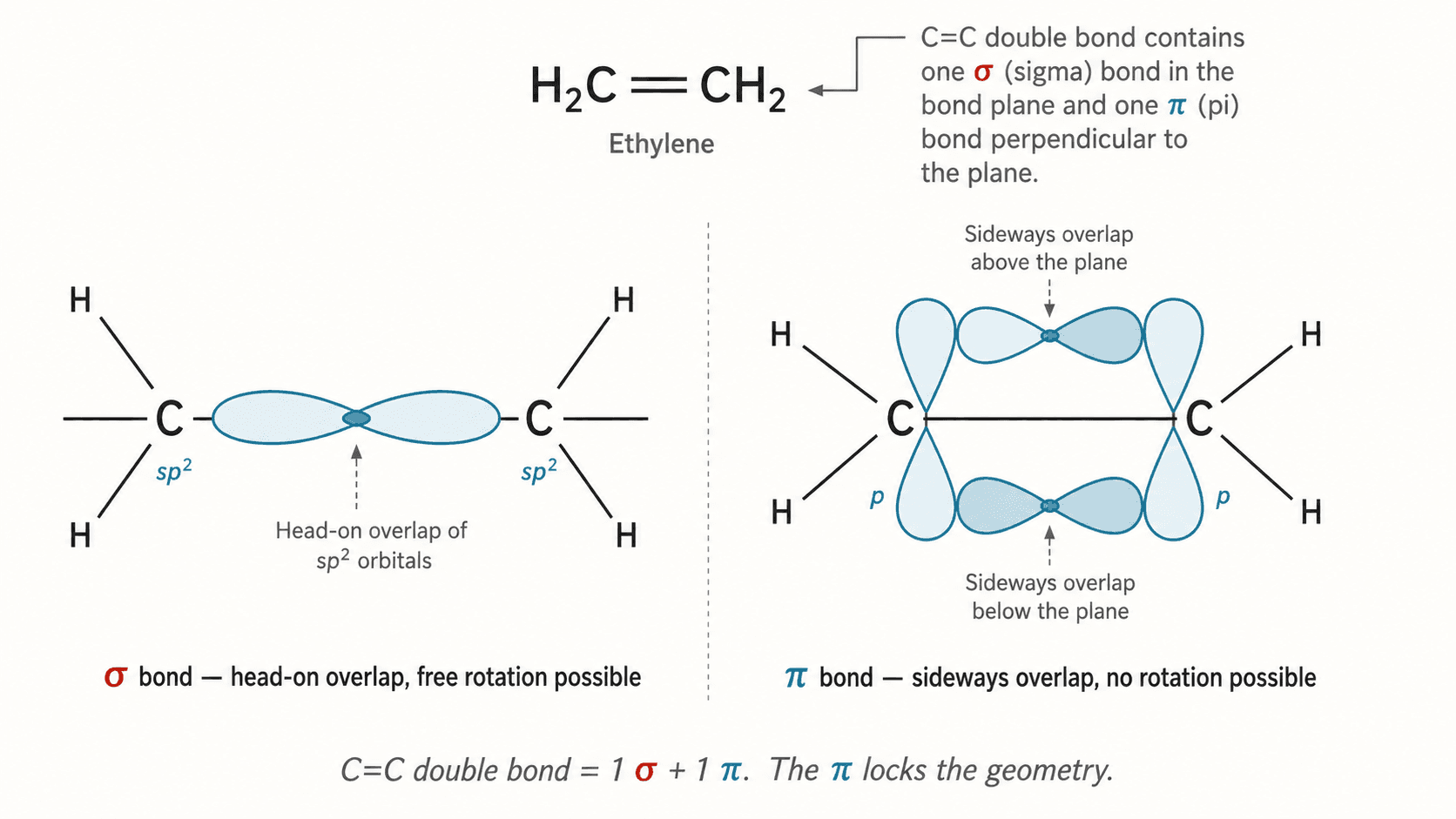
- Head-on overlap (along the bond axis) → σ (sigma) bond: the strongest.
- Lateral overlap (perpendicular to the axis) → π (pi) bond: weaker, the reactive site in alkenes.
A C–C single bond = 1 σ. A C=C double bond = 1 σ + 1 π. A C≡C triple bond = 1 σ + 2 π.
Hybrid orbital theory (sp³, sp², sp) explains methane's tetrahedral geometry, ethylene's planarity, and acetylene's linearity — fundamental concepts for organometallic chemistry and preparatory classes.
Finished this lesson?