What is a reaction mechanism?
A balanced equation — such as A + B → C + D — summarises the overall result of a reaction but says nothing about how bonds form and break. A reaction mechanism describes the sequence of elementary steps by which reactants transform into products. Each step involves the rearrangement of a small number of bonds simultaneously.
Understanding mechanisms means moving from memorising reactions to predicting new products. This is the core of university-level organic chemistry.
Curved arrows
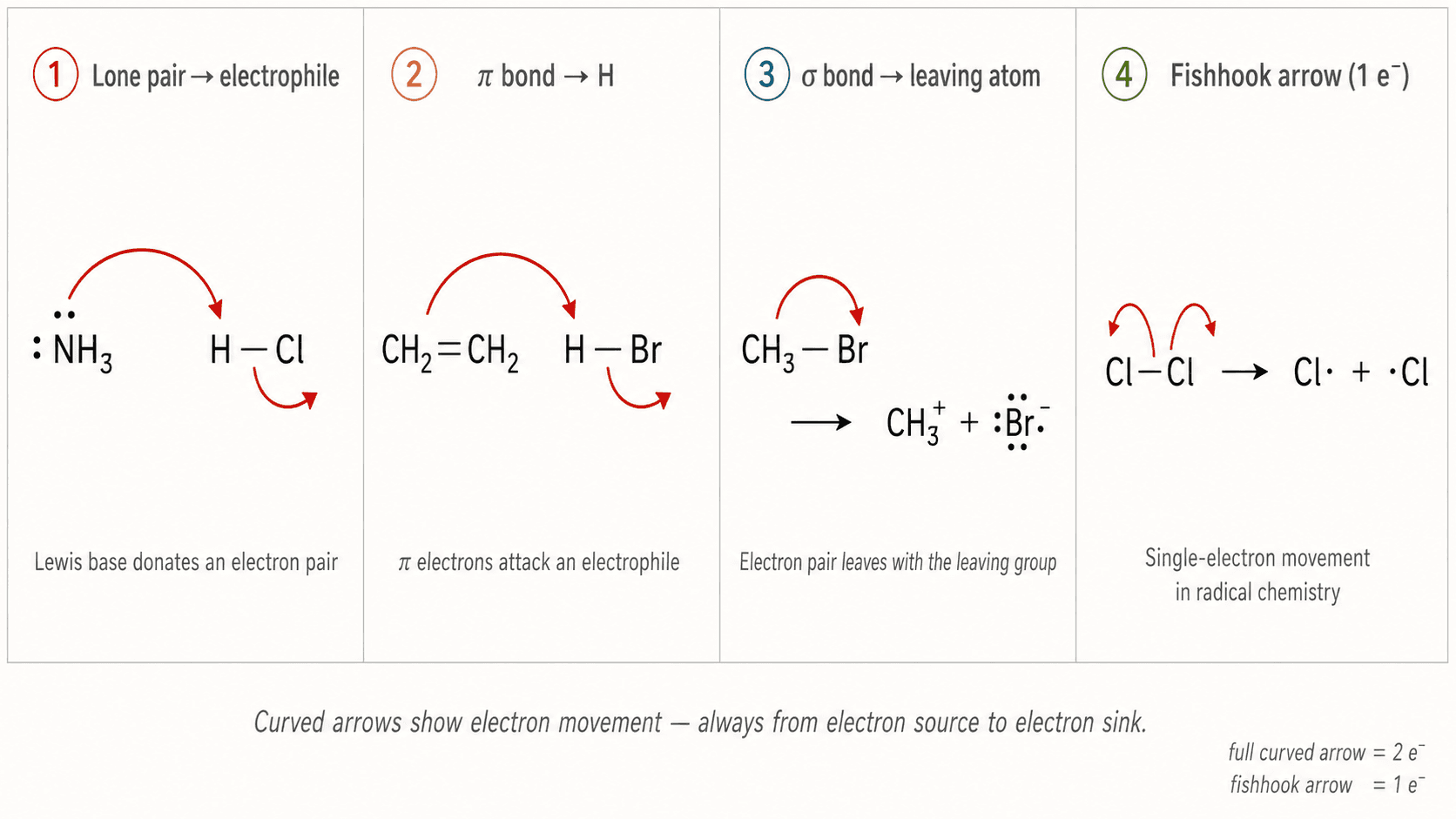
The principal notation of mechanisms uses curved arrows (mechanistic arrows): - A full curved arrow (with a double-headed tip) represents the movement of an electron pair (two electrons) from an electron-rich to an electron-poor region. - A half-headed arrow (fish-hook) represents the movement of a single electron (radical mechanism).
The arrow always starts from a lone pair (or from a bond) and points toward an electrophilic atom or a bond to be broken. It symbolises electron movement, not atom movement.
Reactive intermediates
In a multi-step mechanism, intermediates form — short-lived species that do not appear in the overall equation.
| Intermediate | Description | Stability |
|---|---|---|
| Carbocation | Carbon with a + charge (6 valence electrons) | Tertiary > secondary > primary |
| Carbanion | Carbon with a − charge (8 valence electrons) | Stabilised by induction, resonance |
| Radical | Carbon with one unpaired electron | Tertiary > secondary > primary |
| Transition state | Energy maximum on the reaction profile | Cannot be isolated |
Reactive intermediates differ from transition states: an intermediate corresponds to a local energy minimum (exists briefly); a transition state corresponds to the maximum (can never be isolated).
The SN2 mechanism
The SN2 mechanism (Bimolecular Nucleophilic Substitution) is the fundamental mechanism to master:
Reactants: an alkyl halide R–X (X = Cl, Br, I) and a nucleophile Nu⁻ (OH⁻, CN⁻, Br⁻…).
Single step:
Nu⁻ + R–X → Nu–R + X⁻
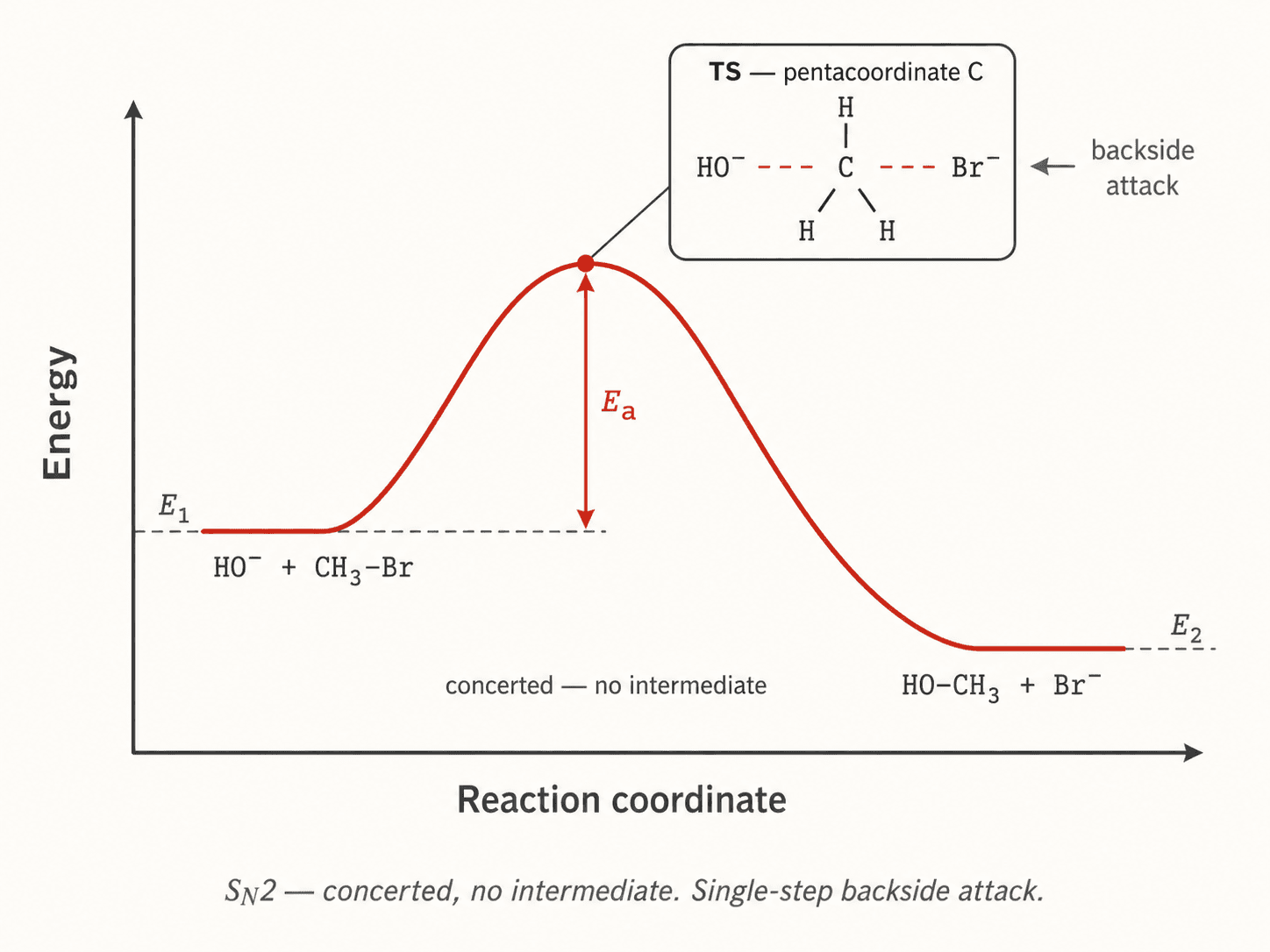
The nucleophile attacks the back face of the carbon bearing X (backside attack, 180° from X). The Nu–C bond forms simultaneously with the breaking of the C–X bond. There is no intermediate: a single transition state (TS).
Characteristics: - Second-order rate law: v = k[R–X][Nu⁻]. - Walden inversion: if the carbon is asymmetric, configuration inverts from R to S (or vice versa) — like an umbrella turning inside out. - Favoured with primary alkyl halides (low steric hindrance) and strong nucleophiles (CN⁻, HO⁻, HS⁻…).
SN2 vs SN1: a first look
Substitution can also follow an SN1 mechanism (two steps: ionisation → attack) proceeding through a carbocation. In SN1: - First-order kinetics: v = k[R–X] (nucleophile concentration does not appear). - Favoured with tertiary alkyl halides (stable tertiary carbocation) and polar protic solvents. - Stereochemistry is racemised (R and S mixture).
This will be detailed in your first-year or preparatory chemistry course.
Tips for drawing a mechanism
1. Identify electron-rich sites (nucleophiles: lone pairs, π bonds) and electron-poor sites (electrophiles: + charges, δ+ carbons). 2. Draw curved arrows from rich to poor regions. 3. Check charge conservation and electron count at each step. 4. Verify that intermediates are reasonable (no pentavalent carbon!).
Finished this lesson?