What are spectroscopies for?
Synthesising a molecule is not enough: you must also prove its structure. The two most widely used spectroscopic tools in organic chemistry are infrared (IR) spectroscopy and nuclear magnetic resonance (NMR). IR reports on the functional groups present; proton NMR reveals the chemical environment of each hydrogen. Used together, they allow identification of almost all common organic molecules.
Infrared (IR) spectroscopy
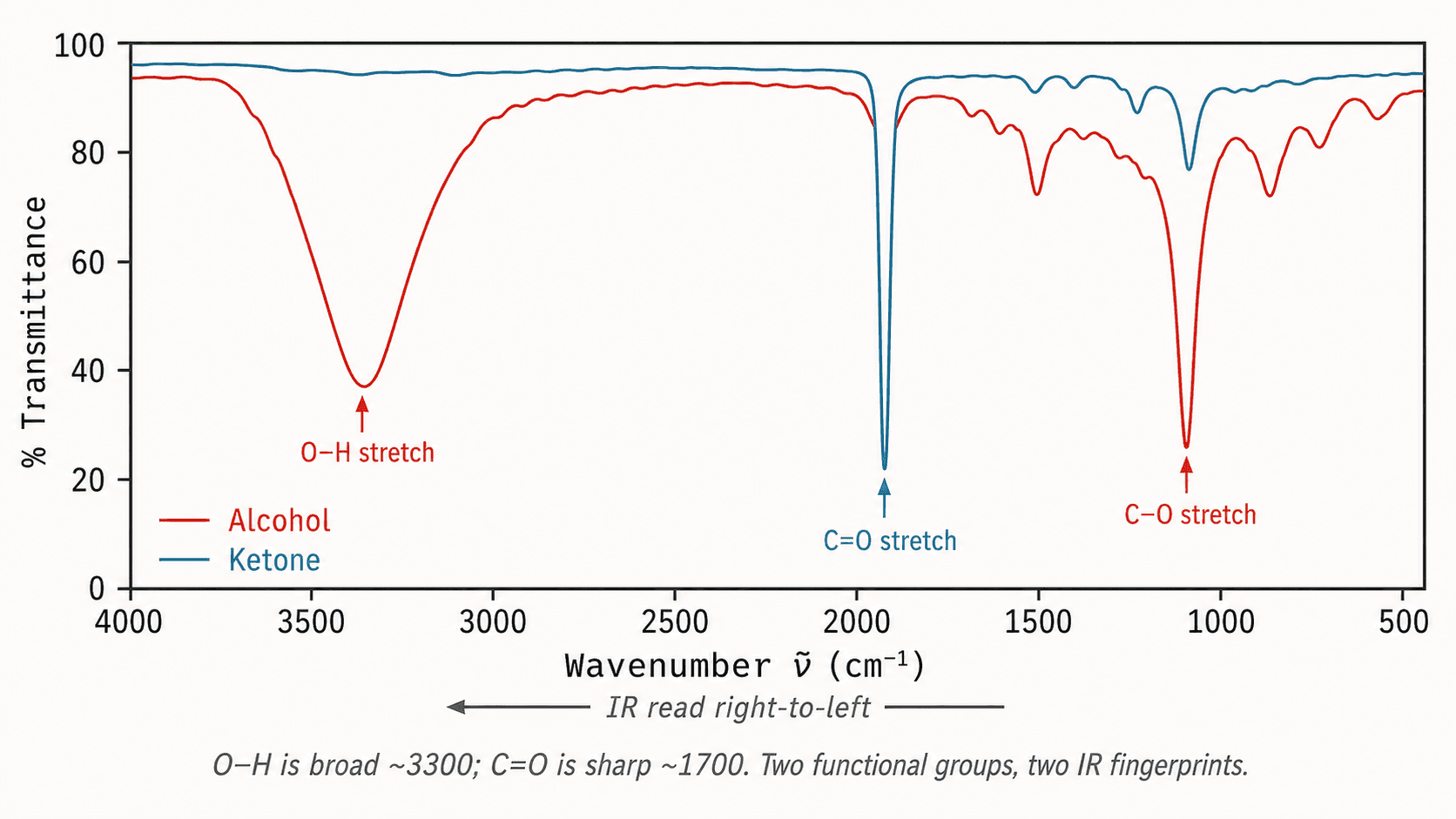
Chemical bonds vibrate (stretching, bending). When the frequency of IR radiation matches a bond's vibration frequency, the molecule absorbs it — this is the IR principle.
An IR spectrum plots transmittance (%) vs wavenumber ν (in cm⁻¹, from 4000 to 400 cm⁻¹). Characteristic absorption bands identify functional groups:
| Group | Wavenumber (cm⁻¹) | Appearance |
|---|---|---|
| –OH (alcohol, free) | 3580–3650 | Sharp |
| –OH (alcohol, H-bonded) | 3200–3550 | Broad |
| –NH₂ | 3300–3500 | Medium |
| –CH (aliphatic) | 2850–3000 | Medium |
| C=O (ketone) | 1700–1750 | Strong, sharp |
| C=O (acid) | 1700–1725 | Strong |
| C–O (alcohol/ester) | 1000–1300 | Strong |
| C=C (alkene) | 1620–1680 | Medium |
The 1500–400 cm⁻¹ region is the molecule's "fingerprint": too complex to interpret atom-by-atom, but unique to each molecule.
Proton NMR — Principle
The proton (¹H) has a nuclear spin of ½. In an external magnetic field B₀, it can align parallel or antiparallel, creating two energy levels. Applying a radiofrequency RF at the Larmor frequency causes resonance — absorption of radiation and a transition between levels. The exact frequency depends on the chemical environment of the proton (neighbouring electrons partially shield the field).
Chemical shift (δ)
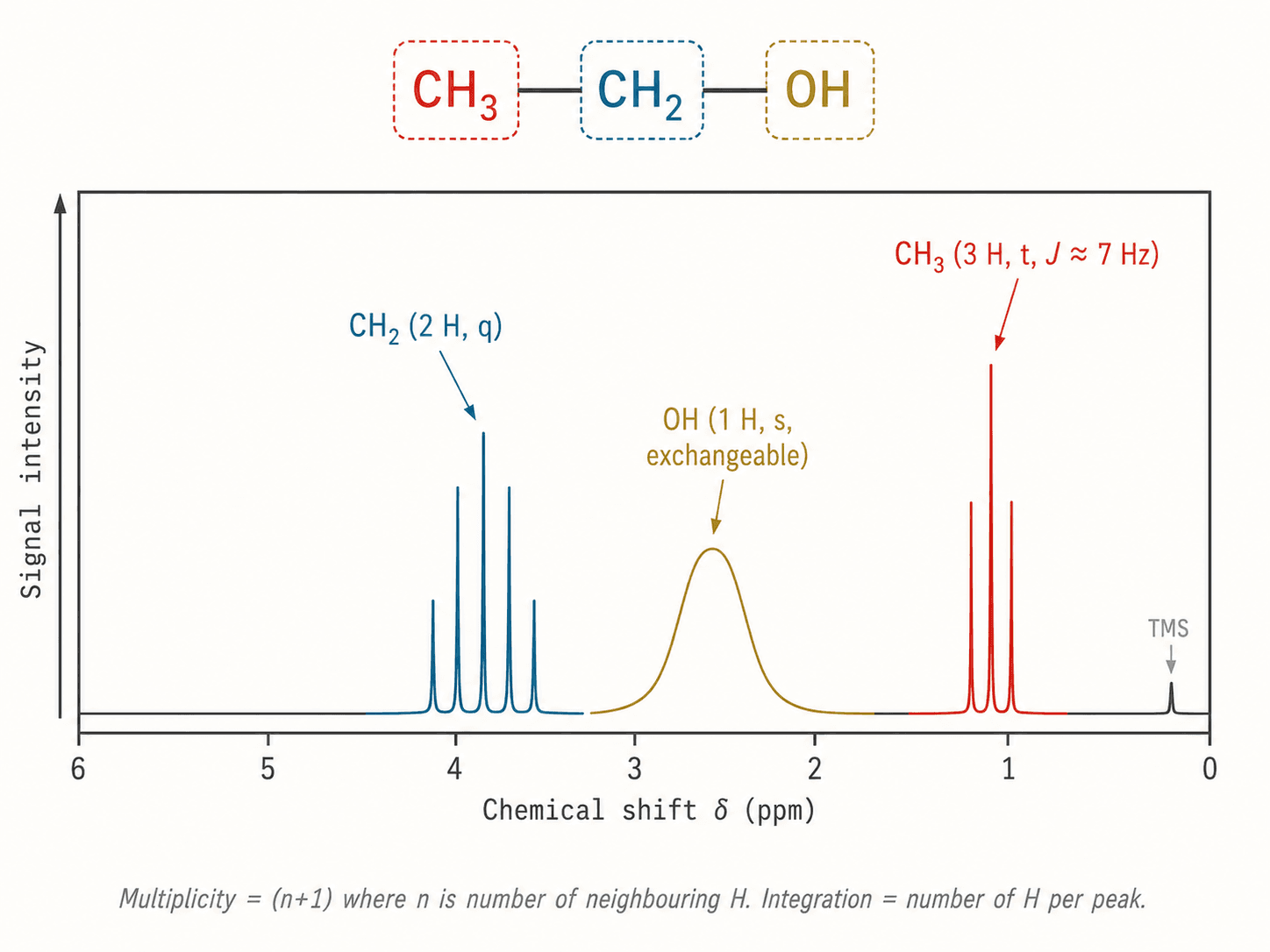
The chemical shift δ (in parts per million, ppm) is the difference between the resonance frequency of the studied proton and a reference (TMS, δ = 0). The more deshielded a proton (electronegative neighbourhood), the larger its δ (towards higher ppm).
| Proton type | δ (ppm) |
|---|---|
| R–CH₃ (alkyl) | 0.8–1.0 |
| –C–CH₂– | 1.2–1.4 |
| –C=C–H (alkene) | 4.5–6.5 |
| –CHO (aldehyde) | 9.0–10.0 |
| –COOH | 10–12 |
| Ar–H (aromatic) | 6.5–8.5 |
Multiplicity and coupling (n+1 rule)
Neighbouring protons (on adjacent carbons) couple to each other via coupling constant J. A proton with n equivalent neighbours appears as a multiplet of n+1 lines: - 0 neighbours → singlet (s) - 1 neighbour → doublet (d) - 2 neighbours → triplet (t) - 3 neighbours → quartet (q)
Example: in ethanol CH₃-CH₂-OH, the –CH₃ group (3H) appears as a triplet (2 CH₂ neighbours) and –CH₂ appears as a quartet (3 CH₃ neighbours).
The integral of the peak is proportional to the number of protons it represents.
Reading a simple spectrum: method
1. Count distinct signals → number of non-equivalent proton environments. 2. Measure integrals → proton ratio per signal. 3. Read δ values → type of proton (alkyl, vinyl, aldehyde…). 4. Analyse multiplicity → number of neighbours. 5. Cross-check with the IR spectrum to confirm the functional group.
Finished this lesson?