Definition of reaction rate
The reaction rate reflects how quickly reactant concentrations decrease and product concentrations increase over time.
For the reaction a A + b B → c C + d D, the volumetric rate v (in mol·L⁻¹·s⁻¹) is defined as: v = -(1/a) d[A]/dt = -(1/b) d[B]/dt = (1/c) d[C]/dt = (1/d) d[D]/dt
The minus signs for reactants ensure that v is always positive (reactant concentrations decrease).
The rate is not constant: it generally decreases over time as reactants are consumed.
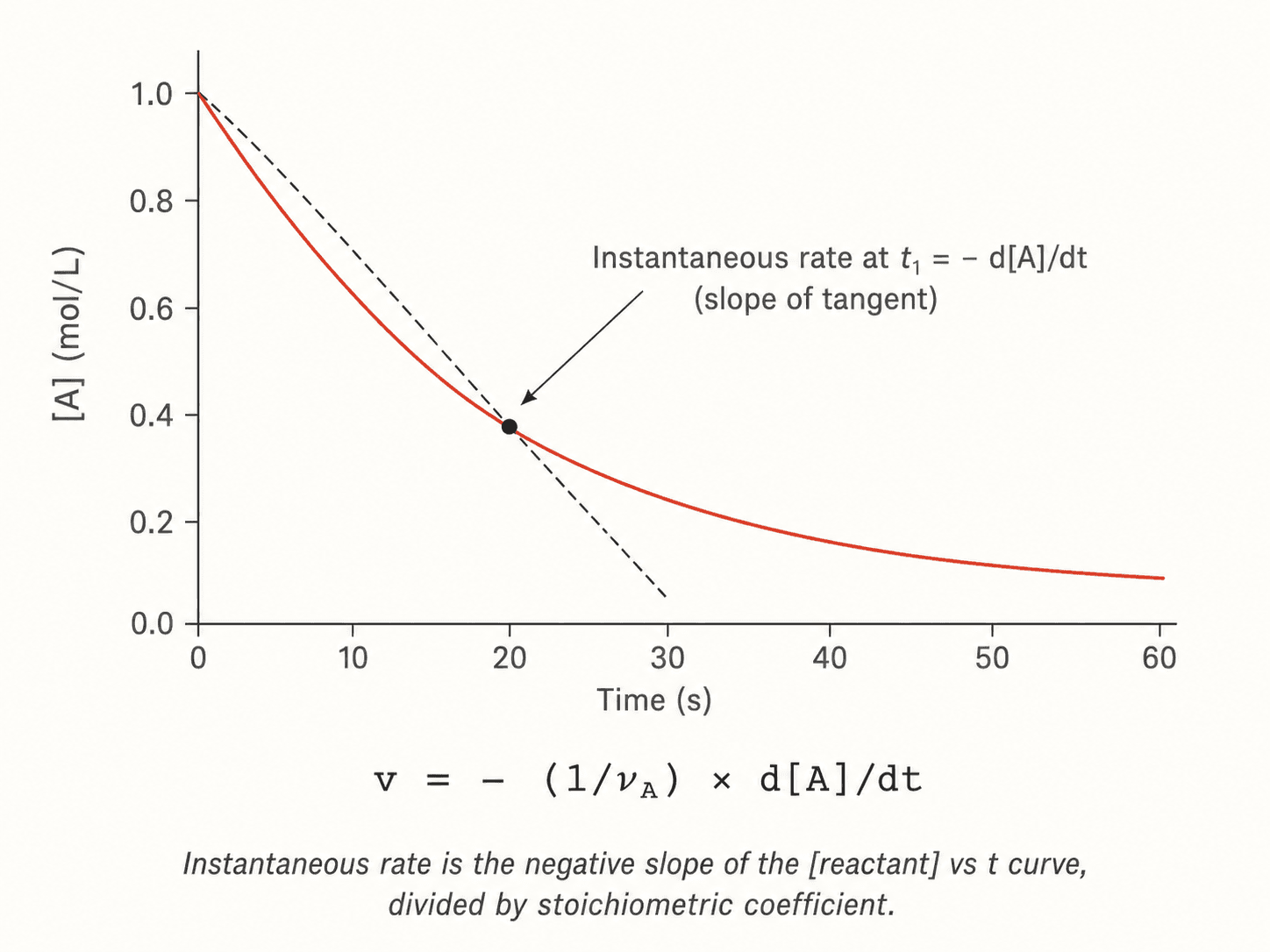
Instantaneous and average rate
- Instantaneous rate at time t: slope of the tangent to the A curve divided by a (with appropriate sign).
- Average rate between t₁ and t₂: Δ[A]/(a × Δt).
The rate is maximum at the start of the reaction (maximum concentrations) and tends to zero at equilibrium or at the end of the reaction.
Kinetic monitoring by conductimetry
Conductimetry measures the conductance G (or conductivity σ) of the solution, which depends on the nature and concentration of ions.
Principle: if the reaction consumes or produces ions with different molar conductivities, the solution conductivity changes over time. σ(t) is related to A by a linear relationship (calibration).
Example — reaction between OH⁻ and ethyl ethanoate: CH₃COOC₂H₅ + OH⁻ → CH₃COO⁻ + C₂H₅OH
OH⁻ (high molar conductivity) is consumed; CH₃COO⁻ (lower conductivity) is formed. Conductivity decreases over time, allowing v to be tracked.
Kinetic monitoring by spectrophotometry
Spectrophotometry measures the absorbance A of a solution at a chosen wavelength λ. The Beer-Lambert law states: A = ε · l · C
where ε is the molar extinction coefficient (L·mol⁻¹·cm⁻¹), l the optical path length (cm), and C the concentration (mol·L⁻¹).
If the reactant (or product) absorbs at λ, A(t) is proportional to its concentration. Plotting A(t) gives C(t), then v(t).
Example: decolourisation of a coloured indicator (methylene blue, potassium permanganate KMnO₄).

Factors affecting the rate
The rate of a reaction depends on several factors:
- Reactant concentration: generally, higher concentration → higher v (rate law, see next lesson).
- Temperature: increasing T speeds up the reaction (Arrhenius law). Empirical rule: v roughly doubles every 10 °C.
- Catalyst: lowers activation energy, increases rate without changing equilibrium.
- Contact surface: for heterogeneous reactions (solid-liquid, solid-gas), larger surface area accelerates the reaction (powder vs large crystals).
- Solvent and pressure: secondary effects depending on reaction type.
Finished this lesson?