3D Bohr-model representation of the Palladium atom (symbol Pd, atomic number Z=46). Electron shell configuration: 2, 8, 18, 18 electrons.
Scroll to activate 3D
Bohr model · educational
Bohr model of palladium
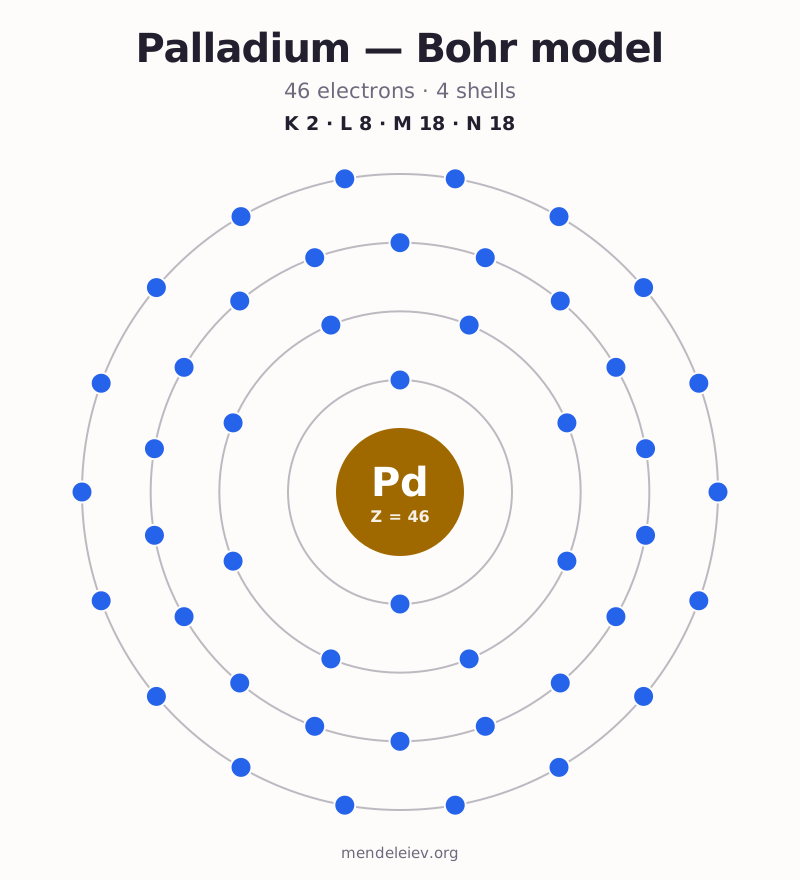
Palladium (Pd) has 46 electrons, spread over 4 shells. The diagram places them on circles around the nucleus, from the K shell — the closest — outward.
| Shell | Electrons |
|---|---|
| K (n = 1) | 2 |
| L (n = 2) | 8 |
| M (n = 3) | 18 |
| N (n = 4) | 18 |
The Bohr model is a teaching picture: electrons do not travel in circular orbits, but the number of electrons per shell is exact.
Related lesson
Catalysis
Catalyst, activation energy, energy profile. Homogeneous, heterogeneous, enzymatic catalysis.
11 minElectron configuration
Full1s² 2s² 2p⁶ 3s² 3p⁶ 3d¹⁰ 4s² 4p⁶ 4d¹⁰
Short[Kr] 4d¹⁰
Valence electrons10
KLMNOPQ shells
K2
L8
M18
N18
Electronegativity
Pauling2.2
Allen1.58
Mulliken (eV)—
Atomic radii
Empirical140 pm
Calculated169 pm
Covalent139 pm
Van der Waals163 pm
Ionic radii (Shannon-Prewitt)
+286 pm
Successive ionisation energies
I₁804.4 kJ/mol
I₂1870 kJ/mol
I₃3177 kJ/mol
Electron affinity53.7 kJ/mol
Oxidation states
0+1+2+3+4
Bold states = most common.
Warm-up
Palladium — do you remember?
3 questions on this page. The right answer shows every time, and nothing is asked of you to play.
No account · one minute