The twelve principles of green chemistry
Green chemistry (Anastas & Warner, 1998) formulates twelve principles to design environmentally respectful and economically efficient chemical processes. These principles guide design from the molecular stage.
| # | Principle | Key concept |
|---|---|---|
| 1 | Waste prevention | Better not to generate waste than to treat it |
| 2 | Atom economy | Maximise incorporation of reactants into product |
| 3 | Less hazardous synthesis | Avoid toxic intermediates |
| 4 | Safer products | Functionality without toxicity |
| 5 | Safer solvents and auxiliaries | Reduce solvents and auxiliaries (water, scCO₂) |
| 6 | Energy efficiency | Ambient conditions if possible |
| 7 | Renewable feedstocks | Biomass, CO₂ |
| 8 | Reduce derivatives | Avoid unnecessary protecting groups |
| 9 | Catalysis | Catalyst > stoichiometric reagent |
| 10 | Design for degradation | Biodegradable products |
| 11 | Real-time analysis | Monitor during processing |
| 12 | Inherently safer chemistry | Minimise accident potential |
Quantitative metrics: - Atom Economy (AE) = M_product / Σ M_reactants × 100 % - E-factor (Sheldon) = mass of waste / mass of product (ideal: E → 0) - PMI (Process Mass Intensity) = total mass used / mass product (ideal: PMI → 1)
Example: traditional Wittig reaction has AE ~ 40 % (generates Ph₃P=O waste); the HWE (Horner-Wadsworth-Emmons) version with recyclable phosphonate significantly improves AE.
Catalysis: principle and classification
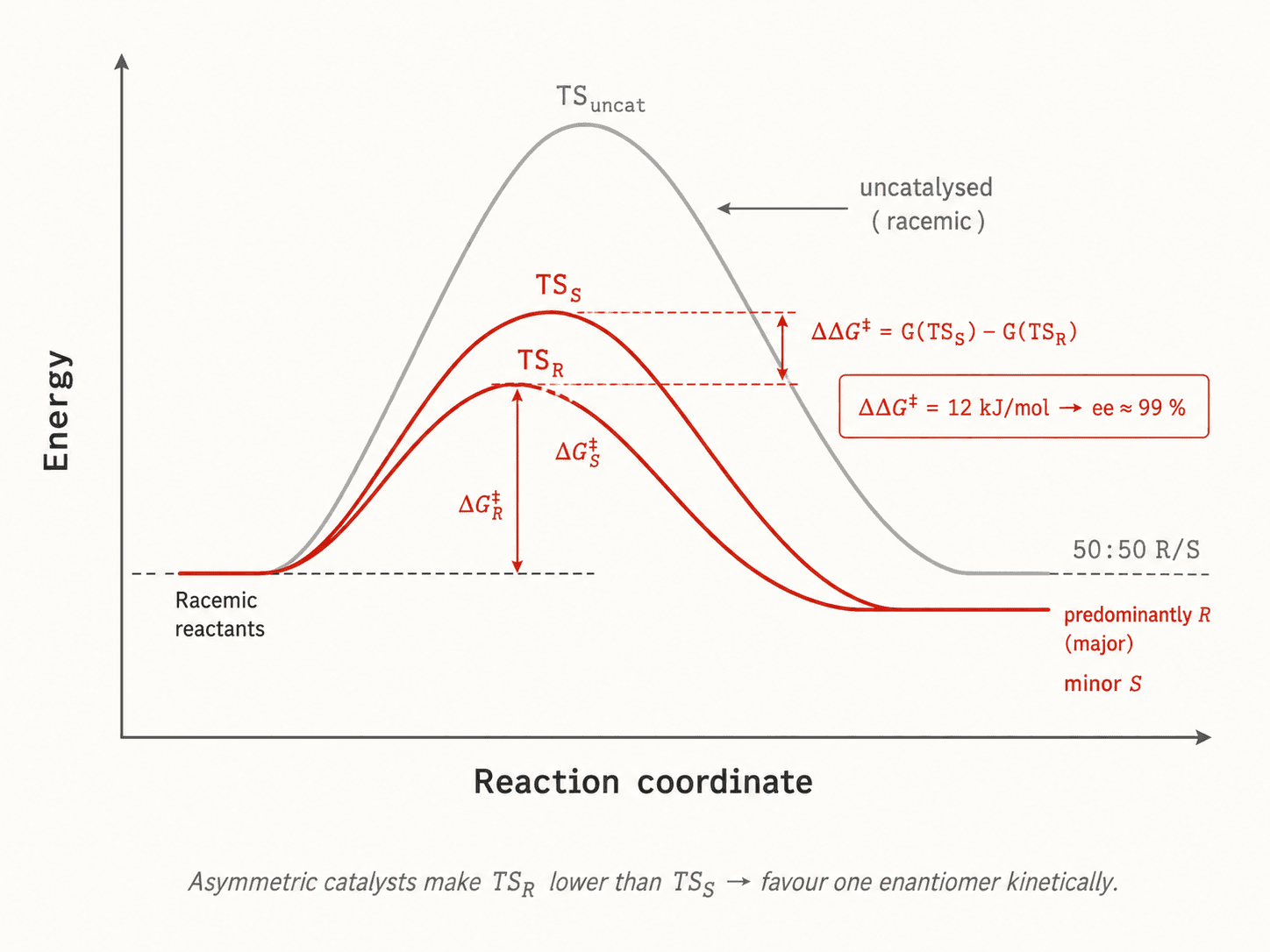
A catalyst accelerates a reaction without being consumed. It lowers the activation energy ΔG‡ by providing an alternative reaction pathway. Catalysis obeys the principle of microscopic reversibility: the catalyst equally accelerates the reverse reaction.
Classification: - Homogeneous catalysis: catalyst and reactants in the same phase (e.g. Rh-BINAP in asymmetric hydrogenation). - Heterogeneous catalysis: solid catalyst, gas/liquid-phase reactants (e.g. Raney-Ni, Pd/C, zeolites). - Organocatalysis: chiral organic molecule as catalyst (e.g. proline in aldolisation). - Biocatalysis: enzymes or whole cells — high selectivity in water at ambient temperature.
Turnover frequency (TOF) = mol product / (mol catalyst × time) and turnover number (TON) = total mol product / mol catalyst measure efficiency and durability.
Stereochemistry and chirality
A chiral molecule is non-superimposable on its mirror image (enantiomer). In biological contexts, two enantiomers can have radically different effects:
- Thalidomide: (R)-enantiomer sedative, (S)-enantiomer teratogenic.
- Ibuprofen: (S)-enantiomer active (NSAID), (R)-enantiomer inactive.
- L-DOPA: only the L-enantiomer is active against Parkinson's disease.
Enantioselective synthesis aims to produce a single enantiomer. Enantiomeric excess measures selectivity:
ee = (|[R] − [S]|) / ([R] + [S]) × 100 %
ee > 99 % is required for most pharmaceutical applications.
Asymmetric catalysis: landmark chiral catalysts
Asymmetric hydrogenation (Noyori, Nobel 2001): The Rh(I)-BINAP complex (2,2'-bis(diphenylphosphino)-1,1'-binaphthyl) catalyses hydrogenation of prochiral alkenes with ee > 95 %. Key mechanism: alkene coordination to metal, then H₂ transfer via a chiral dihydride intermediate.
Sharpless asymmetric epoxidation (Nobel 2001): Ti(O-iPr)₄ / diethyl tartrate (DET or L-DET) / TBHP catalyses epoxidation of allylic alcohols with ee 90–99 %. The Sharpless model predicts the attacked enantioface: the "quadrant" mnemonic.
Organocatalysis (MacMillan & List, Nobel 2021): - Proline: catalyses intramolecular aldolisations (ee up to 96 %) via a chiral enamine. - MacMillan imidazolidinones: LUMO activation through chiral iminium for Diels-Alder cycloadditions. - Advantages: no metal, mild conditions, green solvents, low loading (~10–20 mol%).
| Catalyst | Reaction | Typical ee | Mechanism |
|---|---|---|---|
| Rh-BINAP | Hydrogenation | >95 % | Chiral coordination sphere |
| Ti-tartrate | Sharpless epoxidation | 90–99 % | Facial control by chiral ligand |
| Proline | Aldolisation | 60–96 % | Chiral enamine |
| MacMillan | Asymmetric D-A | >90 % | Iminium activation |
"Organocatalysis has shifted asymmetric synthesis from metal dependence to a more sustainable paradigm." — Benjamin List, Nobel lecture 2021.
Green solvents and sustainable processes
Solvents often represent 80–90 % of the mass of a pharmaceutical process. Preferred green solvents: - Water: non-toxic, abundant, high ΔH_vap (industrial limitation). - Bio-sourced ethanol: biodegradable, renewable. - Supercritical CO₂ (T_c = 31.1 °C, P_c = 73.8 bar): good non-polar solvent, easy separation by depressurisation. - Ionic liquids: near-zero vapour pressure, recyclable — but costly synthesis. - Deep eutectic solvents (DES): HBD/HBA mixtures with low melting point — biodegradable, bio-sourced.
Continuous flow chemistry (flow chemistry) improves heat and mass transfer, reduces solvent volumes, facilitates automation and safety (avoids accumulation of hazardous intermediates). It is now indispensable in the pharmaceutical and fine chemical industries.
Finished this lesson?