Symmetry and symmetry groups
Group theory is the mathematical language of molecular symmetry. A symmetry group is a set of symmetry operations satisfying group axioms (closure, associativity, identity, inverse). For molecules, these operations are:
- E — identity (changes nothing).
- Cₙ — rotation by 2π/n about a principal axis.
- σ — reflection through a plane (σ_h perpendicular to the principal axis, σ_v containing it, σ_d bisecting).
- i — inversion through the centre.
- Sₙ — improper rotation (Cₙ rotation followed by σ_h).
Molecules are classified into point groups (Schoenflies notation): C_1, C_s, C_i, Cₙ, Cₙᵥ, Cₙₕ, Dₙ, Dₙₕ, Dₙd, T_d, O_h, I_h, K_h, etc.
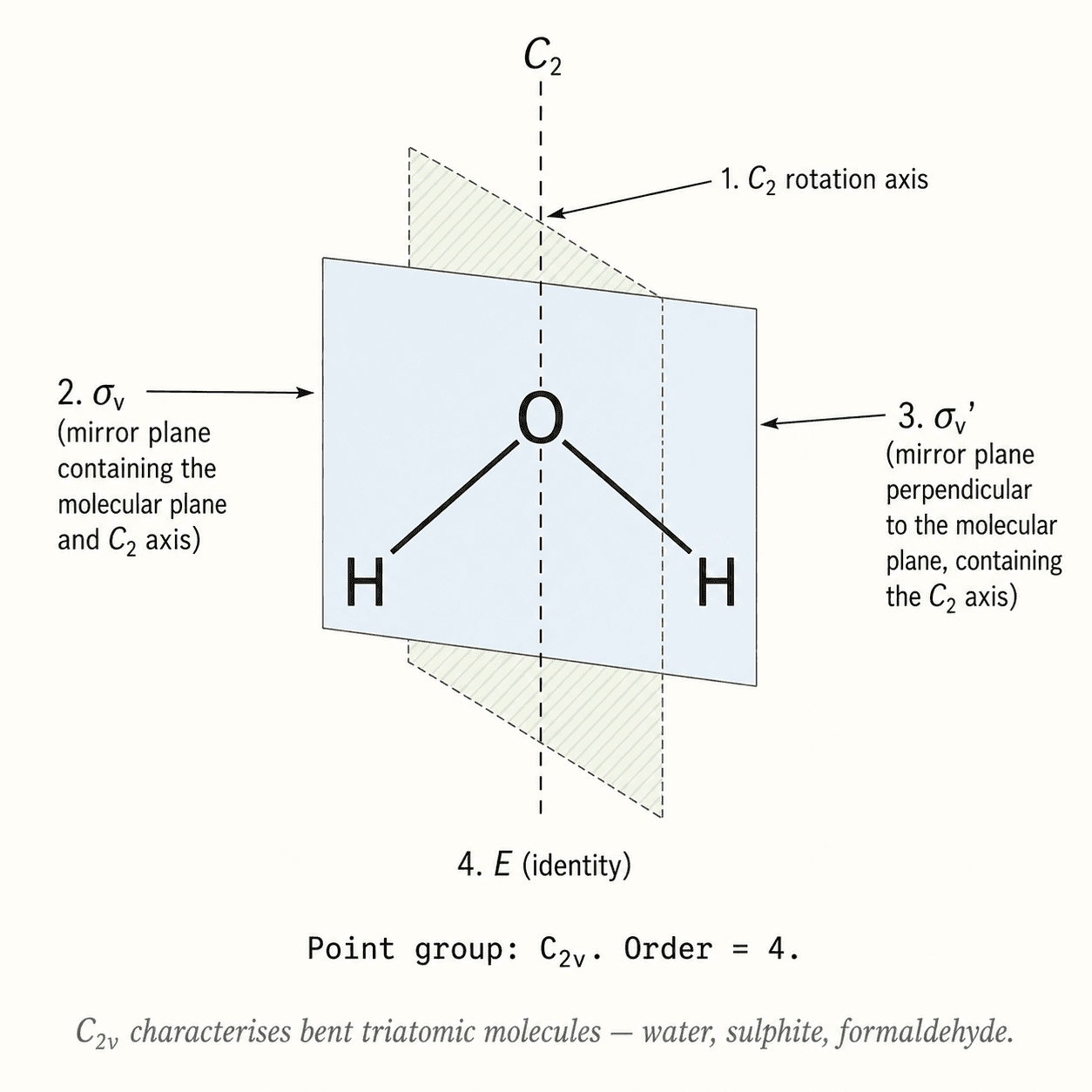
Identifying the point group of a molecule
The systematic flowchart: 1. Linear molecule → C_∞ᵥ or D_∞ₕ. 2. Tetrahedral, cubic, icosahedral → T_d, O_h, I_h. 3. Find the highest-symmetry Cₙ axis → principal axis. 4. n perpendicular C₂ axes present → D groups. 5. σ_h, σ_v planes → suffix h, v, d.
Examples: - H₂O → C₂ᵥ: E, C₂, σᵥ(xz), σᵥ'(yz) - NH₃ → C₃ᵥ: E, 2C₃, 3σᵥ - Benzene (C₆H₆) → D₆ₕ: E, 2C₆, 2C₃, C₂, 3C₂', 3C₂'', i, 2S₆, 2S₃, σₕ, 3σᵥ, 3σd - CH₄ → T_d: E, 8C₃, 3C₂, 6S₄, 6σd
Character tables
Each point group is described by its character table. Here is the C₂ᵥ table:
| C₂ᵥ | E | C₂ | σᵥ(xz) | σᵥ'(yz) | Linear functions | Quadratic functions |
|---|---|---|---|---|---|---|
| A₁ | 1 | 1 | 1 | 1 | z | x², y², z² |
| A₂ | 1 | 1 | −1 | −1 | R_z | xy |
| B₁ | 1 | −1 | 1 | −1 | x, R_y | xz |
| B₂ | 1 | −1 | −1 | 1 | y, R_x | yz |
The irreducible representations (A₁, A₂, B₁, B₂) are the fundamental building blocks. The character χ(R) is the trace of the matrix representing operation R. The orthogonality relation guarantees their independence.
Applications to molecular orbitals
Molecular orbitals must belong to an irreducible representation of the molecule's point group. The procedure:
1. Choose the basis of atomic orbitals. 2. Compute the reducible representation Γ under all symmetry operations. 3. Decompose Γ = n₁Γ₁ + n₂Γ₂ + … into irreducibles using the reduction formula:
n_i = (1/h) Σ_R g(R) · χ(R) · χᵢ(R)
where h is the group order and g(R) the number of operations in class R.
4. Only orbitals of the same symmetry (same irreducible representation) can combine. This explains why in water, the O 2p_z orbital and the symmetry-adapted 1s(H₁ + H₂) combination form A₁ MOs, while O 2p_y is a non-bonding B₂ orbital.
"Symmetry is the poetry of the laws of nature." — Hermann Weyl, Symmetry, 1952.
Normal vibrational modes and selection rules
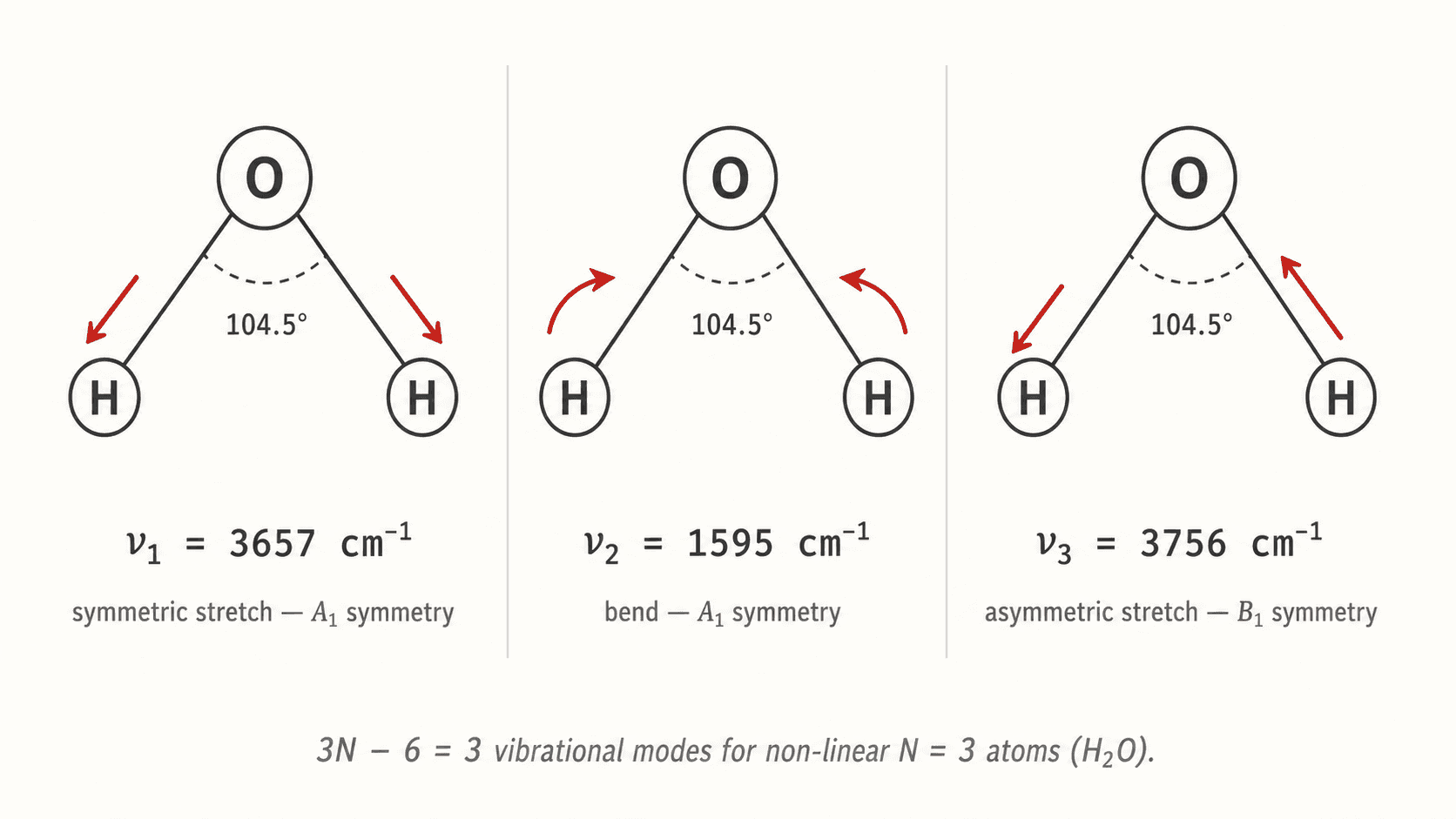
The number of normal modes is 3N−6 for a non-linear molecule (3N−5 for linear). Their symmetry determines spectroscopic activity:
- IR active: the mode belongs to an irreducible representation carrying a translational component (x, y, z in the character table).
- Raman active: the mode belongs to a representation carrying a quadratic component (x², xy, etc.).
For H₂O (C₂ᵥ, 3 modes: 2A₁ + B₁, in the Cotton convention where the molecular plane is σᵥ — convention used by the figure below): | Mode | Symmetry | IR | Raman | Description | |------|----------|----|-------|-------------| | ν₁ (3657 cm⁻¹) | A₁ | ✓ | ✓ | Symmetric O-H stretch | | ν₂ (1595 cm⁻¹) | A₁ | ✓ | ✓ | H-O-H scissor bend | | ν₃ (3756 cm⁻¹) | B₁ | ✓ | ✓ | Antisymmetric O-H stretch |
Note: the IUPAC convention swaps σᵥ and σᵥ' (molecular plane = σᵥ(xz)), in which case ν₃ becomes B₂ and the decomposition reads 2A₁ + B₂. Both conventions coexist in the literature.
The mutual exclusion rule applies to centrosymmetric molecules (D₂ₕ, D₆ₕ …): a mode cannot be simultaneously IR and Raman active.
Group theory and spectrochemistry
In coordination chemistry, group theory explains the lifting of d-orbital degeneracy in a ligand field. In an octahedral complex (O_h), the five d orbitals decompose as:
Γ_d = e_g + t₂g
- e_g (d_{z²}, d_{x²−y²}): point towards ligands, energy +0.6 Δ_o
- t₂g (d_{xy}, d_{xz}, d_{yz}): point between ligands, energy −0.4 Δ_o
This decomposition, derived from symmetry alone, underpins crystal field theory and the first level of MO theory for complexes.
Finished this lesson?