Beyond the covalent bond
Supramolecular chemistry — defined by Jean-Marie Lehn as "chemistry beyond the molecule" — studies molecular assemblies held together by non-covalent interactions. These interactions are individually weak (1–50 kJ/mol) but collectively powerful through cooperativity and structural complementarity.
The main interactions: | Interaction | Energy (kJ/mol) | Directionality | Example | |-------------|-----------------|----------------|---------| | Hydrogen bond | 4–120 | Strong | DNA, proteins | | Metal coordination | 40–400 | Strong | MOFs, cages | | π–π (stacking) | 2–10 | Moderate | DNA base pairs | | Ion–dipole | 10–50 | Moderate | Crowns + cations | | Van der Waals | 0.1–5 | Weak | Gecko, graphite | | Hydrophobic | 1–40 | Entropic | Micelles, enzyme pocket |
"Supramolecular chemistry is the chemistry of intermolecular interactions." — Jean-Marie Lehn, Nobel Prize 1987.
Molecular recognition: complementarity and selectivity
Molecular recognition results from geometrical and electronic matching between a host (receptor) and a guest (substrate). Fischer's lock-and-key principle is enriched by induced fit (Koshland): the host can reorganise to optimise contact.
The association constant K_a = [HG] / ([H][G]) quantifies affinity. For practical applications: - Sensors and sequencers: K_a ~ 10⁶–10¹² M⁻¹ - Catalysis: moderate K_a + fast exchange (Michaelis-Menten principle) - Membrane transport: ion selectivity (Na⁺ vs K⁺)
Selectivity is expressed as K_a(target guest) / K_a(competing guest). Crown ethers (18-crown-6) discriminate K⁺ from Na⁺ through the geometrical match between cavity diameter (~2.6–3.2 Å) and ionic radius.
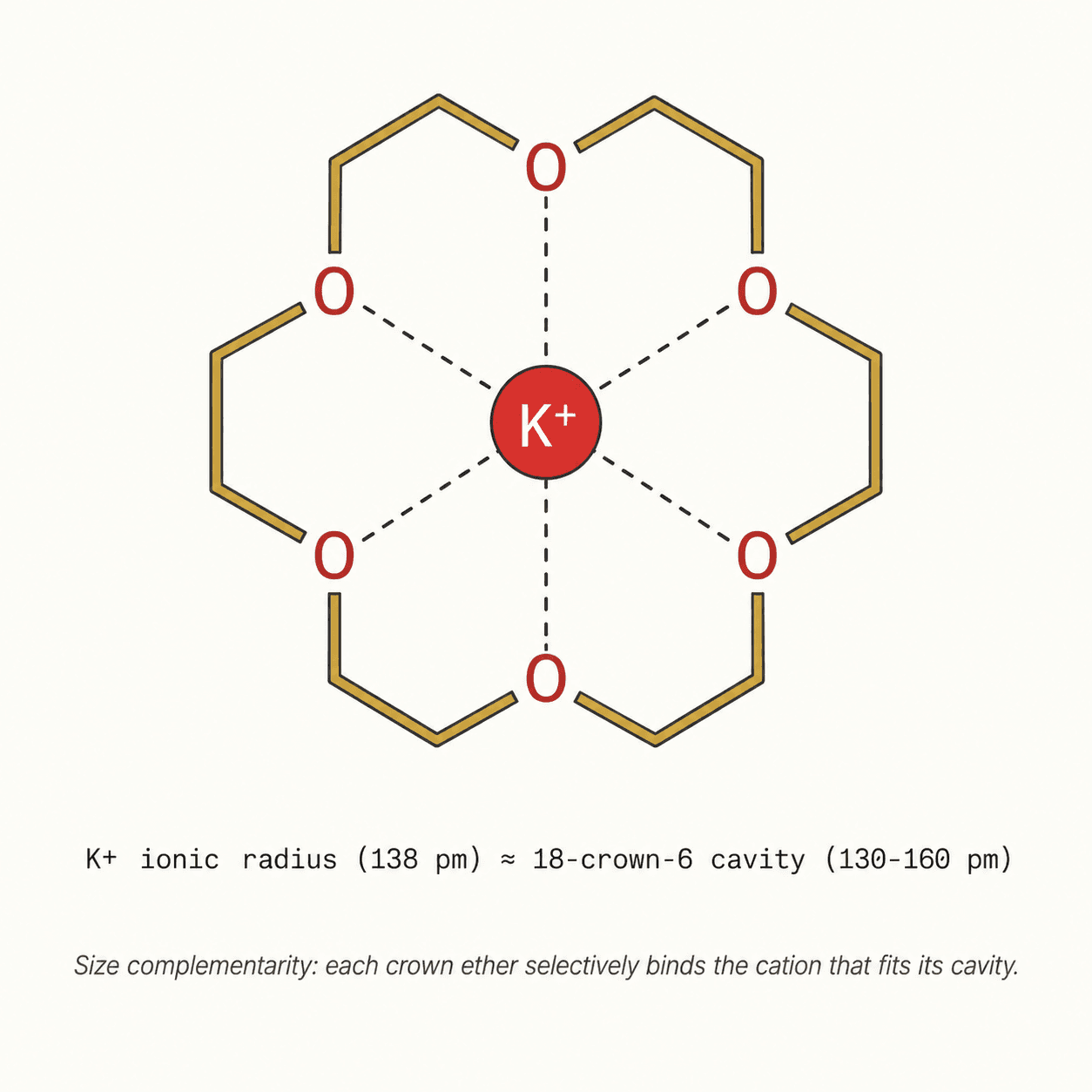
Self-assembly
Self-assembly is the spontaneous formation of ordered structures from components that organise without external direction. It is driven by Gibbs free energy minimisation: ΔG = ΔH − TΔS < 0.
Hierarchical examples: - Micelles: amphiphiles (soaps) → spherical aggregates in water (ΔH ≈ 0, ΔS > 0 — hydrophobic effect). - Lipid bilayers: self-organised cell membranes. - DNA double helix: 3 × 10⁹ base pairs held by ~2 kcal/mol per base pair (π-stacking + H-bonds). - Molecular capsules: 3D cages formed by metal-ligand coordination (cavities of 10–1000 ų). - Self-assembled monolayers (SAMs): thiols on gold — ordered monomolecular carpets.
Self-assembly requires components with encoded structural information (supramolecular program, Lehn's concept). Assembly errors are corrected by the reversibility of non-covalent interactions.
Host-guest complexes: from cyclodextrin to carcerands
Cyclodextrins (α, β, γ) are cyclic oligosaccharides composed of 6, 7, or 8 glucopyranose units. Their truncated-cone cavity (inner diameter 4.7–8.3 Å) is hydrophobic, enabling encapsulation of hydrophobic organic molecules in water. Applications: drug solubilisation (ibuprofen/β-cyclodextrin), food aroma de-bittering, remediation.
Calixarenes (phenolic macrocycles) and cucurbiturils (molecular pumpkins) offer rigid cavities with high selectivity for organic cations.
Carcerands (Cram, Nobel 1987) are covalent capsules in which the guest molecule is permanently trapped — chemistry in a "molecular prison".
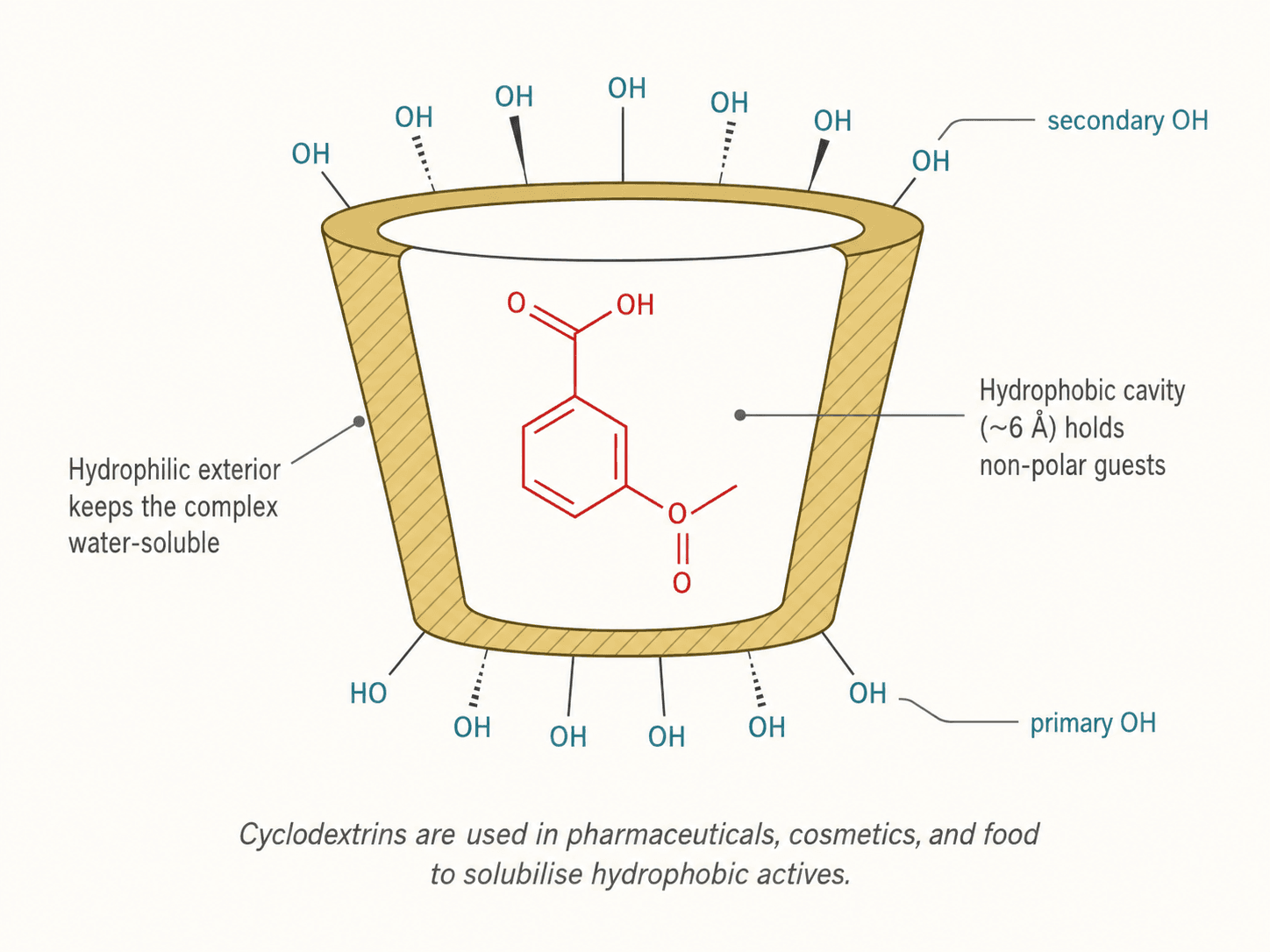
Metal-Organic Frameworks (MOFs)
Metal-Organic Frameworks (MOFs) are porous crystalline solids built by coordination between metal nodes (SBU clusters) and polytopic organic linkers. Their remarkable properties:
- Specific surface area: up to 7000 m²/g (MOF-177, Zn₄O(BTB)₂, exceeding activated carbon).
- Tunable porosity: pore diameter from 3 Å to 10 nm depending on linker.
- Post-synthetic functionalisation: grafting of functional groups into the cavity.
Emerging industrial applications: - H₂ and CO₂ storage: carbon capture (CCS). - Drug delivery: stimulus-controlled release (pH, light). - Asymmetric heterogeneous catalysis: combining zeolite selectivity and MOF modularity. - Gas separation: zeolitic imidazolate frameworks (ZIF-8) for CO₂/CH₄.
Supramolecular chemistry thus connects isolated molecules to functional materials, from drugs to environmental sensors.
Finished this lesson?