From crystals to solid-state chemistry
Solid-state chemistry studies the structure, synthesis, and properties of crystalline and amorphous materials. At the atomic scale, a crystal is a three-dimensional periodic arrangement of atoms, ions, or molecules. This periodicity underlies virtually all physical properties: electrical conductivity, optical behaviour, and mechanical strength.
X-ray crystallography (XRD) is the primary technique for elucidating structures at the atomic scale. Since von Laue's discovery of diffraction (1912) and Bragg's law (1913), thousands of structures have been solved — from minerals to proteins.
Bravais lattices — the 14 fundamental structures
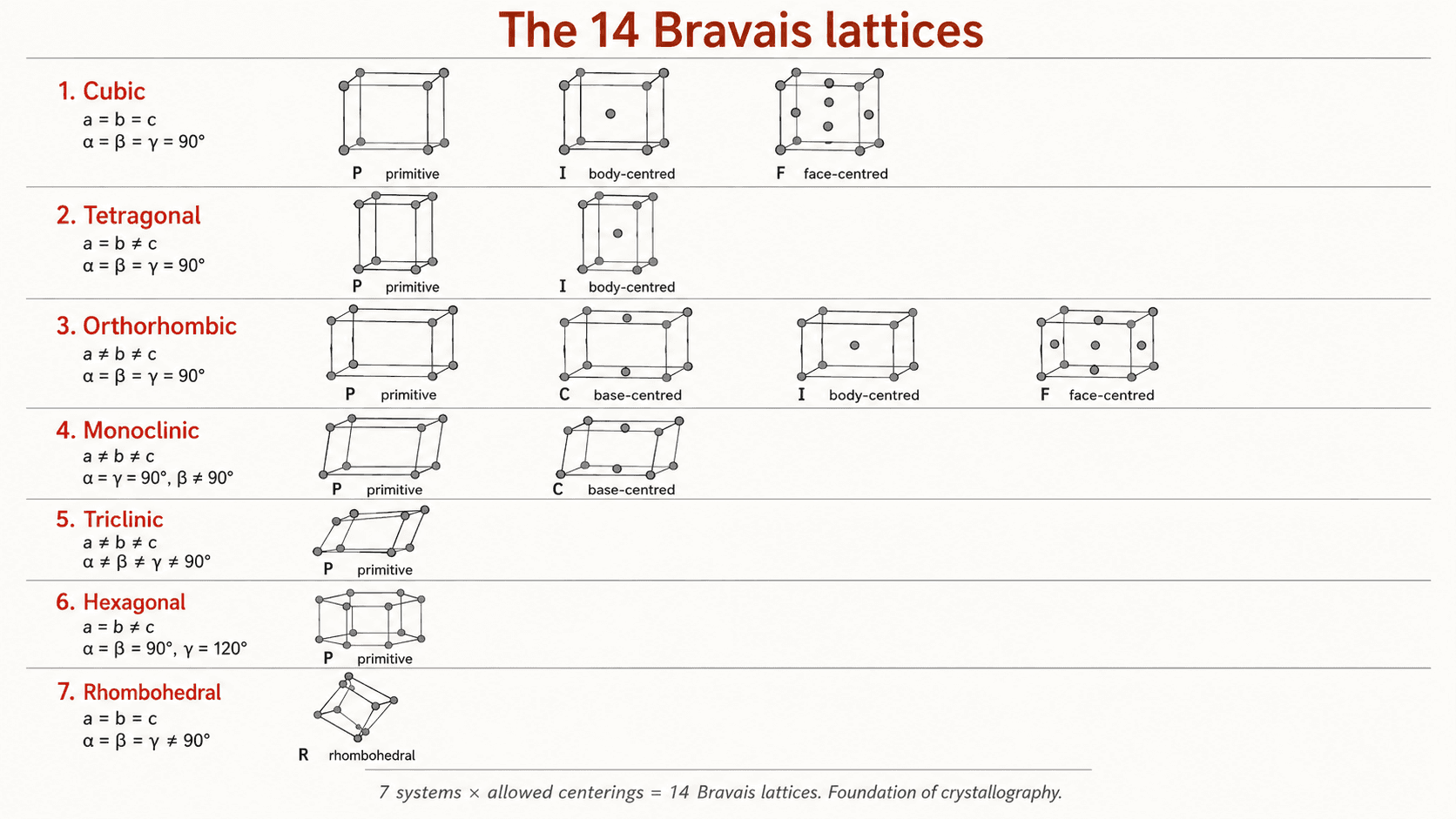
A Bravais lattice is the set of all points in a periodic crystal, defined by three basis vectors a, b, c and angles α, β, γ. There are exactly 14 Bravais lattices grouped into 7 crystal systems:
| System | Conditions | Examples |
|---|---|---|
| Cubic | a = b = c, α = β = γ = 90° | NaCl, Fe, Cu |
| Tetragonal | a = b ≠ c, α = β = γ = 90° | SnO₂, TiO₂ |
| Orthorhombic | a ≠ b ≠ c, α = β = γ = 90° | BaSO₄, olivine |
| Hexagonal | a = b ≠ c, α = β = 90°, γ = 120° | Graphite, ZnO |
| Rhombohedral | a = b = c, α = β = γ ≠ 90° | Calcite, Al₂O₃ |
| Monoclinic | a ≠ b ≠ c, α = γ = 90° ≠ β | Gypsum, sucrose |
| Triclinic | a ≠ b ≠ c, α ≠ β ≠ γ | Feldspars |
The 14 lattices include centring modes: primitive (P), face-centred (F), body-centred (I), and base-centred (C).
The unit cell and its parameters
The unit cell is the smallest parallelepiped that, by repeated translation, reproduces the entire crystal. Key characteristics:
- Lattice parameters: a, b, c (Å or pm) and α, β, γ (°).
- Atoms per unit cell: a corner atom counts 1/8, an edge atom 1/4, a face atom 1/2, an interior atom 1.
- Packing fraction: for FCC τ = π/(3√2) ≈ 74.0%; for BCC τ = π√3/8 ≈ 68.0%.
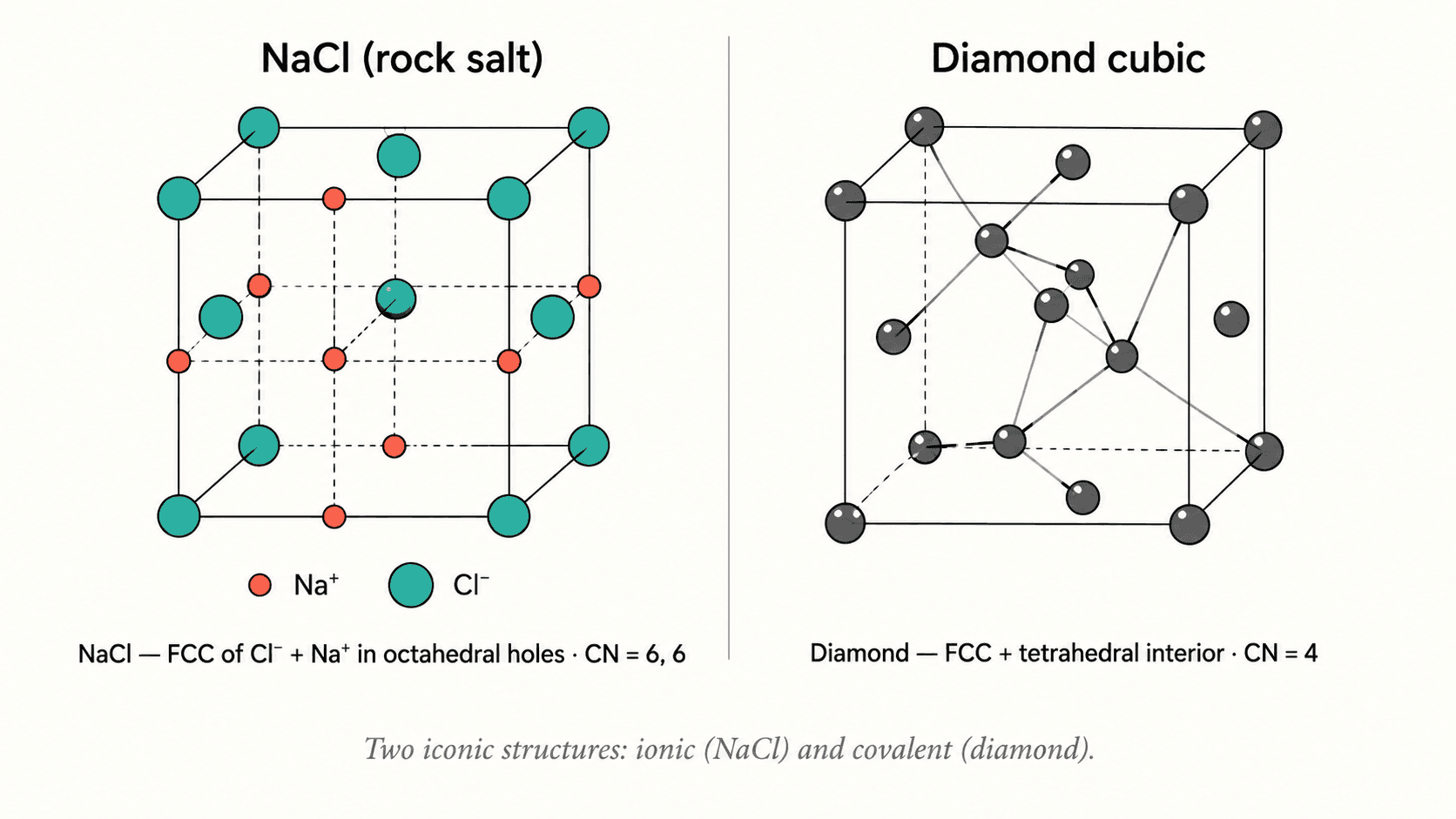
Example: sodium chloride (rock salt, NaCl) crystallises in a face-centred cubic system with alternating Na⁺ / Cl⁻ ions. The unit cell contains 4 NaCl pairs (a ≈ 5.64 Å, coordination number 6:6).
Miller indices — notation for planes and directions
Miller indices (h k l) describe a family of equidistant crystal planes. The procedure: 1. Find the intercepts of the plane on the a, b, c axes (in unit-cell units). 2. Take the reciprocals. 3. Reduce to the smallest integers with no common factor.
A negative index is written with an overbar: h̄ (read "h bar").
The interplanar spacing d_{hkl} for a cubic lattice with parameter a is:
1 / d²_{hkl} = (h² + k² + l²) / a²
Bragg's law links this spacing to the X-ray wavelength λ and glancing angle θ:
n λ = 2 d sin θ
A diffractogram (XRD pattern) is a series of peaks at characteristic 2θ angles that allows determination of lattice parameters and phase identification.
Structural types — from NaCl to semiconductors
Rock salt (NaCl) structure: FCC lattice of Cl⁻ with Na⁺ occupying all octahedral sites. Coordination 6. Found in MgO, FeO, NiO.
CsCl structure: simple cubic lattice of Cl⁻, Cs⁺ at the centre. Coordination 8:8. Found in CsBr, CsI, some alloys.
Fluorite structure (CaF₂): FCC lattice of Ca²⁺, F⁻ in all tetrahedral sites. Coordination 8:4. UO₂ has the same structure.
Semiconductors: silicon and germanium crystallise in the diamond cubic structure (FCC, each atom in a tetrahedral site). The band gap Eg determines electronic properties: Si Eg = 1.12 eV, Ge Eg = 0.67 eV. n-doping (P, As) or p-doping (B, Al) introduces controlled charge carriers.
Crystal defects and properties
Real crystals are imperfect. Point defects (Schottky: paired cation + anion vacancies; Frenkel: ion displaced to interstitial site) influence ionic conductivity (batteries, fuel cells). Dislocations (line defects) govern the plasticity of metals.
Sodium chloride typically contains ~10¹⁷ Schottky defects per cm³ at room temperature — which explains its non-zero ionic conductivity even in the solid state.
Finished this lesson?