Definition and position in the periodic table
Transition metals (d block) occupy groups 3 to 12 of the periodic table, across periods 4 to 7. Their defining feature is a partially filled d subshell in at least one common oxidation state (zinc Zn, cadmium Cd, and mercury Hg — group 12 — are sometimes excluded because their d subshell is full at the +2 state).
The d block contains 38 elements: the 3d series (Sc to Zn), 4d (Y to Cd), 5d (Hf to Hg) and 6d (Rf to Cn) — lutetium and lawrencium being assigned to the lanthanides and actinides respectively.
Electron configurations — the rule and its exceptions
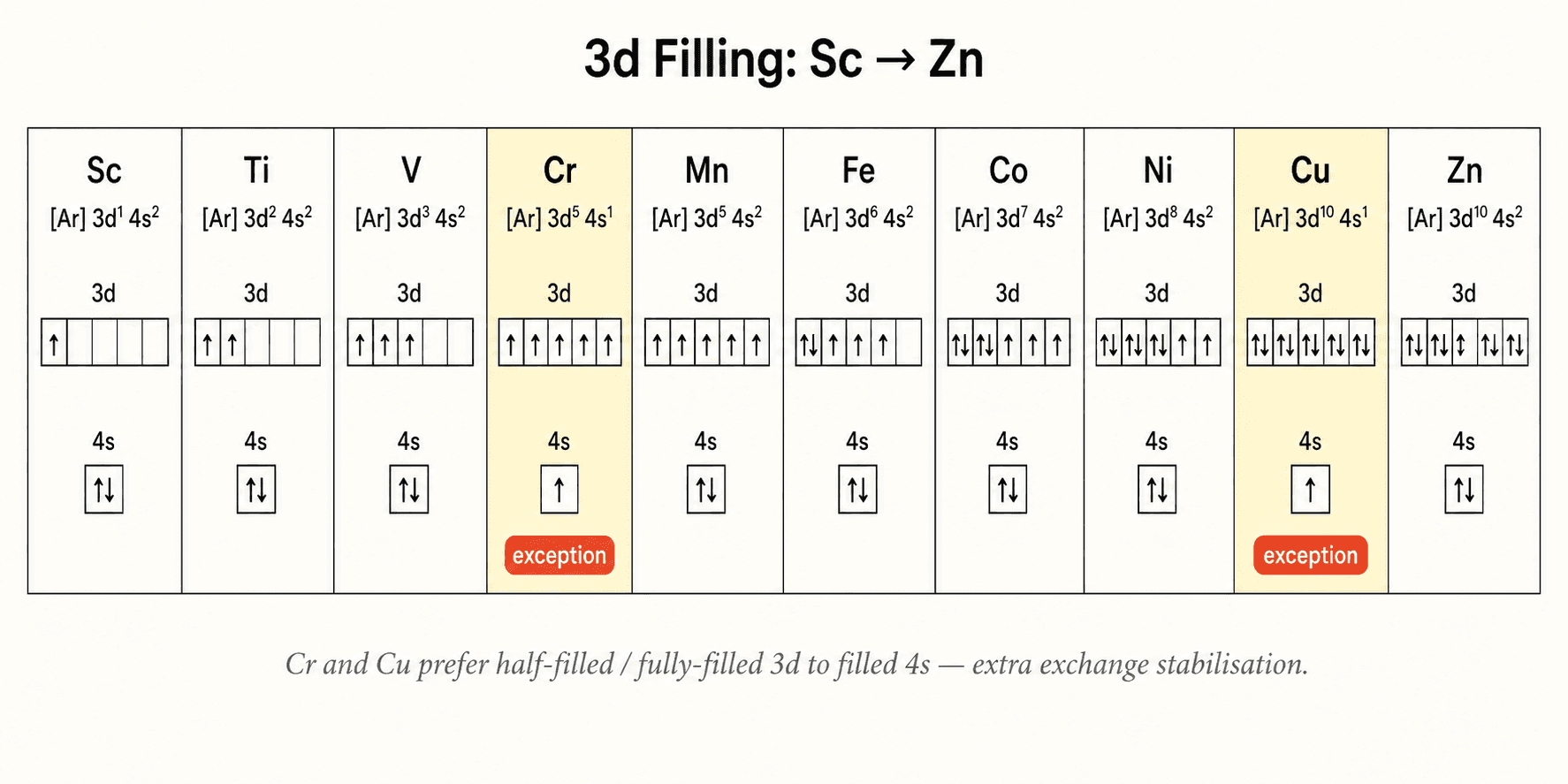
The Aufbau (Madelung) principle predicts ns before (n−1)d — which is why the expected configuration of chromium is [Ar] 3d⁴ 4s². In practice, several exceptions occur:
| Element | Expected configuration | Actual configuration |
|---|---|---|
| Cr | [Ar] 3d⁴ 4s² | [Ar] 3d⁵ 4s¹ |
| Cu | [Ar] 3d⁹ 4s² | [Ar] 3d¹⁰ 4s¹ |
| Mo | [Kr] 4d⁴ 5s² | [Kr] 4d⁵ 5s¹ |
These exceptions reflect the special stabilisation of d⁵ (half-filled) and d¹⁰ (fully filled) configurations. Copper (Cu) and chromium (Cr) are the canonical examples in the 3d series.
Upon ionisation, 4s electrons are removed before 3d electrons: Fe²⁺ = [Ar] 3d⁶.
Multiple oxidation states
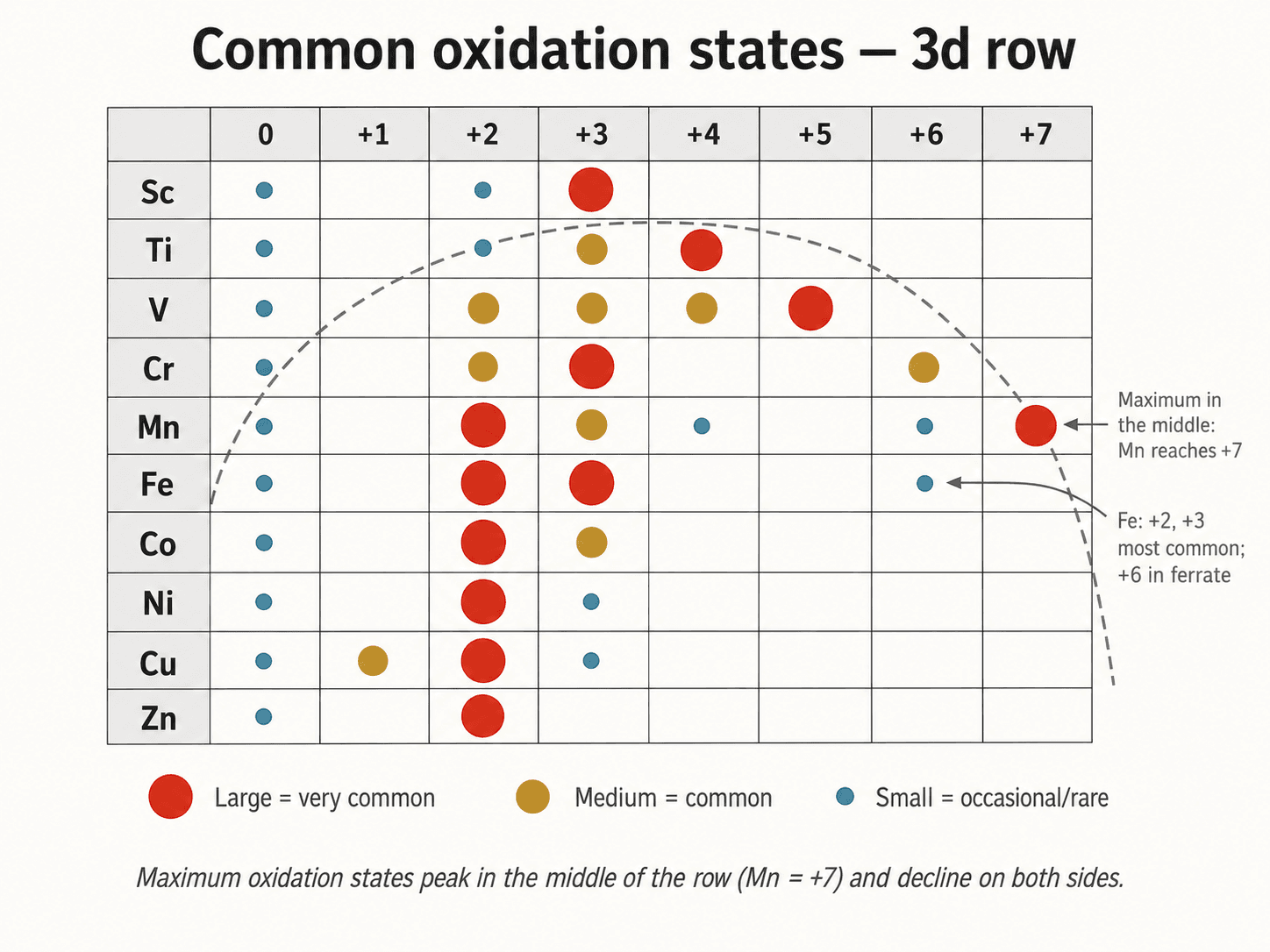
Transition metals can display many oxidation states because 3d and 4s energy levels are close. Key examples:
| Metal | Common oxidation states | Example |
|---|---|---|
| Fe | +2, +3 (rarely +4, +6) | Fe²⁺ (FeSO₄), Fe³⁺ (Fe₂O₃) |
| Mn | +2 to +7 | MnO₄⁻ (permanganate, +7) |
| Cu | +1, +2 | CuCl (Cu⁺), CuSO₄·5H₂O (Cu²⁺) |
| Cr | +2, +3, +6 | CrO₄²⁻ (chromate, +6) |
The +3 state is especially stable for 3d metals because it involves loss of 4s² and one d electron, often leaving a well-stabilised d⁰, d³, or d⁶ configuration.
Shared properties
All transition metals share several properties tied to their d electrons:
- High electrical and thermal conductivity: partially filled d bands allow electron conduction.
- High melting points: d electrons strengthen metallic bonding.
- High density: high atomic mass combined with a metallic radius shortened by the stronger metallic bonding.
- Complex formation: electron-poor metal centres accept lone pairs from ligands.
- Magnetic properties: unpaired d electrons → paramagnetism (Fe, Ni, Co).
- Catalytic activity: variable oxidation states facilitate redox cycles.
Iron (Fe) alone exemplifies all of these: paramagnetic, excellent catalyst (Haber–Bosch), and central to bioinorganic complexes (haemoglobin).
Key examples
[Iron (Fe)](/element/fe) — most abundant metal in Earth's crust after aluminium. High spin in biological contexts (haem), low spin in [Fe(CN)₆]⁴⁻. Historical catalyst in the Haber process.
[Copper (Cu)](/element/cu) — first metal worked by humans. Its red-orange colour comes from the d → s interband threshold falling within the visible range (≈ 2.1 eV, i.e. ≈ 590 nm): copper absorbs blue-violet and reflects red. In silver that same threshold sits in the UV, hence its grey appearance. Catalyst in organic synthesis (Ullmann coupling).
[Platinum (Pt)](/element/pt) — 5d metal with exceptional oxidation resistance. Catalytic converter in exhaust treatment; active in anticancer drugs (cisplatin: cis-[PtCl₂(NH₃)₂]).
[Manganese (Mn)](/element/mn) — widest oxidation-state range of the 3d series. Permanganate (KMnO₄, Mn(VII)) is a powerful oxidant used in volumetric analysis.
Redox chemistry and standard potentials
Multiple oxidation states make transition metals key players in redox chemistry. The standard potential E° predicts reaction spontaneity:
- Fe³⁺ / Fe²⁺: E° = +0.77 V
- Cu²⁺ / Cu: E° = +0.34 V
- MnO₄⁻ / Mn²⁺ (acidic medium): E° = +1.51 V
Finished this lesson?