Review: coordination complexes
A coordination complex consists of a central metal ion surrounded by ligands — molecules or ions that donate at least one electron pair to the metal. Crystal field theory (CFT), introduced by Hans Bethe (1929), models ligands as point charges and examines their electrostatic effect on the metal's five d orbitals.
Despite its simplicity (it ignores covalent effects), CFT is remarkably predictive for colour, magnetism, and relative stability of complexes.
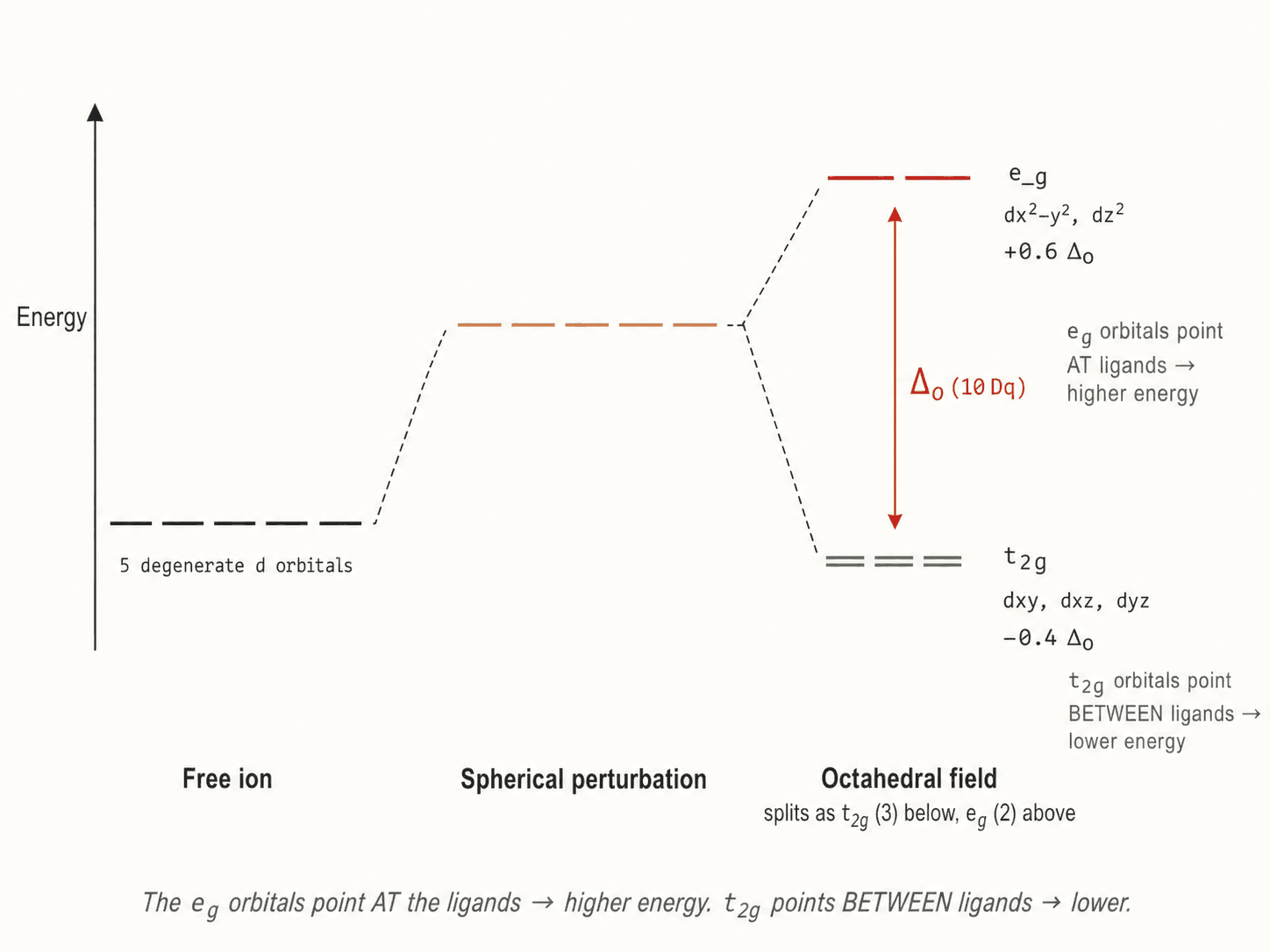
Degeneracy splitting in an octahedral field
Without ligands, the five d orbitals are degenerate (same energy). When six identical ligands are placed at the vertices of an octahedron (Oh), spherical symmetry is broken and the orbitals split into two sets.
| Set | Orbitals | Orientation | Energy |
|---|---|---|---|
| e_g | d_{z²}, d_{x²−y²} | Point toward ligands | +0.6 Δo |
| t₂g | d_{xy}, d_{xz}, d_{yz} | Point between ligands | −0.4 Δo |
The parameter Δo = 10 Dq is the total splitting. It depends on the metal (period, oxidation state), the ligands (spectrochemical series), and the geometry.
Spectrochemical series (extract): I⁻ < Br⁻ < Cl⁻ < F⁻ < OH⁻ < H₂O < NH₃ < en < CN⁻ < CO
Weak-field ligands (left) give a small Δo; strong-field ligands (right) give a large Δo.
High spin and low spin complexes
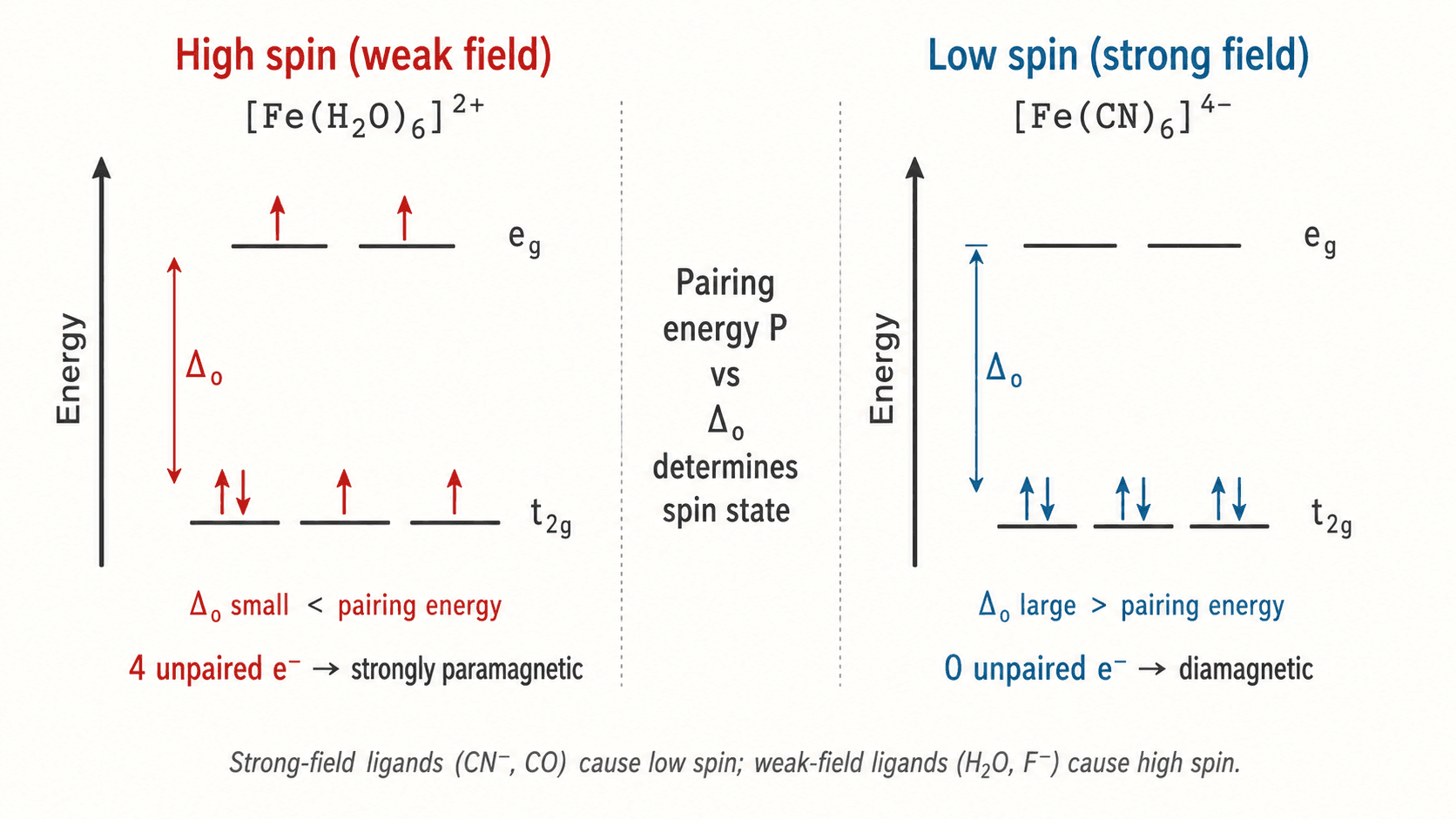
For d⁴ to d⁷ configurations, two electronic arrangements are possible depending on whether Δo is large or small relative to the pairing energy P.
- Weak field (Δo < P) → high spin: electrons spread out to maximise spin (Hund's rule).
- Strong field (Δo > P) → low spin: electrons preferentially pair up in t₂g.
Example: [Fe(H₂O)₆]²⁺ is high spin (d⁶, 4 unpaired electrons) while [Fe(CN)₆]⁴⁻ is low spin (d⁶, 0 unpaired electrons). Iron (Fe) perfectly illustrates this duality: the same ion can show radically different magnetic properties depending on the ligand.
Crystal field stabilisation energy (CFSE)
CFSE is the energy gain from preferential occupation of t₂g orbitals:
CFSE = (−0.4 × n_{t₂g} + 0.6 × n_{e_g}) × Δo
For a d³ complex (t₂g³): CFSE = −1.2 Δo. This extra stabilisation explains why chromium (Cr) forms particularly stable octahedral complexes in the Cr(III) state.
Colour of coordination complexes
Colour arises from a d–d transition: a visible photon is absorbed to promote an electron from t₂g to e_g. The absorbed wavelength λ is linked to Δo by:
Δo = h · c / λ
The perceived colour is the complement of the absorbed colour. For example, [Ti(H₂O)₆]³⁺ absorbs around 500 nm (green) and appears violet. Complexes with d⁰ or d¹⁰ configurations are colourless (no d–d transition is possible).
The Beer–Lambert law relates absorbance A to the molar absorption coefficient ε, concentration c, and path length l: A = ε · c · l.
Alternative geometries: tetrahedral and square planar
In a tetrahedral field (Td), the splitting is inverted (t₂ above e) and Δt ≈ 4/9 Δo. As a result, tetrahedral complexes are almost always high spin.
Square planar geometry (D₄h) corresponds to extreme compression of the octahedron along z. It is favoured for d⁸ configurations (Ni(II), Pt(II)) because the lowering of d_{x²−y²} delivers a substantial CFSE gain.
Finished this lesson?