What is an organometallic compound?
An organometallic compound contains at least one direct metal–carbon (M–C) bond. This distinguishes it from classical coordination chemistry where ligands (H₂O, NH₃, CN⁻) bear no carbon directly bonded to the metal. Organometallic chemistry began with Frankland's discovery of diethylzinc (1849) and exploded with ferrocene (1951).
Applications are vast: industrial catalysis (Ziegler-Natta, Grubbs), pharmaceuticals, and fine chemistry.
The 18-electron rule
In a d-block organometallic complex, the 18-electron rule (analogous to the octet rule in organic chemistry) predicts maximum kinetic stability: metal and ligands assemble to reach 18 valence electrons around the metal — full filling of the 9 valence orbitals (ns + 3 np + 5 (n−1)d), i.e. 9 × 2 = 18 electrons.
Electron count: - electrons from the metal at oxidation state zero (or chosen state) - electrons donated by ligands (2e for 2e donors: CO, PR₃, Cl⁻; 4e for η⁴ dienes; 6e for η⁶ arenes). For cyclopentadienyl the count depends on the model: 6e for Cp⁻ in the ionic view, 5e for Cp• in the covalent view — both give the same total, provided they are not mixed.
| Complex | Electrons | 18e rule? |
|---|---|---|
| Cr(CO)₆ | 6 + 6×2 = 18 | Yes |
| Fe(CO)₅ | 8 + 5×2 = 18 | Yes |
| [Fe(η⁵-Cp)₂] (ferrocene) | covalent: Fe⁰ 8 + 2×5 = 18 · ionic: Fe²⁺ 6 + 2×6 = 18 | Yes |
| Ni(CO)₄ | 10 + 4×2 = 18 | Yes |
16-electron complexes (square planar: Pd, Pt, Rh) are kinetically more labile and often more active in catalysis.
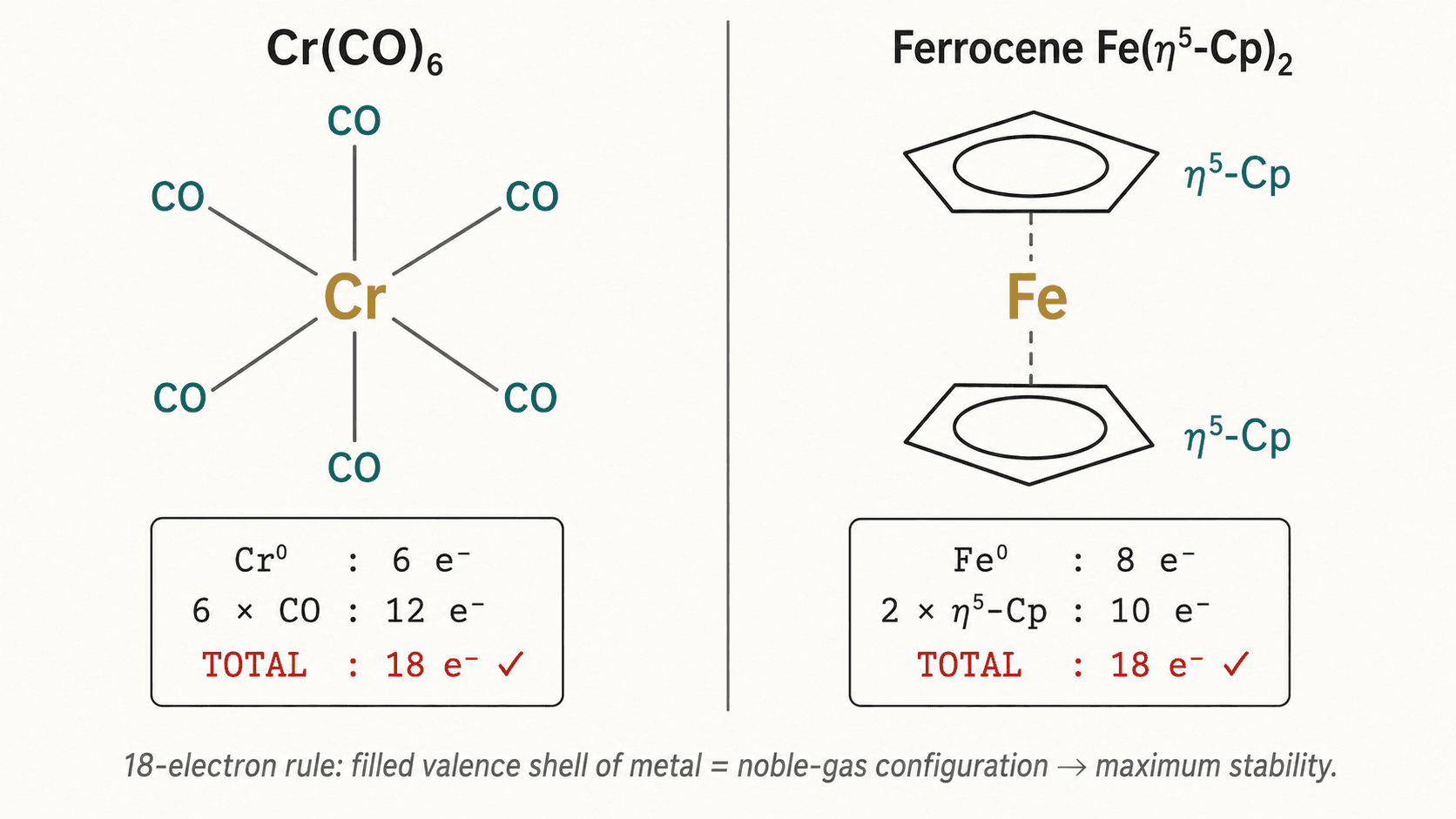
Ferrocene — archetypal sandwich compound
Ferrocene [Fe(η⁵-C₅H₅)₂] was synthesised in 1951 (Kealy, Pauson; structure established by Fischer and Wilkinson, Nobel Prize 1973). Iron (Fe) is in the +2 state; each cyclopentadienyl Cp⁻ ligand donates 6 π electrons → 18e total.
Remarkable properties: - Exceptional thermal stability (melting point 173 °C, stable to 400 °C under N₂). - Cp aromaticity: all five ring protons resonate at δ = 4.04 ppm in ¹H NMR. - Reversible redox: Fc/Fc⁺ E° = 0.40 V vs. NHE — standard internal reference in electrochemistry. - Friedel-Crafts acylation on the Cp ring — route to ferrocenyl pharmacophores.
Grubbs catalysts — olefin metathesis
Metathesis is a reaction that swaps substituents on C=C double bonds:
R¹CH=CHR² + R³CH=CHR⁴ → R¹CH=CHR³ + R²CH=CHR⁴
Grubbs catalysts (ruthenium alkylidene, [Ru]=CHR) enable this reaction with high functional-group tolerance. They follow the Chauvin catalytic cycle (metallacyclobutane intermediate). The 2005 Nobel Prize in Chemistry was awarded to Chauvin, Grubbs, and Schrock. Applications: polymer synthesis (ROMP), natural macrolides, drugs.
Ziegler-Natta catalysts — stereospecific polymerisation
Discovered by Ziegler (TiCl₄ / AlEt₃) and refined by Natta, Ziegler-Natta catalysts enable the stereospecific polymerisation of olefins: high-density polyethylene (HDPE), isotactic polypropylene (iPP). Nobel Prize 1963.
The Cossee-Arlman mechanism involves 1,2-insertion of the monomer into a Ti–C bond followed by migration. Stereochemical control arises from the symmetry of the metal site — a concept extended by metallocene catalysts (Kaminsky, 1980s) for even finer control (homogeneous, C₂-symmetric → isotactic; C_s-symmetric → syndiotactic).
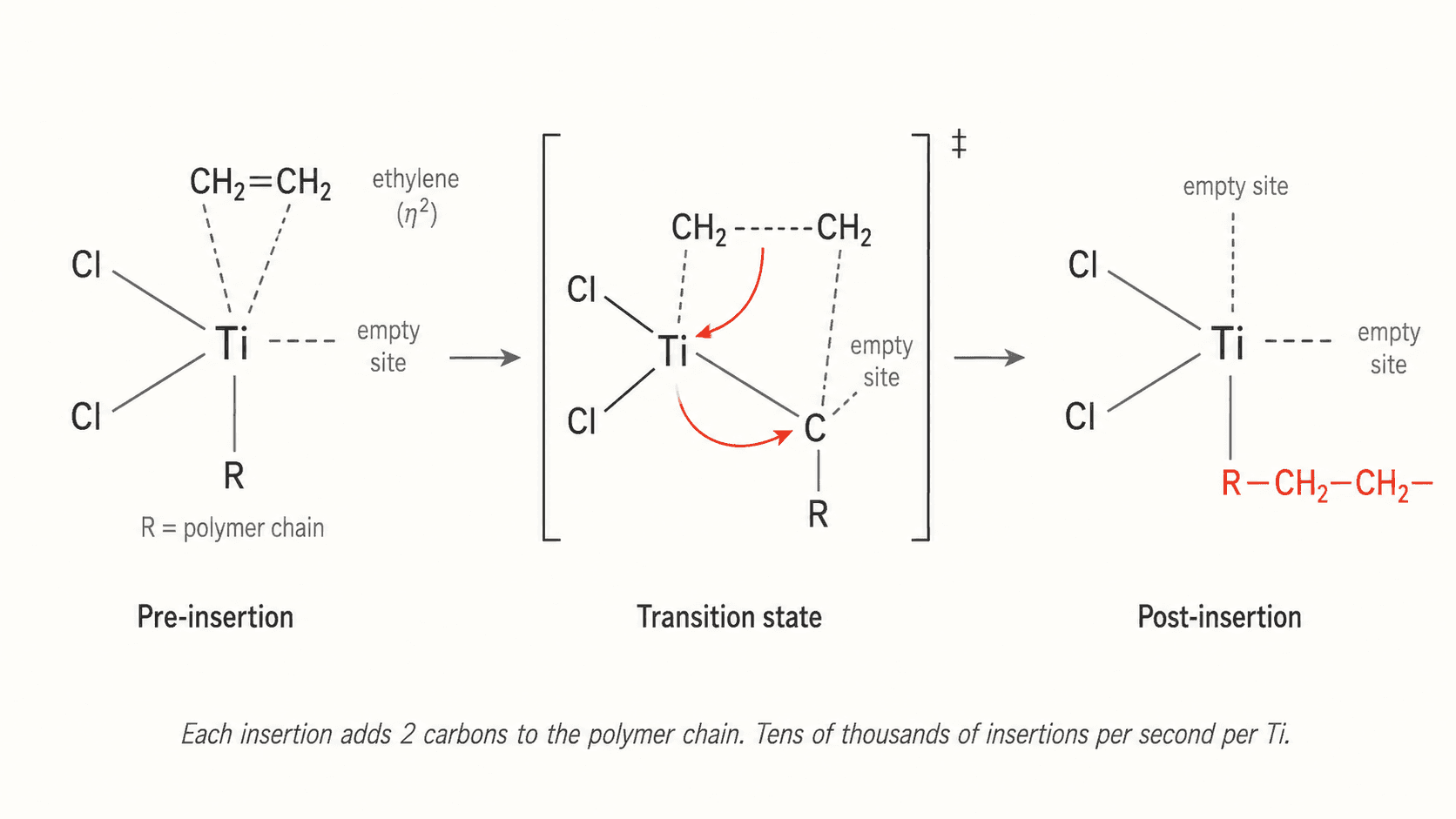
M–C bonds: nature and diversity
The M–C bond can be: - σ only (alkyls, aryls): σ donation from sp³ or sp² carbon to metal. - σ + π back-donation (CO, isonitriles): CO donates its lone pair (σ) and receives electron density into its π (back-donation) — weakens the C≡O bond (ν_{CO} lowered). - Hapto η^n*: ligand binds through n carbons simultaneously (η², η⁴ diene, η⁵ Cp, η⁶ arene).
IR spectroscopy is a key tool: the ν_{CO} stretching frequency directly reports on metal electron density (electron-rich metal → lower ν_{CO}).
Finished this lesson?