Recap: Lewis structures
A Lewis structure represents the valence electrons of a molecule as bonding pairs (lines) and lone pairs (dots). The octet rule states that each atom tends to be surrounded by 8 electrons in its valence shell.
Construction steps: 1. Count the total valence electrons. 2. Draw the skeleton (central atom connected to peripheral atoms). 3. Distribute electrons to satisfy each atom's octet. 4. Calculate formal charges.
Formal charges
The formal charge on an atom in a Lewis structure is:
FC = (valence electrons of free atom) − (non-bonding electrons) − ½(bonding electrons)
The most stable structure is the one where: - Formal charges are closest to zero. - Negative formal charges reside on the most electronegative atoms.
Example for CO₂: the structure O=C=O gives FC = 0 on all atoms, which is preferred over structures with ±1 formal charges.
Resonance and bond order
When multiple equivalent Lewis structures can be drawn, the molecule is described by a resonance hybrid — a quantum superposition, not an alternating mixture of structures.
For the carbonate ion CO₃²⁻: - Three contributing Lewis structures (one C=O and two C−O⁻ bonds). - The resonance hybrid has three equivalent C−O bonds. - Bond order = (total bonding electrons) / (number of bonds × 2) = 4/3 ≈ 1.33.
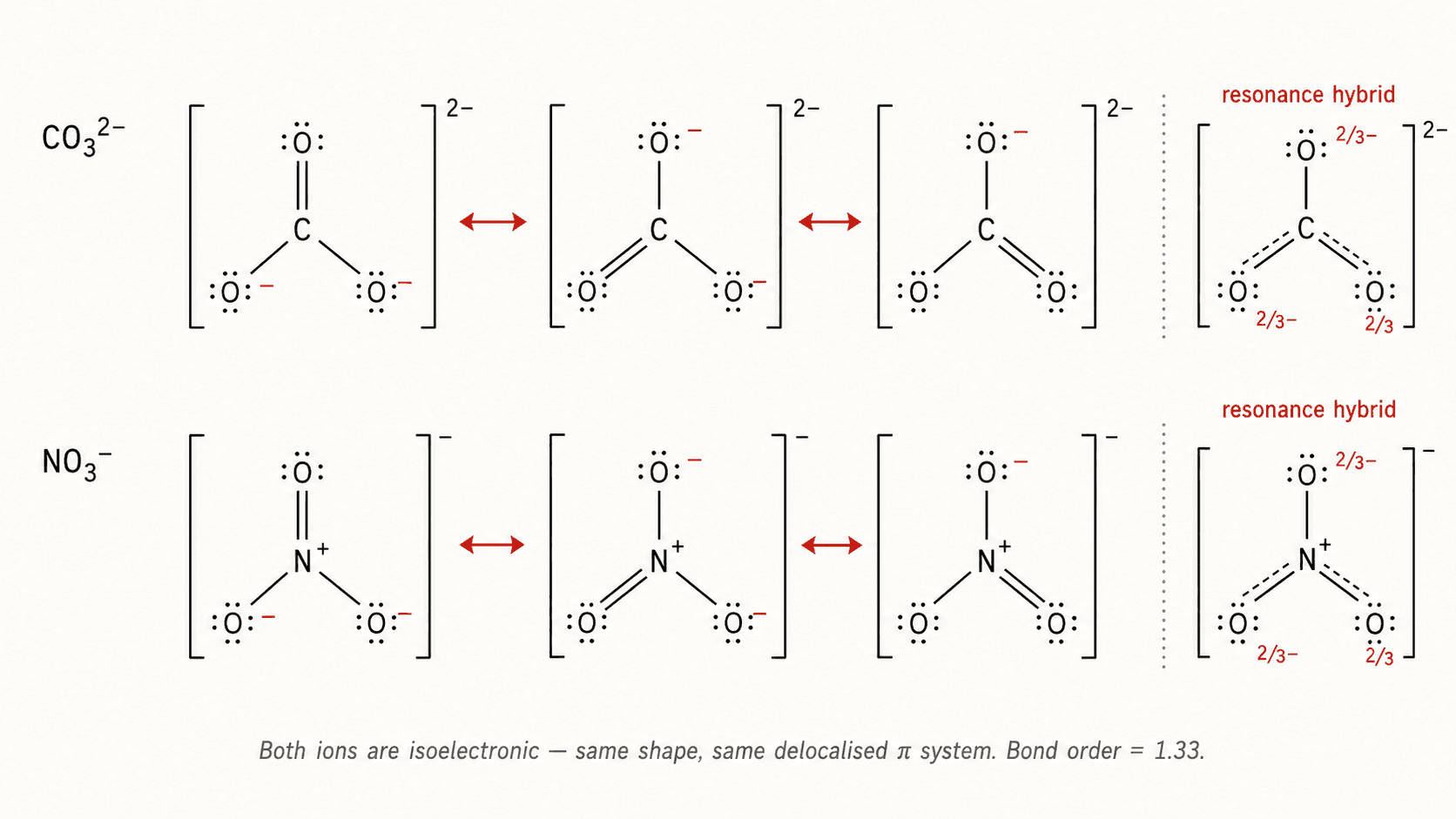
Bond order (BO) quantifies bond multiplicity. A non-integer BO is characteristic of a resonance hybrid.
Hypervalence — exceeding the octet
Atoms in period 3 and beyond can accommodate more than 8 electrons by using available d orbitals (or, in a modern interpretation, through ionic delocalisation):
| Molecule | Central atom | Valence electrons around centre |
|---|---|---|
| PCl₅ | P (period 3) | 10 |
| SF₆ | S (period 3) | 12 |
| ClF₃ | Cl (period 3) | 10 |
| XeF₄ | Xe (period 5) | 12 |
Period-2 atoms (C, N, O, F) cannot be hypervalent: their 2d orbitals do not exist at accessible energies.
For Sulfur (S) in SF₆, the Lewis structure requires 6 S−F bonds (12 electrons around S). With six single bonds the formal charge on S is zero: FC = 6 − 0 − ½(12) = 0. No S=F double bonds are invoked — fluorine, the most electronegative element, never forms multiple bonds. The modern description uses six strongly polarised bonds with partial ionic character, with no appeal to d orbitals.
Exceptions to the octet rule
Three classes of exception:
1. Odd-electron molecules (radicals): NO, NO₂, ClO₂. An unpaired electron is unavoidable. 2. Electron deficiency (incomplete octet): BF₃, AlCl₃, BeCl₂. The central atom has only 6 or 4 electrons. These are Lewis acids because they accept an electron pair. 3. Octet expansion: hypervalence described above.
"The octet rule is a rule, not a law." — Linus Pauling
The Lewis structure of NO has an unpaired electron on N or O depending on the contributing structure — this molecule is a stable radical and plays a crucial role in vascular biochemistry.
Finished this lesson?