Principle of VSEPR theory
VSEPR (Valence Shell Electron Pair Repulsion) theory was formalised by Gillespie and Nyholm in 1957, building on ideas from Sidgwick and Powell. Its central postulate is simple:
Valence-shell electron pairs around a central atom arrange themselves in space to minimise mutual repulsion.
Molecular geometry follows directly from this minimisation.
AXₙEₘ formalism
A molecule is labelled AXₙEₘ where: - A = central atom. - X = bonded atom or group (bonding pair counted as one entity). - E = lone pair on A. - n + m = total number of electron domains (EDs).
The electron-domain geometry (Gillespie arrangement) depends on n + m:
| n + m | Arrangement | Ideal angles |
|---|---|---|
| 2 | Linear | 180° |
| 3 | Trigonal planar | 120° |
| 4 | Tetrahedral | 109.5° |
| 5 | Trigonal bipyramidal | 90° / 120° |
| 6 | Octahedral | 90° |
The molecular geometry (observed shape) counts only atom positions X, not lone pairs E.
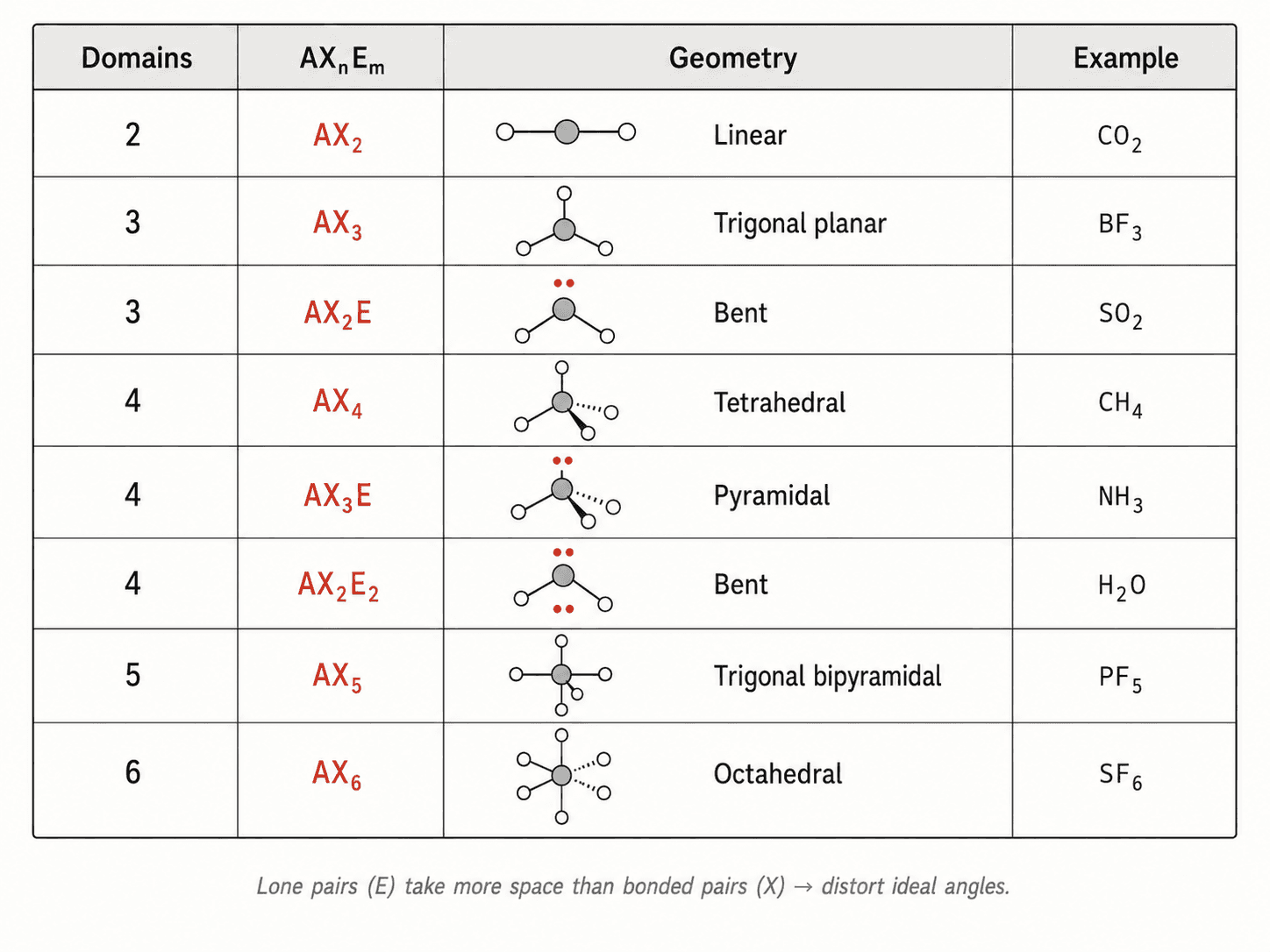
Repulsion hierarchy
Not all pairs repel equally. The decreasing order of repulsion strength is:
E−E > E−X > X−X
Practical consequences: - In NH₃ (AX₃E₁): the lone pair compresses the H−N−H angle from 109.5° to 107°. - In H₂O (AX₂E₂): two lone pairs compress the H−O−H angle to 104.5°. - In SF₄ (AX₄E₁): the lone pair occupies an equatorial position (fewer 90° interactions). - In ClF₃ (AX₃E₂): T-shaped geometry (two equatorial lone pairs).
Pathologies and limits
AX₅ and AX₆ molecules: in PCl₅ (trigonal bipyramidal), axial and equatorial positions are inequivalent — axial bonds are longer than equatorial ones.
Multiple bonds: a double or triple bond is treated as one electron domain in VSEPR, but it occupies more space (stronger repulsion) than a single bond. In SO₂ (AX₂E₁) the O−S−O angle is 119.5° instead of the 120° of a trigonal plane: consistent with the E−X > X−X hierarchy stated above, it is the lone pair that compresses the angle.
Limits of VSEPR: - Fails for transition-metal complexes (requires crystal-field or MO theory). - Fails for heavy group 15-16 hydrides, whose angles depart sharply from the predicted tetrahedron (H₂S: 92°, H₂Se: 91°, AsH₃: 92°). - Predicts CaF₂, SrF₂ and BaF₂ to be linear in the gas phase, whereas they are bent. - Provides no information on bond energies, magnetism, or spectra. - Very bulky AX₂ ligands can deviate from predicted linearity.
Despite these limits, VSEPR remains a fast and powerful predictive tool for light main-group molecules.
Finished this lesson?