Why hybridise?
Pure atomic orbitals (s, p, d) do not always point in the right directions to explain observed geometries. In methane CH₄, the four C−H bonds are identical and subtend angles of 109.5° — something the carbon 2s and 2p orbitals (mutually perpendicular) cannot directly rationalise.
Hybridisation is the linear combination of atomic orbitals on the same atom to form new hybrid orbitals that are directed and equivalent. It is a mathematical construction within the AO-MO model, not a directly observable physical phenomenon.
sp hybridisation
Mixing 1 s orbital + 1 p orbital → 2 sp orbitals directed at 180°.
The hybridised atom is linear (AX₂ geometry). Examples: CO₂, acetylene HC≡CH, BeCl₂.
Resulting orbitals: two sp σ hybrids along the axis (head-on overlap) + two pure p orbitals perpendicular to the axis, available for two π bonds.
In HC≡CH, each carbon forms: - 1 σ bond C−H (sp − 1s). - 1 σ bond C−C (sp − sp). - 2 π bonds C−C (p − p side-on), giving the triple bond.
sp² hybridisation
Mixing 1s + 2p → 3 sp² orbitals in a plane, separated by 120°. The atom is trigonal planar (AX₃). Examples: ethylene H₂C=CH₂, benzene C₆H₆, BF₃.
In ethylene: - Each C forms 3 in-plane σ bonds (2 C−H + 1 C−C). - The remaining p orbital perpendicular to the plane forms the π bond C=C.
Benzene C₆H₆ is the canonical example: six sp² carbons, six perpendicular p orbitals overlapping in a ring → fully delocalised aromatic π system (Hückel rule: 4n+2 = 6 π electrons for n = 1).
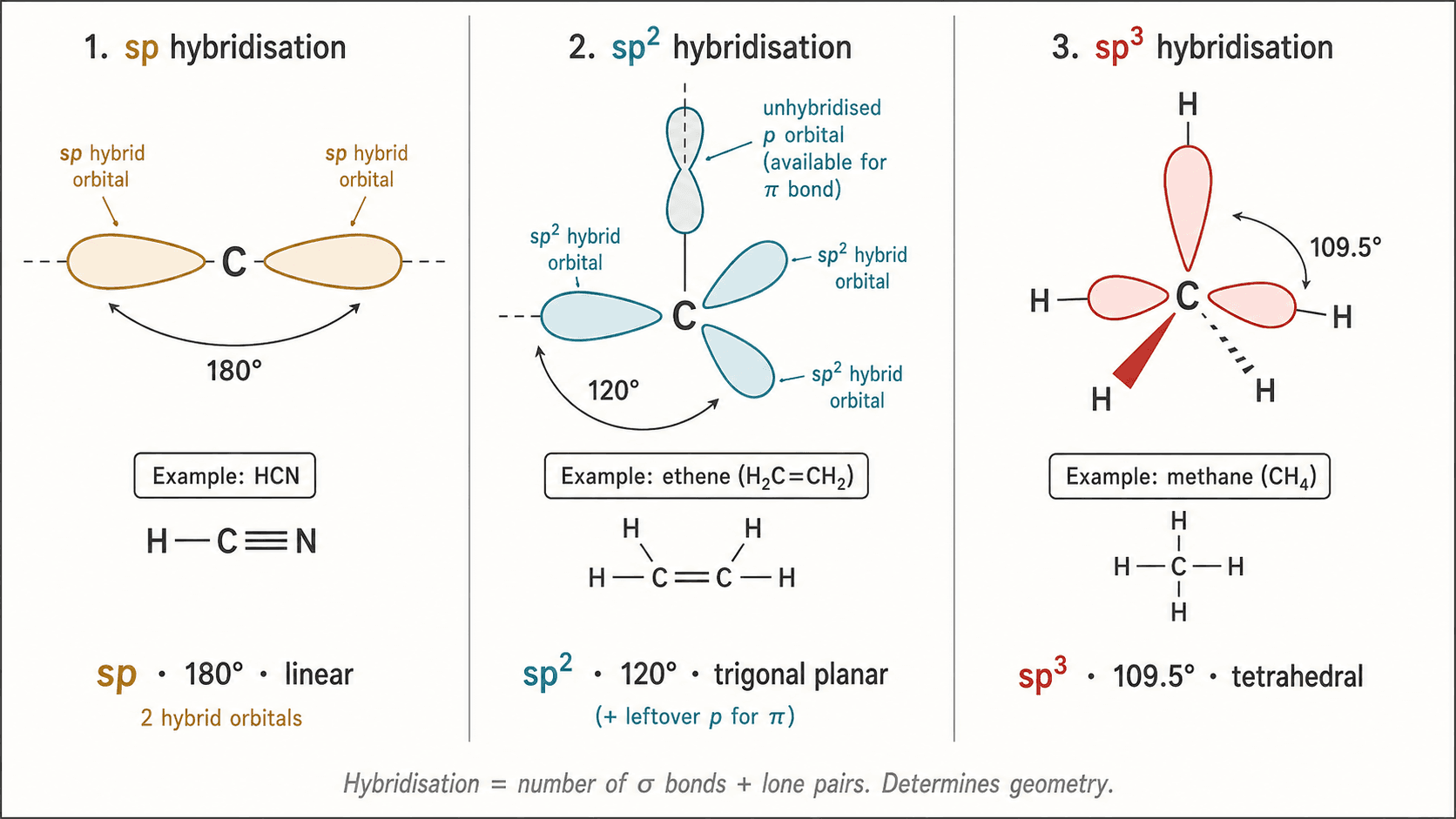
sp³ hybridisation
Mixing 1s + 3p → 4 sp³ orbitals arranged tetrahedrally at 109.5°. The atom is tetrahedral (AX₄, or AX₃E₁, AX₂E₂ with lone pairs).
Canonical examples: - Methane CH₄: 4 equivalent σ C−H bonds, 109.5°. - Ammonia NH₃: 3 σ N−H bonds + 1 lone pair (angle 107°). - Water H₂O: 2 σ O−H bonds + 2 lone pairs (angle 104.5°).
d-involved hybridisation — sp³d and sp³d²
For period-3+ atoms, d orbitals participate in hybridisation:
| Hybridisation | Geometry | Example |
|---|---|---|
| sp³d | Trigonal bipyramidal | PCl₅ |
| sp³d² | Octahedral | SF₆, [Fe(CN)₆]³⁻ |
| sp³d³ | Pentagonal bipyramidal (rare) | IF₇ |
In SF₆, the six equivalent S−F bonds arise from six sp³d² orbitals of Sulfur (S) overlapping with fluorine p orbitals.
σ and π overlap
- σ bond: head-on (axial) overlap — maximum electron density on the internuclear axis. Present in all single, double, and triple bonds.
- π bond: side-on p orbital overlap — electron density above and below the axis. Present in double bonds (1 π) and triple bonds (2 π).
A π bond is weaker than the corresponding σ bond because side-on overlap is less effective than head-on overlap.
Finished this lesson?