Beyond Lewis and hybridisation
Lewis theory and hybridisation describe simple molecules well, but fail to explain: - The paramagnetism of O₂ (two unpaired electrons). - Bonding in species such as H₂⁺ (only one valence electron). - Properties of metals (energy bands).
Molecular orbital (MO) theory overcomes these limitations by treating electrons as belonging to the whole molecule rather than to localised bonds.
Linear combination of atomic orbitals (LCAO)
MOs are built as linear combinations of atomic orbitals (LCAO). For two atomic orbitals ψ_A and ψ_B:
Bonding MO: ψ⁺ = N⁺(ψ_A + ψ_B) → constructive, density ↑ between nuclei Antibonding MO: ψ⁻ = N⁻(ψ_A − ψ_B) → node between nuclei, density ↓
where N± are normalisation factors. The bonding MO lies lower in energy than the parent AOs; the antibonding MO lies higher.
Conservation rule: n AOs → n MOs (orbital count is conserved).
Criteria for effective combination
For two AOs to combine effectively: 1. Compatible symmetry: overlapping lobes must have the same sign of ψ. 2. Similar energies: |E_A − E_B| < a few eV (empirical criterion). 3. Non-zero overlap: overlap integral S = ∫ ψ_A · ψ_B dV ≠ 0.
Diagrams for homonuclear diatomic molecules
For second-period molecules (Li₂ to Ne₂), MOs are obtained by combining the 1s, 2s, and 2p AOs.
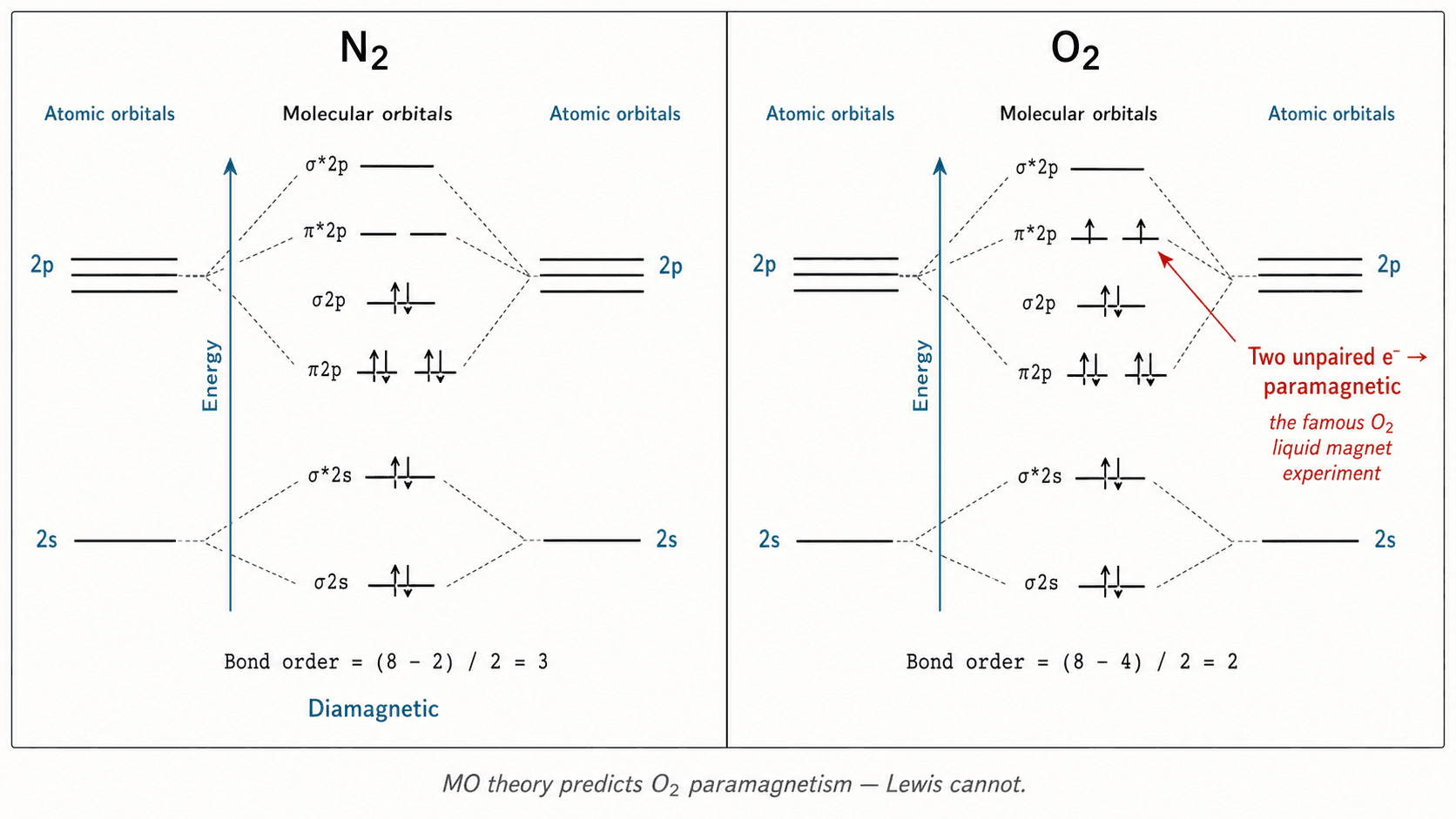
Energy ordering for Li₂ to N₂ (σ/π crossover matters): σ1s < σ1s < σ2s < σ2s < π2p_x = π2p_y < σ2p_z < π2p_x = π2p_y < σ*2p_z
For O₂ and F₂, σ2p lies below π2p (no crossover): σ1s < σ1s < σ2s < σ2s < σ2p_z < π2p_x = π2p_y < π2p_x = π2p_y < σ*2p_z
MO bond order: BO = (bonding electrons − antibonding electrons) / 2
| Molecule | Electronic config. | BO | Properties |
|---|---|---|---|
| H₂ | (σ1s)² | 1 | diamagnetic |
| He₂ | (σ1s)²(σ*1s)² | 0 | unstable |
| Li₂ | …(σ2s)² | 1 | diamagnetic |
| N₂ | …(π2p)⁴(σ2p)² | 3 | diamagnetic |
| O₂ | …(π2p)⁴(π*2p)² | 2 | paramagnetic |
| F₂ | …(π*2p)⁴ | 1 | diamagnetic |
| Ne₂ | …(σ*2p)² | 0 | unstable |
Heteronuclear diatomic molecules
For molecules like CO, NO, HF, the parent AOs have different energies (E_A ≠ E_B). The bonding MO has a larger coefficient on the lower-energy AO (more electronegative atom) — the MO resembles the electronegative partner's AO more closely.
For HF: the bonding σ MO is mainly centred on F (higher electronegativity); the antibonding σ MO is mainly on H. This is why the H−F bond is polarised* δ⁺H−Fδ⁻.
Finished this lesson?