Energy levels of the hydrogen atom
The Schrödinger equation for the hydrogen atom yields discrete energy levels:
E_n = −13.6 eV / n² (n = 1, 2, 3, …)
These correspond to bound states (E < 0). At E = 0 the electron is ionised. The ground-state energy (n = 1) is −13.6 eV; the ionisation energy of Hydrogen (H) is its opposite, +13.6 eV — the energy that must be supplied to remove the electron.
The degeneracy of each level is n² (ignoring spin) or 2n² (including spin).
Emission and absorption — link to transitions
When an electron moves from level E_i to level E_f, energy is conserved through photon emission or absorption:
ΔE = E_i − E_f = hν = hc/λ
- If E_i > E_f: emission (upper level depopulates, a photon is created).
- If E_i < E_f: absorption (electron is promoted by absorbing a photon).
An emission spectrum shows bright lines on a dark background; an absorption spectrum shows dark lines (Fraunhofer lines) on a continuous background.
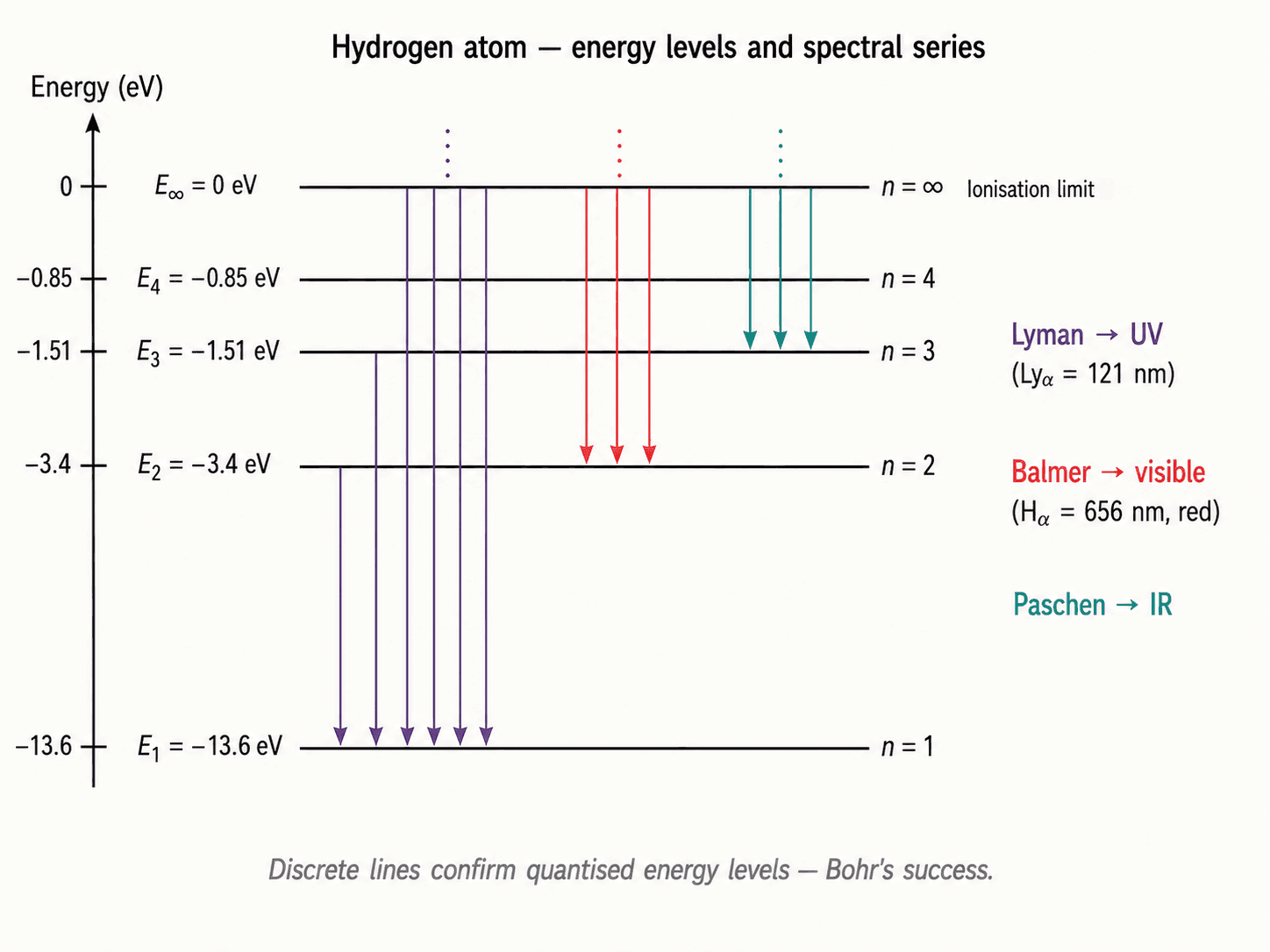
Spectral series of hydrogen
Transitions are grouped by their final level n_f into series:
| Series | n_f | Region | Discoverer |
|---|---|---|---|
| Lyman | 1 | Far UV | T. Lyman |
| Balmer | 2 | Visible / near UV | J. Balmer |
| Paschen | 3 | Near IR | F. Paschen |
| Brackett | 4 | IR | F. Brackett |
| Pfund | 5 | Far IR | A. Pfund |
The Balmer series is the only one partially visible to the naked eye: lines Hα (656 nm, red), Hβ (486 nm, blue-green), Hγ (434 nm, violet), Hδ (410 nm, deep violet). Balmer's empirical formula (1885):
1/λ = R_H (1/2² − 1/n²), n = 3, 4, 5, …
with the Rydberg constant R_H = 1.097 × 10⁷ m⁻¹.
The Rydberg-Ritz formula generalises this to all series:
1/λ = R_H (1/n_f² − 1/n_i²), n_i > n_f
Selection rules for allowed transitions
Not all transitions are permitted. Selection rules for electric dipole transitions are:
- Δn: unrestricted.
- Δl = ±1 (strict angular rule).
- Δm_l = 0, ±1.
- Δs = 0 (spin unaffected by light in the absence of spin-orbit coupling).
The transition 1s → 2s is forbidden (Δl = 0); 1s → 2p is allowed (Δl = +1).
Spectra of many-electron atoms
For multi-electron atoms, electron–electron repulsion and shielding modify energy levels. Sub-shells of different l within the same n are no longer degenerate: E(s) < E(p) < E(d) < E(f) for a given n.
Spectra become more complex but the same principle holds: each line corresponds to a transition between two energy levels, and the line frequency is ν = ΔE/h.
"Had I known Balmer earlier, it would have saved me a great deal of work." — Niels Bohr
Atomic spectra find applications in: - Emission spectroscopy (elemental analysis, ICP-OES). - Solar spectroscopy (Helium (He) was identified in the solar spectrum in 1868 before its terrestrial discovery). - Caesium atomic clocks (line at 9.192 GHz — the SI definition of the second).
Finished this lesson?