Angular momentum in quantum mechanics
In classical mechanics, angular momentum L = r × p is a continuous vector. In quantum mechanics, orbital angular momentum L is quantised: its magnitude is |L| = ħ√(l(l+1)) and its projection onto a z-axis is L_z = m_l ħ, with m_l ∈ {−l, …, +l}.
Spin angular momentum S is an intrinsic electron property with no classical analogue. For the electron, s = 1/2: |S| = ħ√(3/4) and S_z = m_s ħ with m_s = ±1/2 (spin-up ↑ or spin-down ↓).
These two angular momenta can couple — this is spin-orbit coupling.
Physical origin of spin-orbit coupling
In the rest frame of an electron orbiting a nucleus, the nucleus appears to orbit the electron. This apparent motion generates a magnetic field B at the electron's position. The spin magnetic moment μ_s interacts with this field:
H_SO = −μ_s · B ∝ (1/r)(dV/dr) L · S
where V(r) is the Coulomb potential energy. This interaction is the spin-orbit Hamiltonian H_SO. Its magnitude scales as Z⁴: negligible for light elements, dominant for actinides.
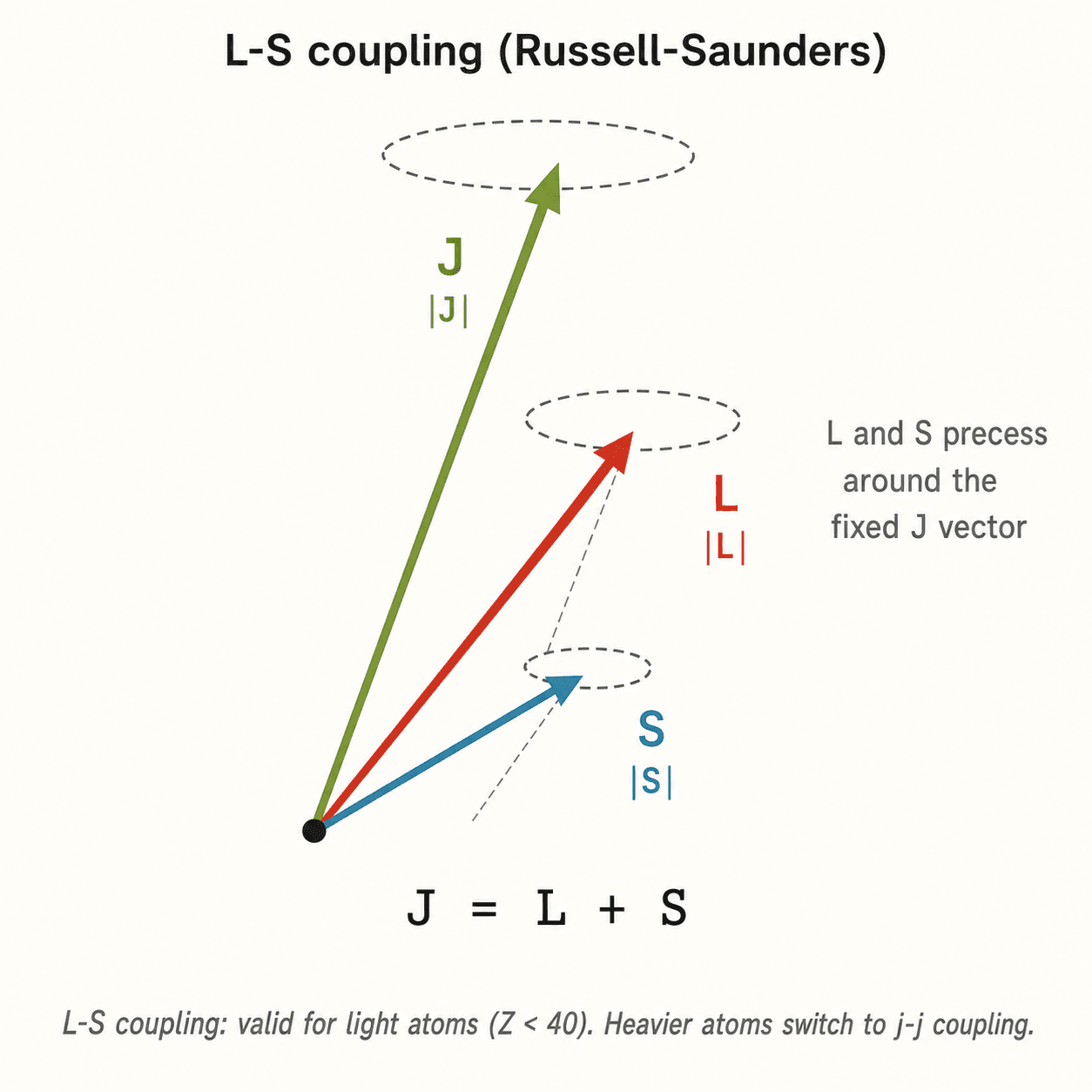
L-S coupling (Russell-Saunders)
For light elements (Z ≲ 40), the spin-orbit perturbation is weak. Individual orbital momenta are first coupled into a resultant L = Σ l_i, then spins into S = Σ s_i, and finally L and S couple to give J = L + S.
Allowed J values are |L − S|, |L − S| + 1, …, L + S. The spectroscopic term symbol is:
^{2S+1}L_J
where 2S+1 is the multiplicity and L is encoded by a letter (S, P, D, F, …). Example for carbon (2p² configuration): ground term ^3P_0.
Hund's rules identify the ground term: 1. Maximise S (parallel spins). 2. Then maximise L. 3. For less-than-half-filled sub-shells: J = |L − S|; more-than-half-filled: J = L + S.
j-j coupling
For heavy elements (Z ≳ 50) or actinides, H_SO dominates over electron–electron repulsion. Each electron carries its own j_i = l_i + s_i (values |l_i − 1/2| and l_i + 1/2), and the total moment is J = Σ j_i. The ^{2S+1}L_J notation loses physical meaning.
| Regime | Valid for | Good quantum numbers |
|---|---|---|
| L-S | Z ≲ 40, organic elements | L, S, J, M_J |
| j-j | Z ≳ 50, lanthanides, actinides | individual j_i, J |
| Intermediate | Pd, Pt, Xe… | J only |
Effects on atomic energy levels
Spin-orbit coupling removes degeneracy in spectral terms: a ^3P term splits into ^3P_0, ^3P_1, ^3P_2 with slightly different energies. This is the origin of the fine structure in atomic spectra.
For Sodium (Na), the famous yellow D line is actually a doublet at 589.0 nm and 589.6 nm: the 3p levels (^2P_{1/2} and ^2P_{3/2}) are split by spin-orbit coupling.
Chemical consequences are far-reaching: - Relativistic contractions in heavy elements (e.g. the colour of gold). - Magnetic properties of heavy-metal complexes. - Selectivity of photochemical reactions (intersystem crossing S₁ → T₁).
Finished this lesson?