What is an orbital?
An atomic orbital is a single-electron wave function ψ(r,θ,φ), solution to the Schrödinger equation for the hydrogen atom. It factorises into a radial part and an angular part:
ψ(r,θ,φ) = R_{n,l}(r) · Y_l^m(θ,φ)
where R_{n,l} contains the associated Laguerre polynomials and Y_l^m are the spherical harmonics. The probability density of finding the electron is |ψ|².
Three quantum numbers characterise each orbital: - n (principal): n = 1, 2, 3, … — sets the energy and radial extent. - l (azimuthal): l = 0, 1, …, n−1 — sets the angular shape. - m_l (magnetic): m_l = −l, …, +l — sets the orientation in space.
The letter labels come from historical spectroscopy: l = 0 → s (sharp), l = 1 → p (principal), l = 2 → d (diffuse), l = 3 → f (fundamental).
s orbitals — spherical symmetry
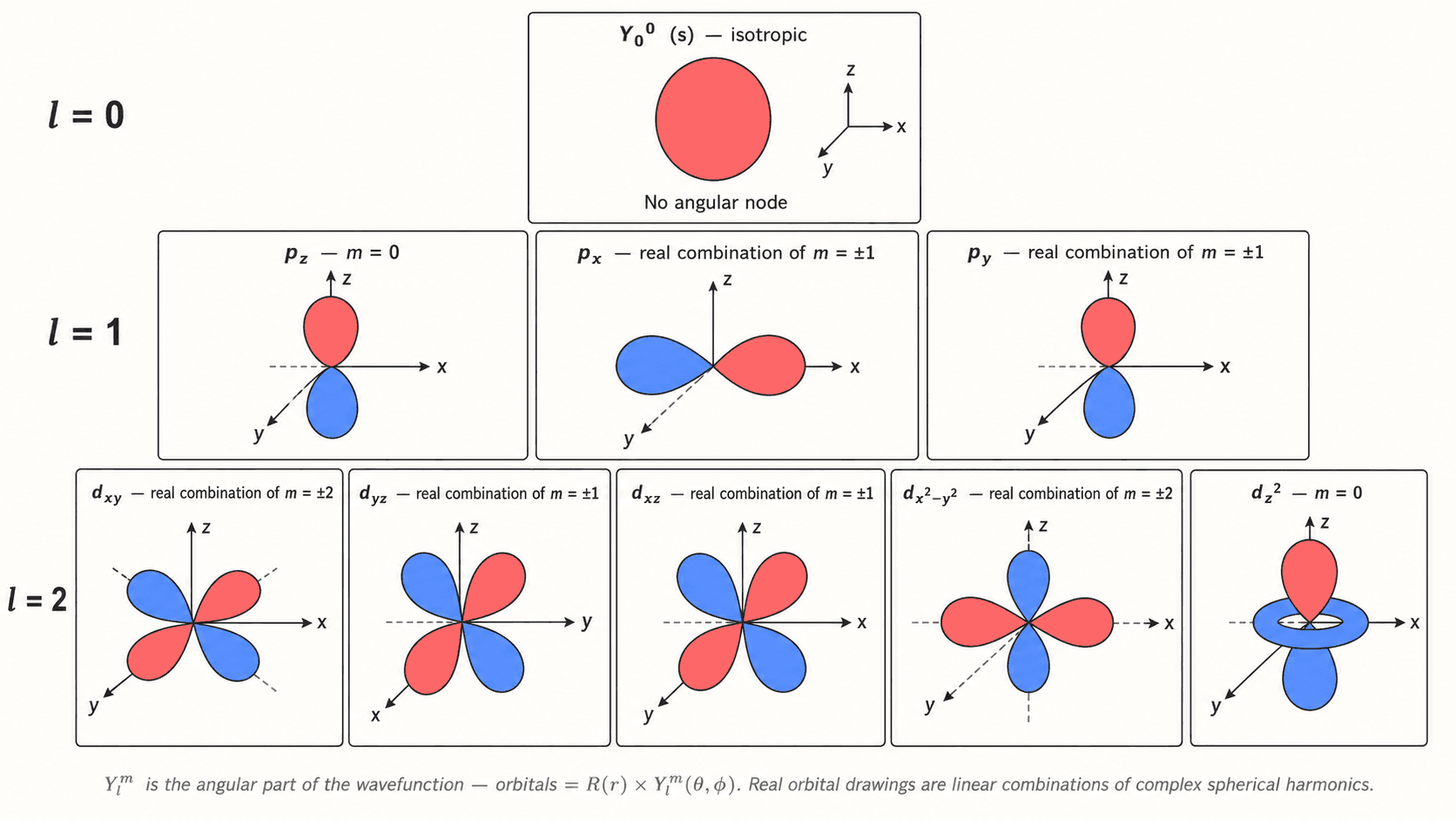
s orbitals (l = 0) are spherically symmetric: Y_0^0 = constant. The radial probability density P(r) = r² |R_{n,0}(r)|² has (n−1) radial nodes. For the 1s orbital of Hydrogen (H), the maximum of P(r) occurs exactly at the Bohr radius a₀ ≈ 52.9 pm.
Chemical consequence: a σ bond formed by overlap of two s orbitals (as in H₂) has maximum electron density along the internuclear axis.
p orbitals — axial symmetry and nodal plane
For l = 1, there are three p orbitals (m_l = −1, 0, +1), usually labelled p_x, p_y, p_z. Each has: - One nodal plane through the nucleus (perpendicular to the orbital axis). - Two lobes of opposite wave-function sign.
The dumbbell shape arises from the spherical harmonic Y_1^0 ∝ cos θ for p_z. p orbitals participate in both σ bonds (head-on overlap) and π bonds (side-on overlap).
d orbitals — five orientations, two morphologies
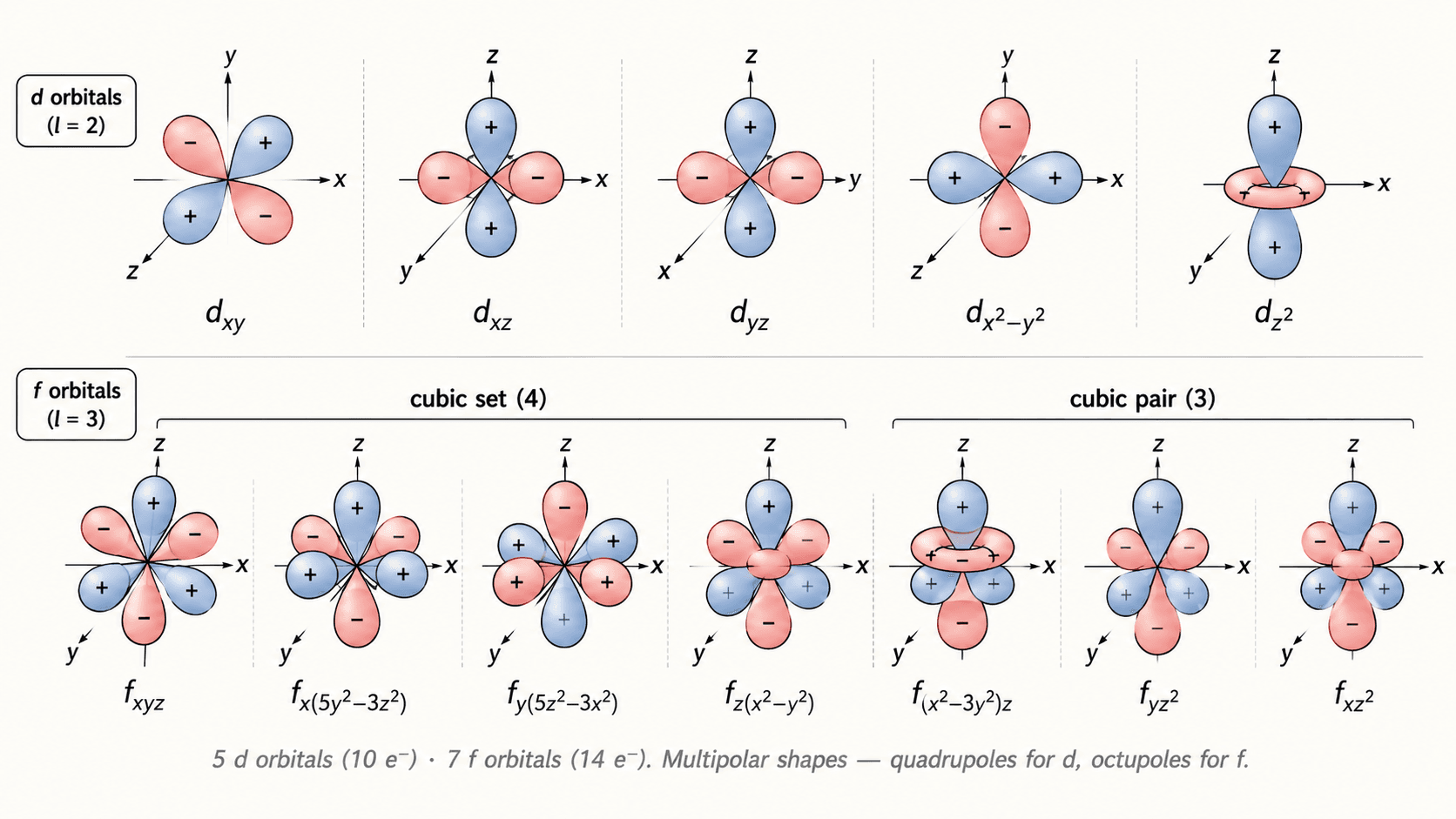
For l = 2, five d orbitals (m_l = −2, …, +2) fall into two shape families: - Four four-lobed orbitals (d_{xy}, d_{xz}, d_{yz}, d_{x²−y²}): lobes between or along coordinate axes. - One d_{z²} orbital: two lobes along z plus a toroidal ring in the xy plane.
| Orbital | Lobes | Nodal plane(s) |
|---|---|---|
| d_{xy} | 4, between x and y | xz and yz |
| d_{xz} | 4, between x and z | xy and yz |
| d_{yz} | 4, between y and z | xy and xz |
| d_{x²−y²} | 4, along x and y | the two diagonal planes x = y and x = −y |
| d_{z²} | 2 + torus | two nodal cones at θ ≈ 54.7° |
d orbitals are central to transition-metal chemistry: their ligand-field splitting (Δ) determines colour and magnetic behaviour of complexes.
f orbitals and beyond
f orbitals (l = 3, seven orbitals, m_l = −3, …, +3) display complex multi-lobed shapes with several angular nodes. They govern the chemistry of lanthanides and actinides. Their poor shielding by inner electrons explains the lanthanide contraction: atomic radii barely change from La to Lu despite adding 14 electrons.
Chemical consequences
Orbital geometry is not a mathematical curiosity — it controls: 1. Bond directionality — covalent bonds form along lobe axes. 2. Hybridisation — linear combination of orbitals on the same atom yields new directed orbitals (sp, sp², sp³, etc.). 3. Spectroscopic selection rules (Δl = ±1 for electric dipole transitions). 4. The Pauli exclusion principle: each orbital holds at most two electrons with opposite spins.
For Helium (He), the 1s² configuration completes the first shell, giving the first noble-gas configuration.
Finished this lesson?