The periodic table: a map of the elements
In 1869, Russian chemist Dmitri Mendeleev had a revolutionary idea: arrange the known chemical elements in a table ordered by increasing atomic mass, aligned in columns by similar properties. The table even predicted the existence of unknown elements — which were later discovered exactly as Mendeleev had foreseen.
Today the periodic table contains 118 confirmed elements, arranged by increasing atomic number Z (no longer by atomic mass).
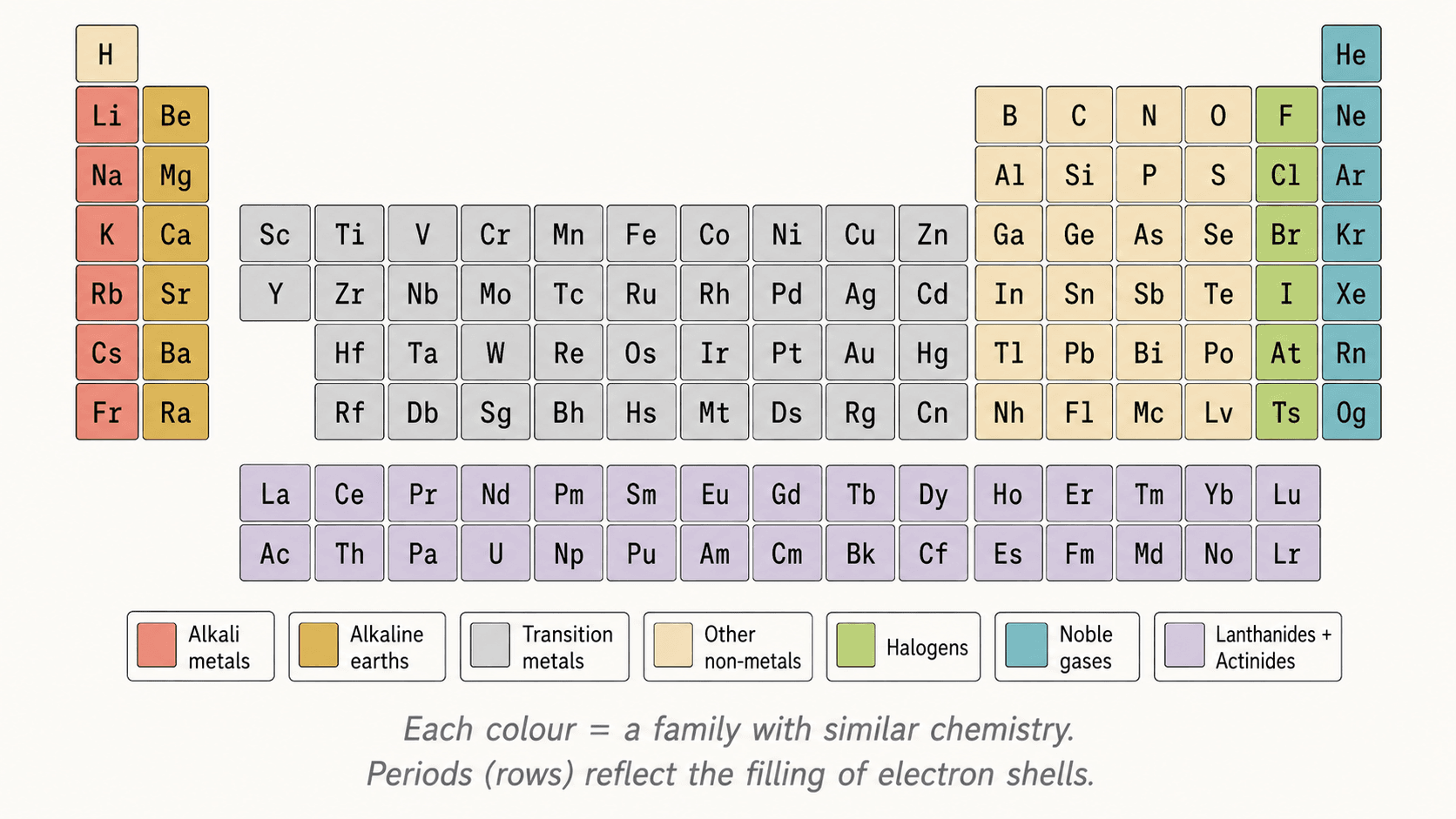
Reading the table
Each cell contains: - the element's symbol (e.g. H, Fe, Au) - the atomic number Z (number of protons) - the relative atomic mass (in atomic mass units)
Elements are arranged in: - periods (horizontal rows): numbered 1 to 7. Elements in the same period have the same number of occupied electron shells. - groups (vertical columns): numbered 1 to 18. Elements in the same group have similar chemical behaviour.
The main element families
Some groups have special names because of their characteristic properties:
| Family | Group | Properties | Examples |
|---|---|---|---|
| Alkali metals | 1 | Very reactive metals, react violently with water | Li, Na, K |
| Alkaline earth metals | 2 | Reactive metals, form basic oxides | Mg, Ca |
| Halogens | 17 | Very reactive non-metals, form salts with alkali metals | F, Cl, Br, I |
| Noble gases | 18 | Inert gases, virtually no chemical reactions | He, Ne, Ar |
The transition metals (groups 3 to 12) include familiar elements like iron (Fe), copper (Cu), and gold (Au).
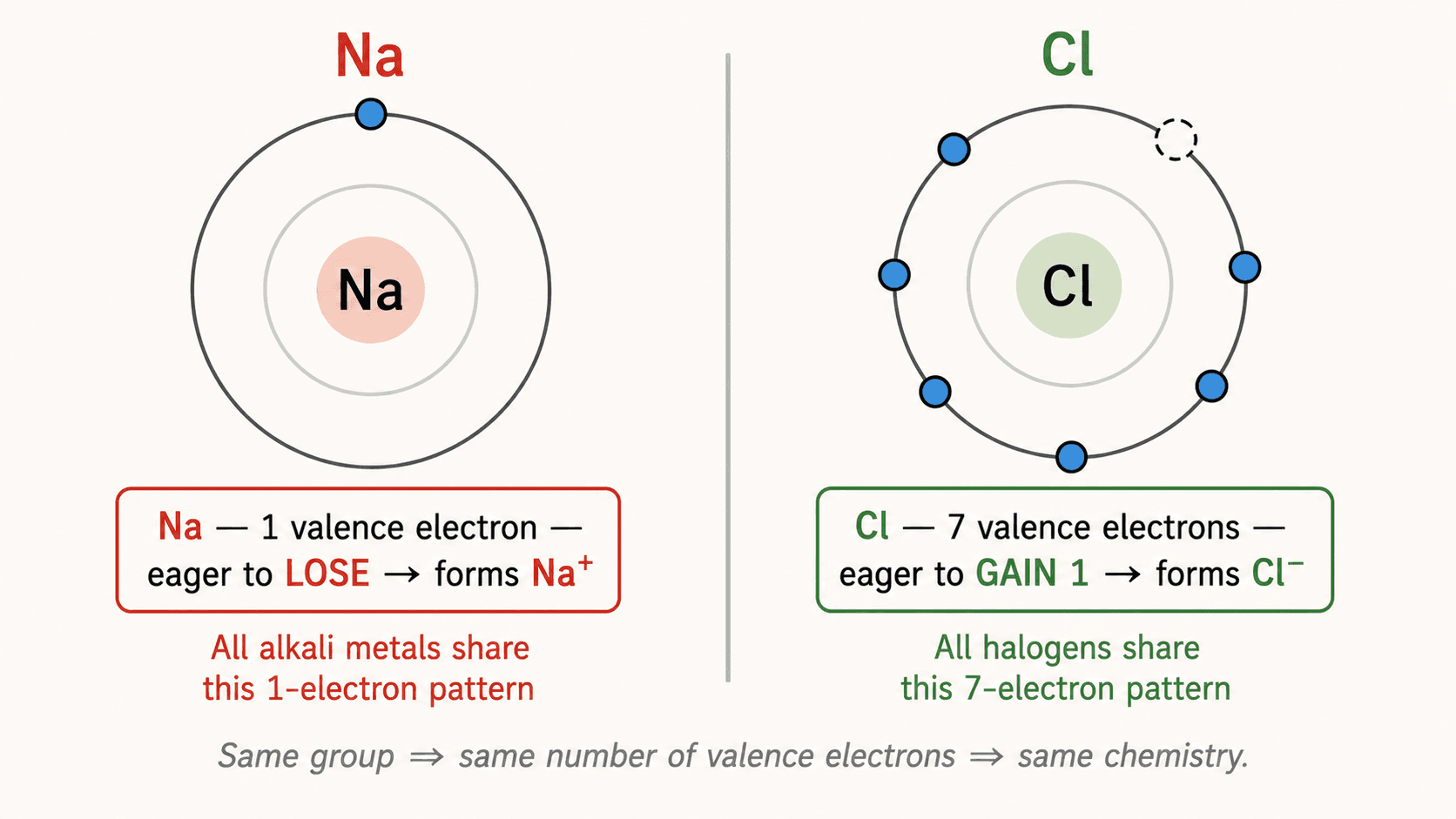
Why similar properties?
Elements in the same group have the same number of electrons in their outermost shell (the valence shell). This number determines chemical behaviour. For example: - All alkali metals (group 1) have 1 electron in their outer shell → they lose it easily → form an M⁺ ion. - All halogens (group 17) have 7 electrons in their outer shell → they gain 1 easily → form an X⁻ ion.
Metals, non-metals, and metalloids
The periodic table is also divided into broad categories: - Metals (left and centre): conductors, shiny, malleable. - Non-metals (right): poor conductors, often gaseous or brittle. - Metalloids (in between, e.g. Si, As): intermediate properties, important in electronics (semiconductors).
An ever-evolving tool
The periodic table is still growing. The last officially named element is oganesson (Og), number 118, first synthesised in 2002 and officially named by IUPAC in 2016. Scientists continue to search for super-heavy elements beyond Z = 118.
Finished this lesson?