Why count in packs?
Imagine being asked to count every grain of rice in a kilogram. There are about 50,000! In chemistry the problem is even more extreme: in a simple glass of water (200 mL) there are around 7 × 10²⁴ molecules. That number is so large that counting molecules one by one is completely impossible.
Chemists therefore invented a special unit to count atoms and molecules in enormous batches: the mole.
The mole: a counting unit
One mole contains about 6.022 × 10²³ entities (atoms, molecules, ions, …). This number is called Avogadro's constant (written N_A) in honour of the physicist Amedeo Avogadro.
To get a feel for the scale: if you had one mole of euros, you could give roughly 75 trillion euros to every person on Earth — more than 250 times the fortune of the richest person alive.
Amount of substance is written n and expressed in moles (mol).

Molar mass
Each element has a molar mass M: the mass in grams of one mole of atoms of that element. The molar mass in g/mol is numerically equal to the relative atomic mass shown on the periodic table.
Examples: - Hydrogen (H): M = 1.0 g/mol - Carbon (C): M = 12.0 g/mol - Oxygen (O): M = 16.0 g/mol - Iron (Fe): M = 55.8 g/mol
For a molecule, the molar mass is the sum of the molar masses of its constituent atoms.
Example: molar mass of water H₂O M(H₂O) = 2 × M(H) + 1 × M(O) = 2 × 1.0 + 16.0 = 18.0 g/mol
Linking amount of substance, mass, and molar mass
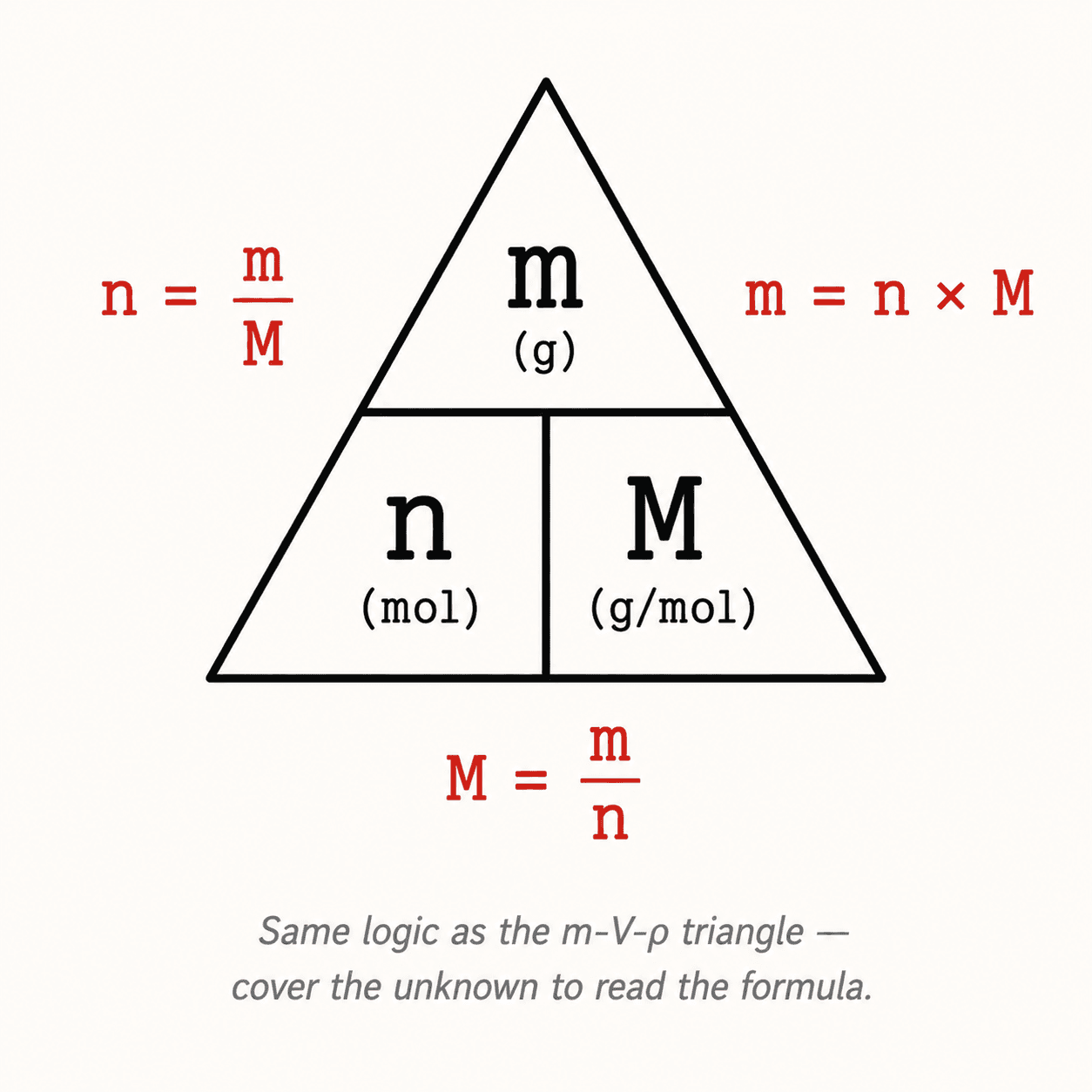
The key relationship is:
n = m / M
- n: amount of substance (in mol)
- m: mass (in g)
- M: molar mass (in g/mol)
Example: how many moles are in 36 g of water? n = 36 / 18 = 2 mol
Example: what mass does 0.5 mol of iron represent? m = n × M = 0.5 × 55.8 = 27.9 g
A taste of stoichiometry
The mole concept opens the door to stoichiometry: calculating the exact proportions in which reactants combine. The coefficients in a chemical equation directly give the ratios of moles. This will be explored in depth in high school — but the intuition of counting in packs starts here.
Finished this lesson?