Elementary charge
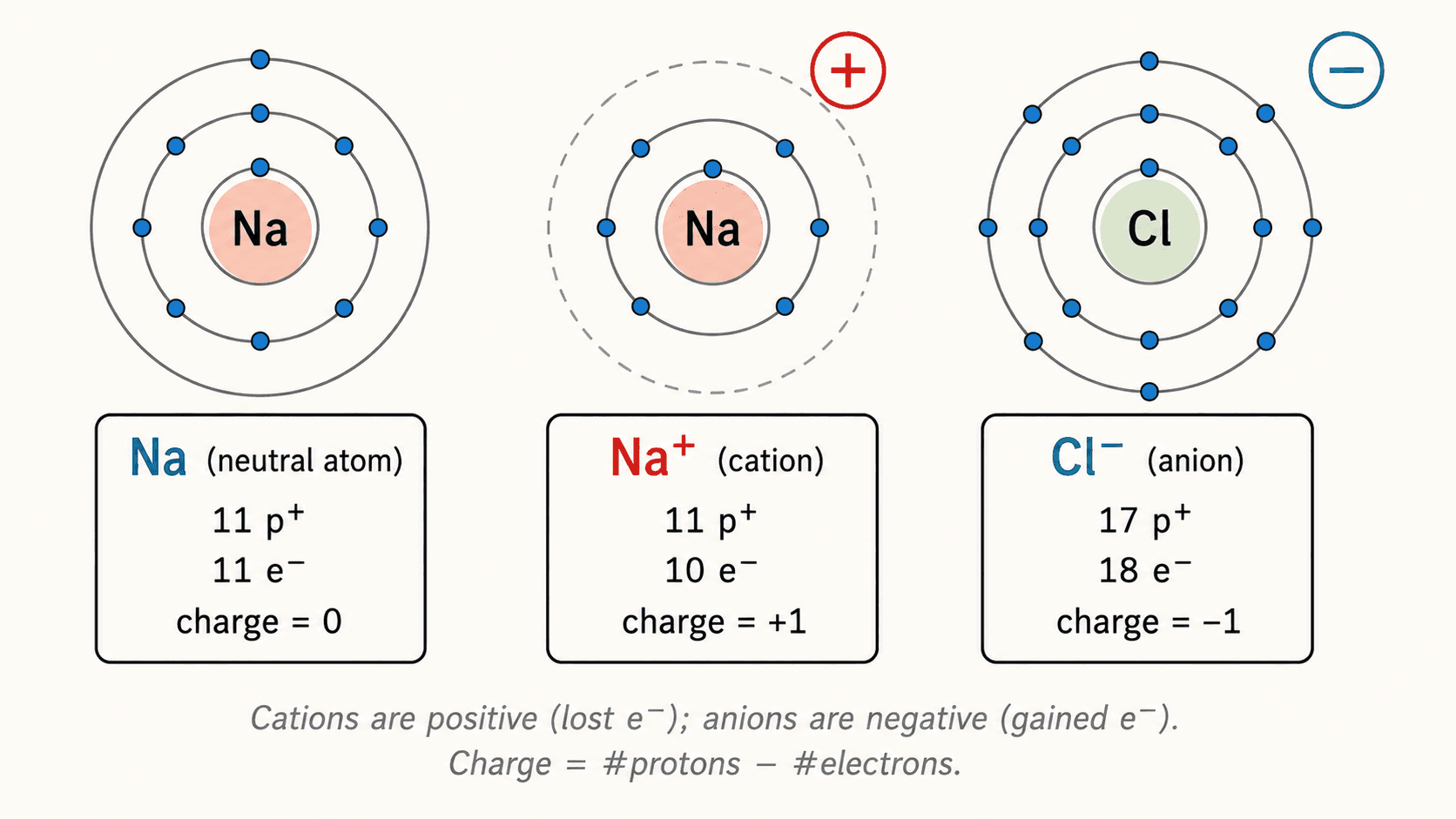
Matter is electrically neutral at large scales, but at the atomic level some particles carry a charge. The elementary charge (written e) is the smallest charge that exists in nature: - A proton carries a charge of +e. - An electron carries a charge of −e. - A neutron is neutral (charge 0).
In a neutral atom, the number of protons equals the number of electrons, so the overall charge is zero.
Cations and anions
When an atom loses electrons, it has more protons than electrons → it is positively charged: it is a cation.
When an atom gains electrons, it has more electrons than protons → it is negatively charged: it is an anion.
Ion notation
The charge of an ion is written as a superscript to the right of the symbol: - Na⁺: sodium ion (lost 1 electron, charge +1) - Cl⁻: chloride ion (gained 1 electron, charge −1) - Cu²⁺: copper(II) ion (lost 2 electrons, charge +2) - O²⁻: oxide ion (gained 2 electrons, charge −2) - Fe³⁺: iron(III) ion (lost 3 electrons, charge +3) - Al³⁺: aluminium ion (lost 3 electrons)
Rule: if the charge is +1 or −1, write + or − without the digit 1.
| Ion | Original atom | Electrons lost/gained | Charge |
|---|---|---|---|
| Na⁺ | Sodium (Na) | −1 | +1 |
| Cl⁻ | Chlorine (Cl) | +1 | −1 |
| Cu²⁺ | Copper (Cu) | −2 | +2 |
| Ca²⁺ | Calcium (Ca) | −2 | +2 |
Ion migration in an electric field
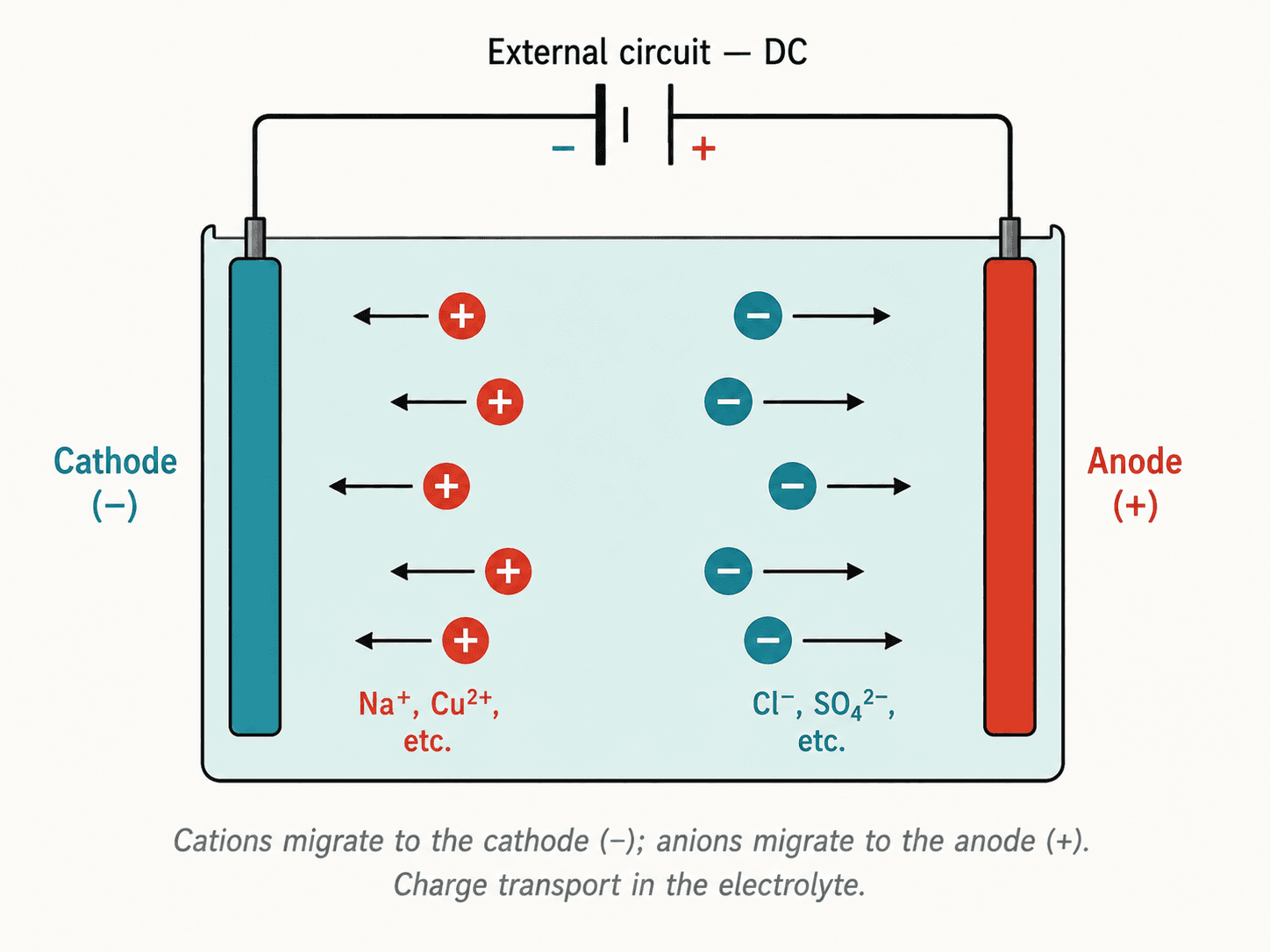
When a voltage is applied between two electrodes in an ionic solution, ions move: - Cations (+ charge) migrate toward the negative electrode (cathode). - Anions (− charge) migrate toward the positive electrode (anode).
This ordered movement of ions constitutes the electric current in the solution.
Electrical neutrality of solutions
In an ionic solution, the sum of positive charges always equals the sum of negative charges: the solution is electrically neutral overall. For example, in a CaCl₂ solution: - 1 Ca²⁺ ion (charge +2) is paired with 2 Cl⁻ ions (2 × (−1) = −2). - Sum: +2 − 2 = 0. ✓
Finished this lesson?