What is electrical conductivity?
A material conducts electricity if charged particles can move freely through it. In metals, electrons move. In solutions, ions move.
To test the conductivity of a solution, use a simple circuit: a power source, two electrodes dipped into the solution, and a light bulb or ammeter. If the bulb lights up (or the ammeter shows a current), the solution is conductive.
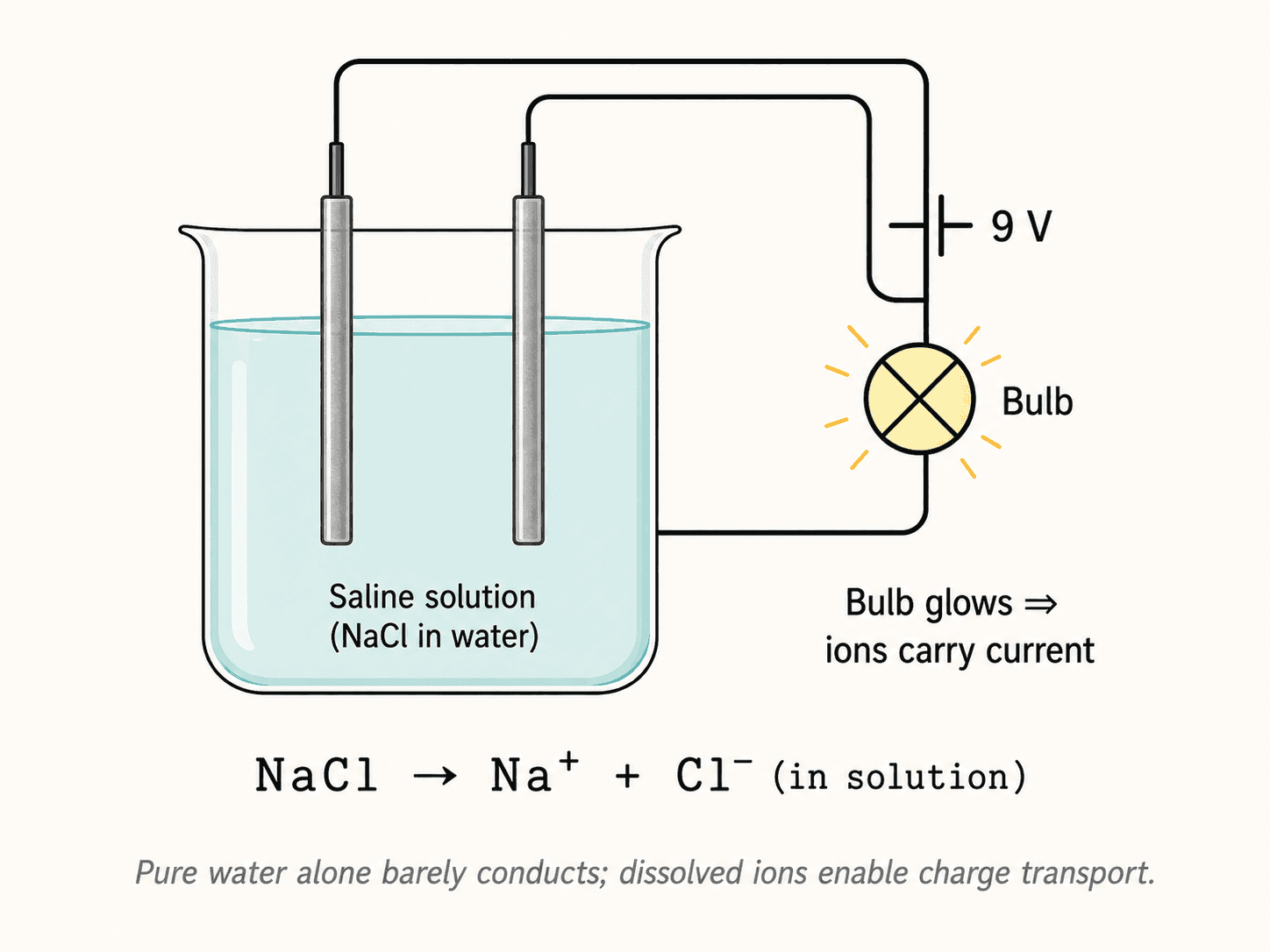
Pure water vs salt water
Pure water barely conducts electricity: it contains almost no mobile ions. But if you dissolve table salt (sodium chloride, NaCl) in water, the solution conducts current noticeably.
Why? Because in solution, NaCl dissociates into ions: NaCl → Na⁺ + Cl⁻
These Na⁺ and Cl⁻ ions are mobile and can move toward the electrodes under the applied voltage, creating a current.
Electrolyte solutions
A solution that contains mobile ions and conducts electricity is called an electrolyte solution (or electrolyte).
| Solution | Ions present | Conductive? |
|---|---|---|
| Pure water | Very few | No (barely) |
| Salt water (NaCl) | Na⁺, Cl⁻ | Yes |
| Lemon juice | H⁺, citrate⁻ | Yes |
| Sugar water | None | No |
| Sodium hydroxide solution | Na⁺, OH⁻ | Yes |
Notice that sugar water does not conduct: sucrose dissolves without forming ions.
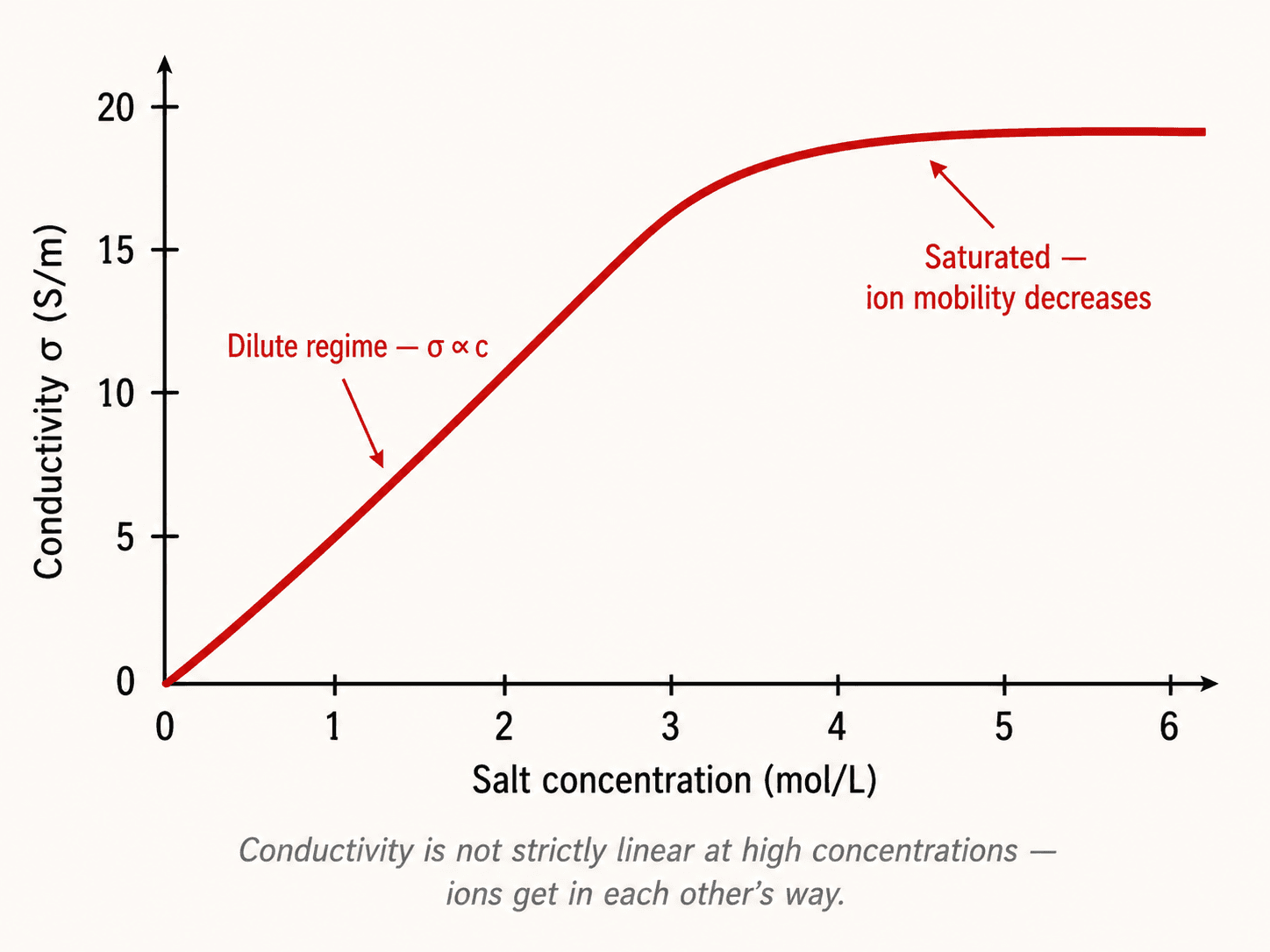
Higher ion concentration means greater conductivity
Conductivity increases with ion concentration in the solution. This is why seawater (very salty, ~35 g/L) conducts far better than slightly salted water.
Important: do not confuse solubility and conductivity. Sugar is very soluble but does not conduct; salt conducts because it dissociates into ions.
Application: water purity testing
Measuring a water's conductivity estimates its dissolved ion content (mineral content). Very pure water (reverse osmosis, distilled water) has near-zero conductivity; mineral water has higher conductivity.
Finished this lesson?