What is a chemical reaction?
A chemical reaction is a transformation in which substances disappear (the reactants) and new substances are formed (the products). Matter is not created or destroyed: it is simply rearranged.
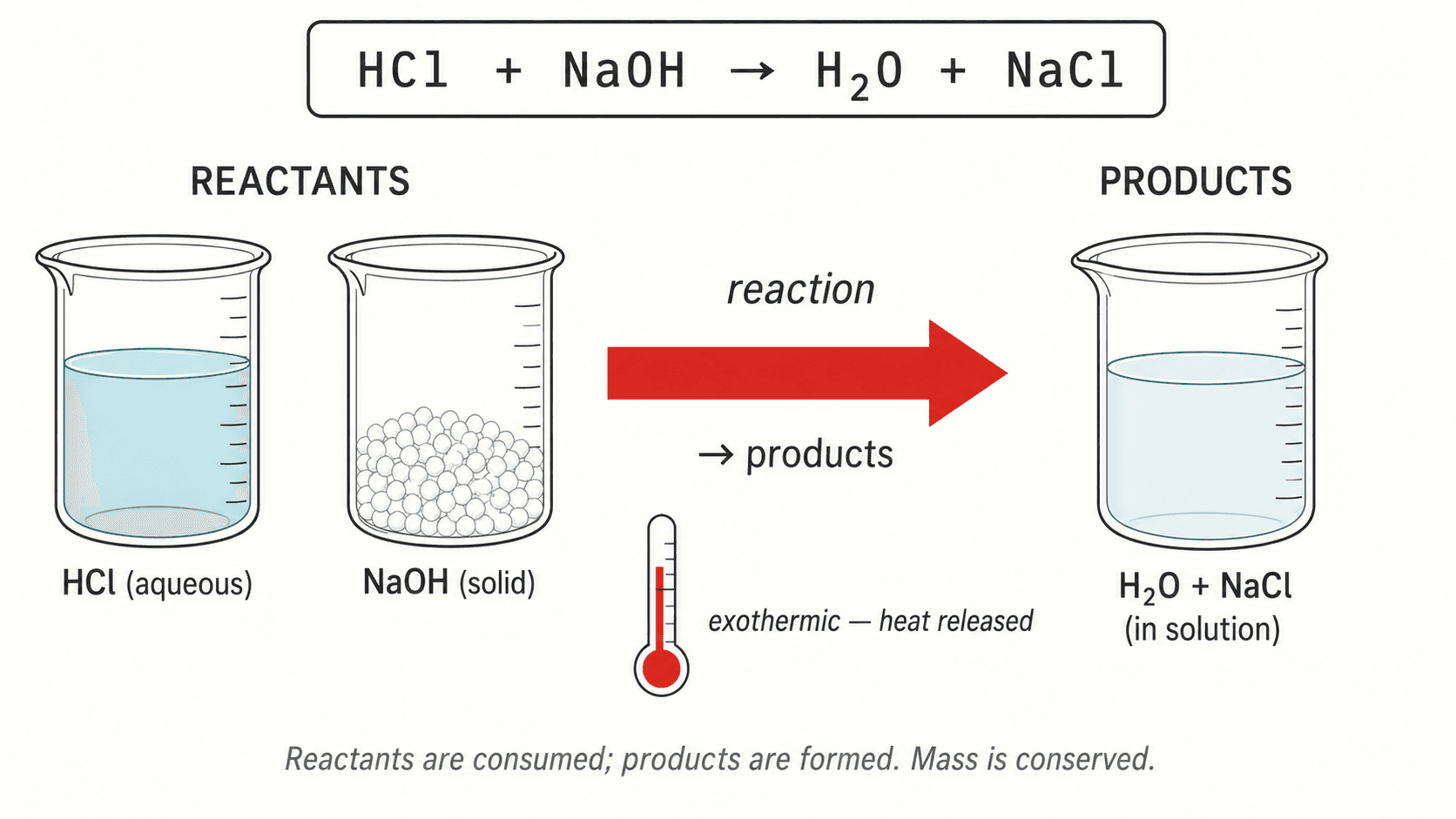
Signs that a chemical reaction has taken place include: - a change of colour; - a gas being released (bubbles); - formation of a precipitate (a solid forming in a solution); - release of heat or light.
Identifying reactants and products
In a chemical reaction written as:
Reactant A + Reactant B → Product C + Product D
- Reactants are the starting substances, to the left of the arrow.
- Products are the substances formed, to the right of the arrow.
Example: combustion of carbon in dioxygen Carbon + Dioxygen → Carbon dioxide C + O₂ → CO₂
The reactants are carbon and dioxygen; the product is carbon dioxide.
Characteristic tests to identify species
Chemists use characteristic tests to identify certain reactants or products.
| Species to detect | Test | Positive result |
|---|---|---|
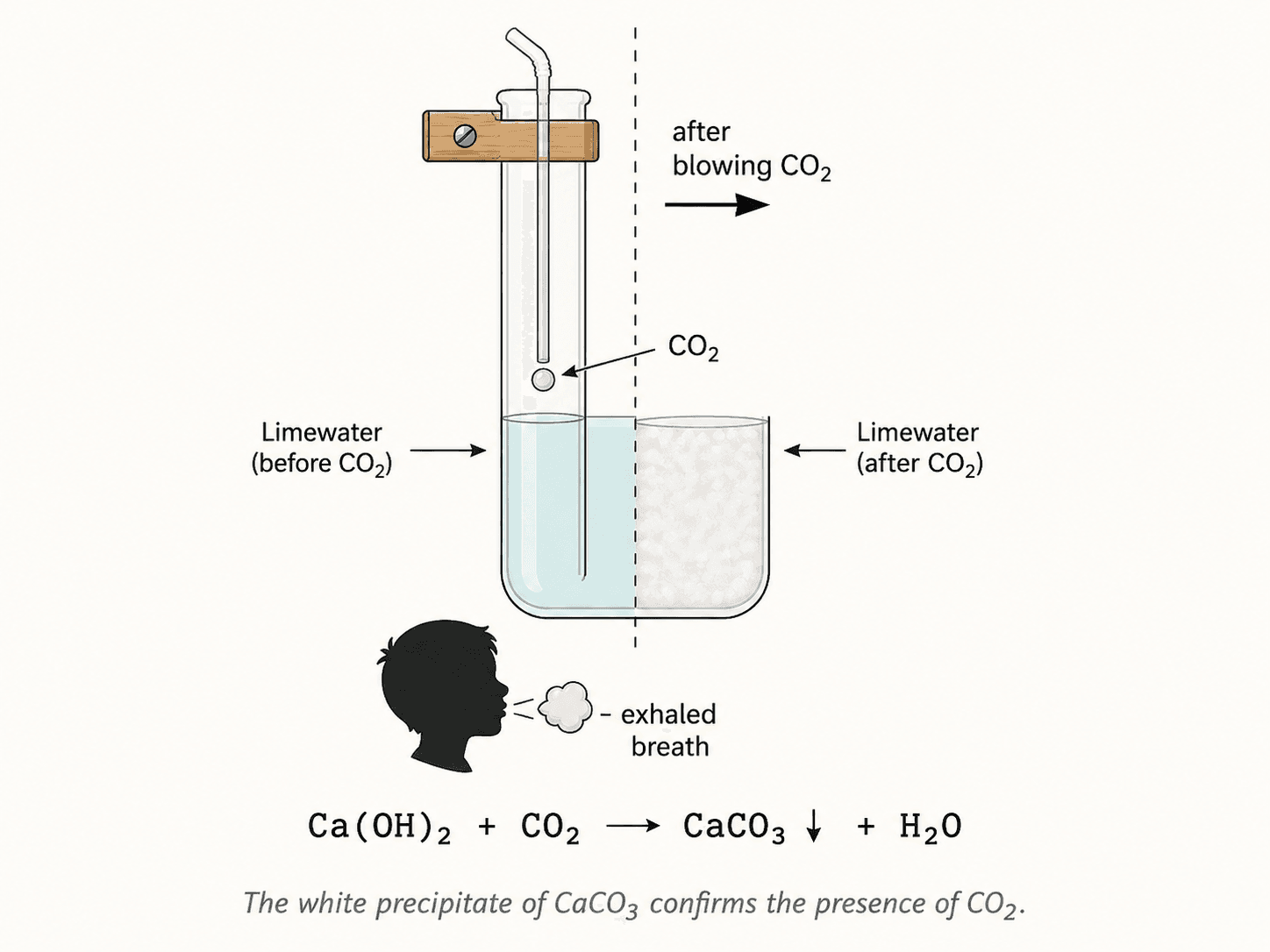
| CO₂ (carbon dioxide) | Limewater | Solution turns cloudy (white) |
| H₂O (water) | Anhydrous copper sulfate | White powder turns blue |
| H⁺ ions (acid) | pH paper / indicator | Red colour / pH < 7 |
| OH⁻ ions (base) | pH paper / indicator | Blue colour / pH > 7 |
The concept of limiting reactant
Reactants are often not present in exactly the right proportions. The limiting reactant is the one that is completely consumed first: it determines how much product forms. The other reactant is in excess.
Example: if 1 g of charcoal burns but only a small amount of dioxygen is available, dioxygen is the limiting reactant, even if there is plenty of charcoal.
Conservation of matter
In a chemical reaction, the total mass is conserved: the mass of reactants equals the mass of products. This is the law of conservation of mass (Lavoisier's law).
"Nothing is lost, nothing is created, everything is transformed."
Finished this lesson?