Representing a reaction with an equation
A chemical equation is the symbolic representation of a chemical reaction. It uses the formulas of reactants and products, separated by an arrow.
Example: combustion of hydrogen in air H₂ + O₂ → H₂O
This says that dihydrogen reacts with dioxygen to produce water. But it is not yet balanced: we must respect conservation of atoms.
The balancing rule: conservation of atoms
During a reaction, atoms are neither created nor destroyed — they change partners. So for each element, the number of atoms before the arrow must equal the number after the arrow.
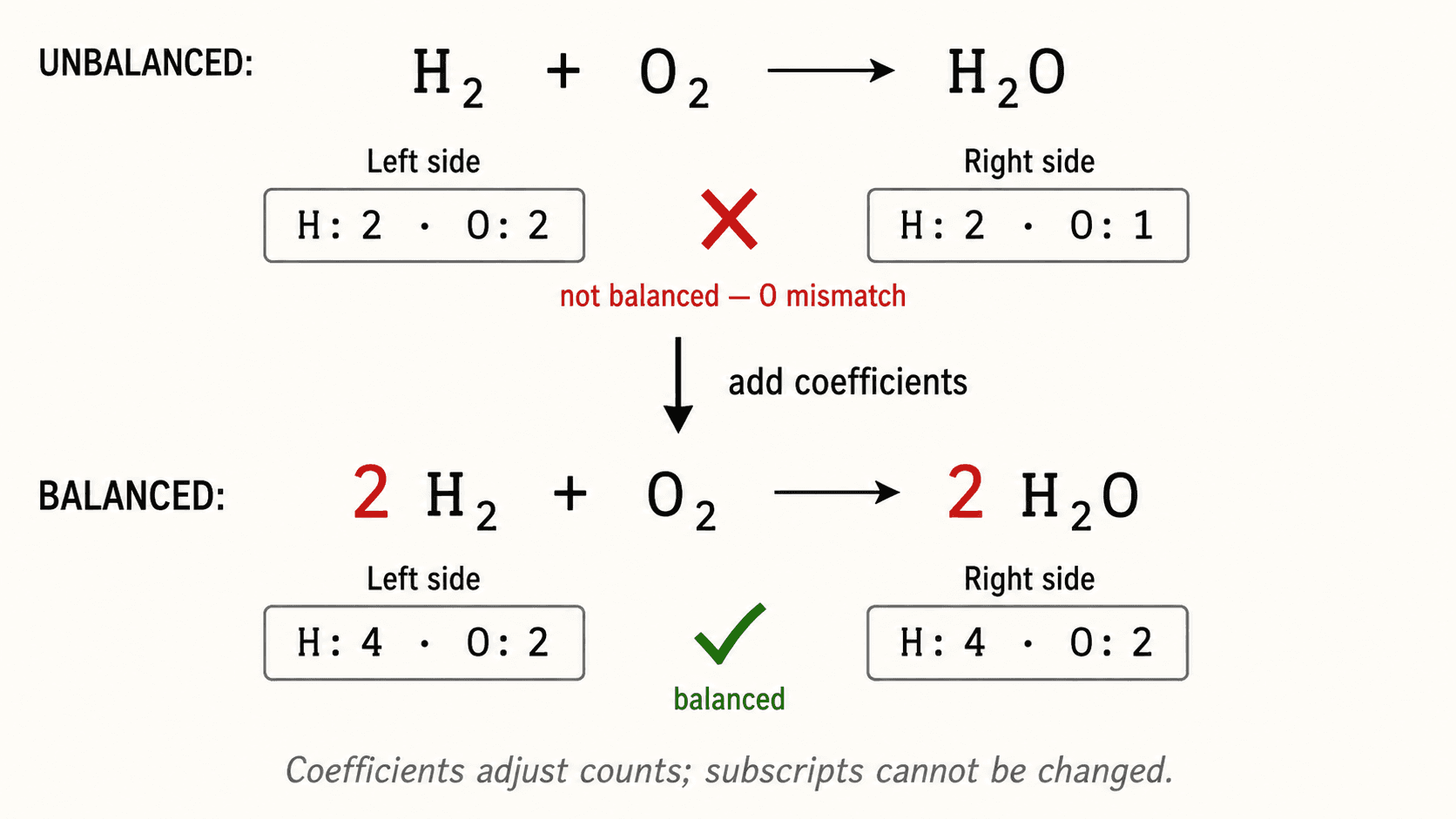
Check H₂ + O₂ → H₂O: - H: 2 on the left, 2 on the right ✓ - O: 2 on the left, 1 on the right ✗
The equation is not balanced. We need to adjust the stoichiometric coefficients.
How to balance an equation
Never change the chemical formulas (the subscripts). Only add coefficients in front of formulas.
Method: 1. Write the unbalanced equation. 2. Identify the most complex element and start there. 3. Adjust coefficients one by one until balanced. 4. Check all elements.
Back to the example: - H₂ + O₂ → H₂O → not balanced (O: 2 ≠ 1) - Put 2 before H₂O: H₂ + O₂ → 2 H₂O (O: 2 = 2 ✓, but H: 2 ≠ 4) - Put 2 before H₂: 2 H₂ + O₂ → 2 H₂O ✓
| Element | Left | Right |
|---|---|---|
| H | 2 × 2 = 4 | 2 × 2 = 4 ✓ |
| O | 1 × 2 = 2 | 2 × 1 = 2 ✓ |
The balanced equation is: 2 H₂ + O₂ → 2 H₂O
More examples
Combustion of methane (methane): CH₄ + 2 O₂ → CO₂ + 2 H₂O
Check: - C: 1 = 1 ✓ - H: 4 = 4 ✓ - O: 4 = 4 ✓
Physical states (optional)
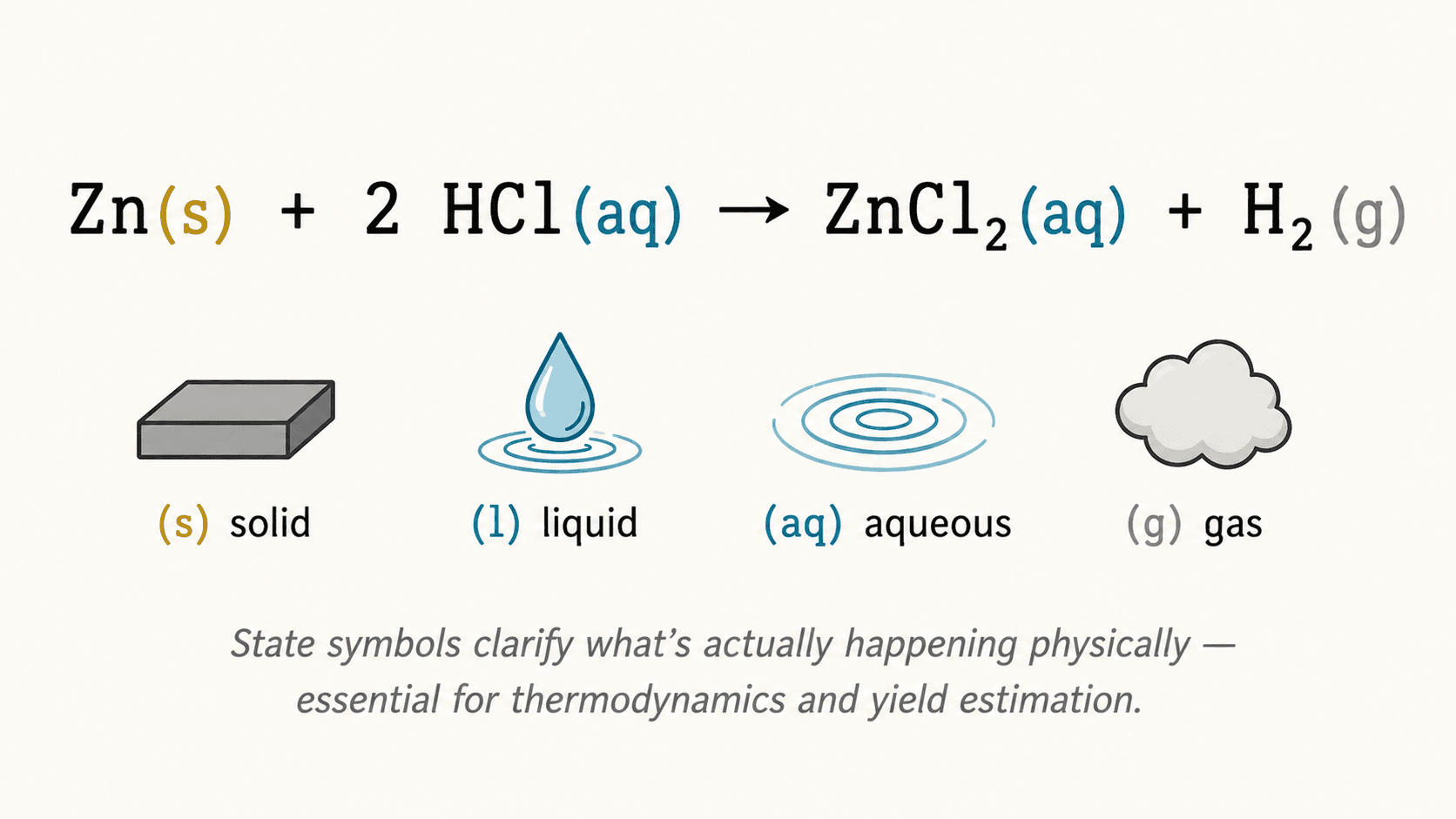
Physical states can be noted in parentheses: - (g) = gas - (l) = liquid - (s) = solid - (aq) = aqueous solution
2 H₂(g) + O₂(g) → 2 H₂O(l)
Finished this lesson?