Why a universal language?
Chemistry is an international science. A French chemist must be able to communicate with a Japanese or Brazilian chemist. To do this, chemists use a universal symbolic language: chemical symbols and formulas.
Element symbols
Each chemical element is represented by a symbol: one or two Latin letters, with the first always capitalised.
| Symbol | Element | Origin |
|---|---|---|
| H | Hydrogen | Hydrogenium |
| O | Oxygen | Oxygenium |
| Fe | Iron | Ferrum |
| Na | Sodium | Natrium |
| Cu | Copper | Cuprum |
| Au | Gold | Aurum |
Many symbols come from Latin or Greek — which explains some surprising letters!
Reading a chemical formula
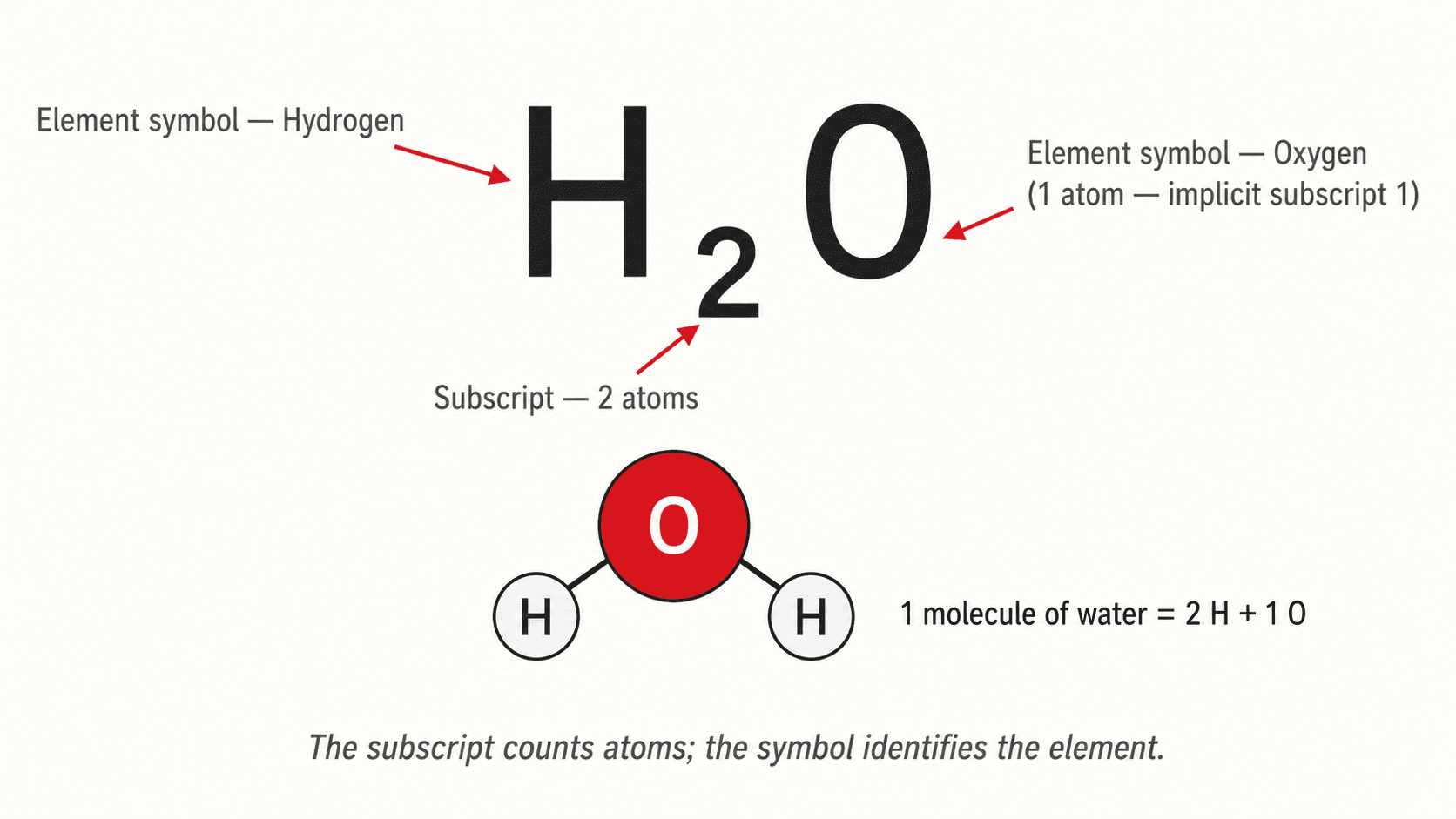
A chemical formula shows the type and number of atoms in a molecule or formula unit.
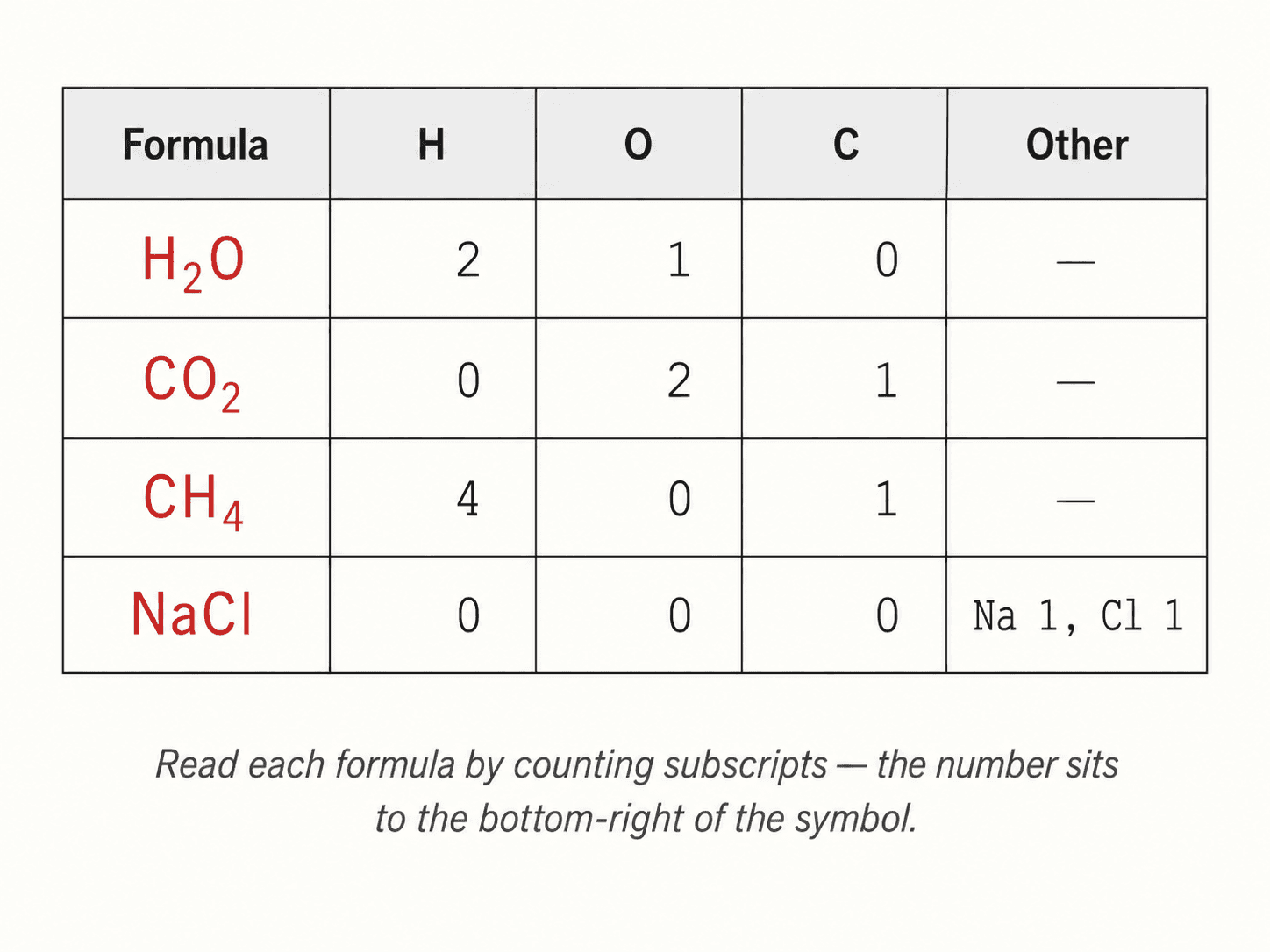
Subscripts (small numbers at the lower right) indicate how many atoms of each element are present: - H₂O: 2 hydrogen atoms + 1 oxygen atom - CO₂: 1 carbon atom + 2 oxygen atoms - NaCl: 1 sodium atom + 1 chlorine atom
If there is no subscript, there is only one atom (implicit subscript of 1).
Stoichiometric coefficients
In chemical equations (covered later), coefficients (large numbers in front of a formula) indicate how many molecules are present:
2 H₂O means 2 water molecules (so 4 H atoms and 2 O atoms total) 3 CO₂ means 3 carbon dioxide molecules
Be careful not to confuse subscripts and coefficients!
| Notation | Meaning |
|---|---|
| H₂O | 1 molecule with 2 H and 1 O |
| 2 H₂O | 2 molecules (4 H, 2 O) |
| H₂O₂ | 1 molecule with 2 H and 2 O (hydrogen peroxide) |
Building a formula
To build the formula of a compound, write the symbols of the elements present, then add the subscripts showing how many atoms of each element there are.
Example: a glucose molecule contains 6 carbon atoms, 12 hydrogen atoms, and 6 oxygen atoms → C₆H₁₂O₆.
Finished this lesson?