The atom: the building block of matter
Everything around us — air, water, rocks, our bodies — is made of atoms. An atom is an extremely small particle: a grain of sand contains around 10¹⁸ atoms (that is 1 followed by 18 zeros!).
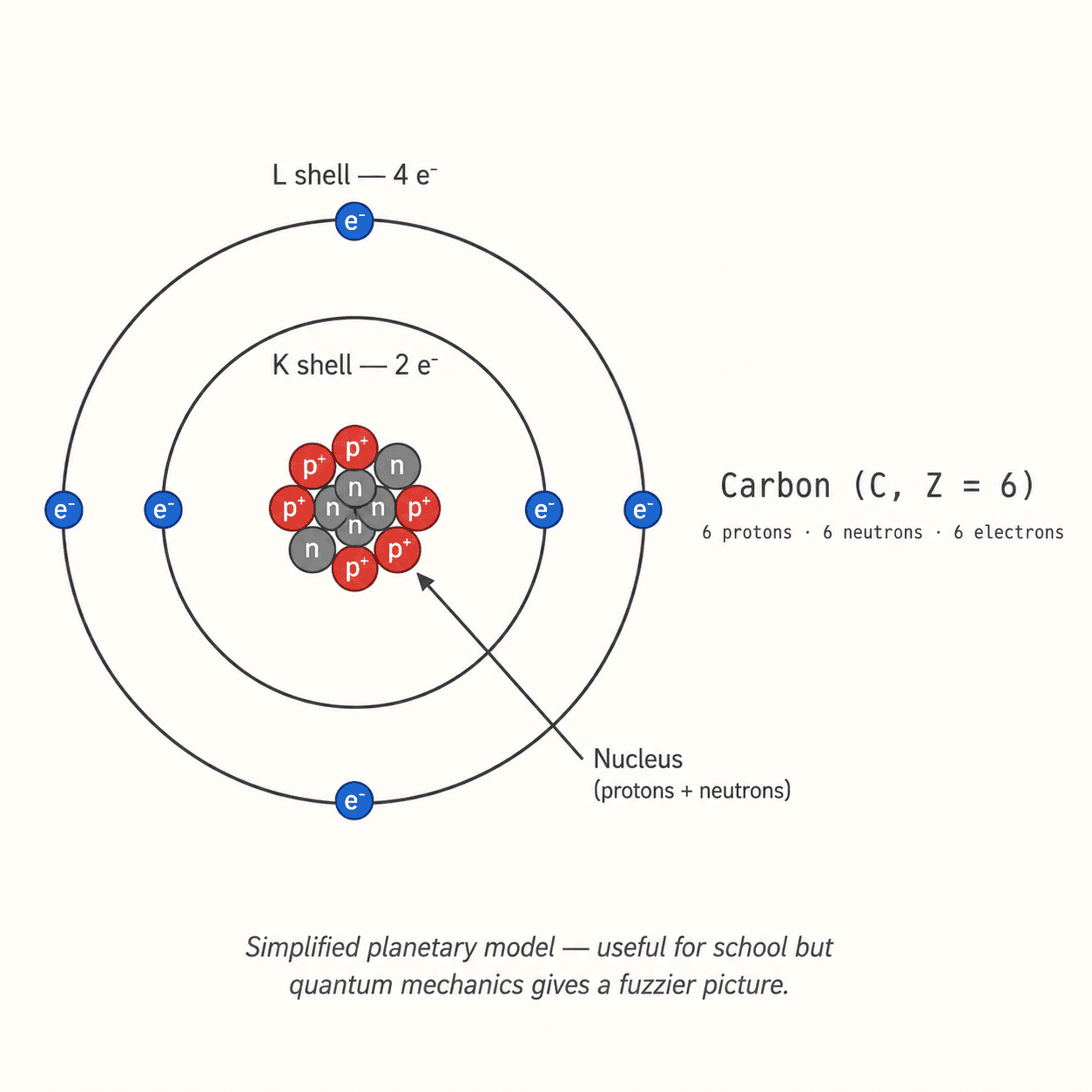
An atom is made of: - a central nucleus, positively charged, containing protons and neutrons; - electrons, negatively charged, orbiting the nucleus.
In a neutral atom, the number of electrons equals the number of protons. The atomic number Z of an element equals its number of protons.
Molecules: atoms bonded together
When two or more atoms join by sharing electrons, they form a molecule. This link is called a covalent bond.
Common examples: - H₂O (water): 2 hydrogen (H) atoms + 1 oxygen (O) atom - CO₂: 1 carbon atom + 2 oxygen atoms - CH₄ (methane): 1 carbon + 4 hydrogens
The molecular formula shows the type and number of each atom in the molecule.
Ions: charged atoms
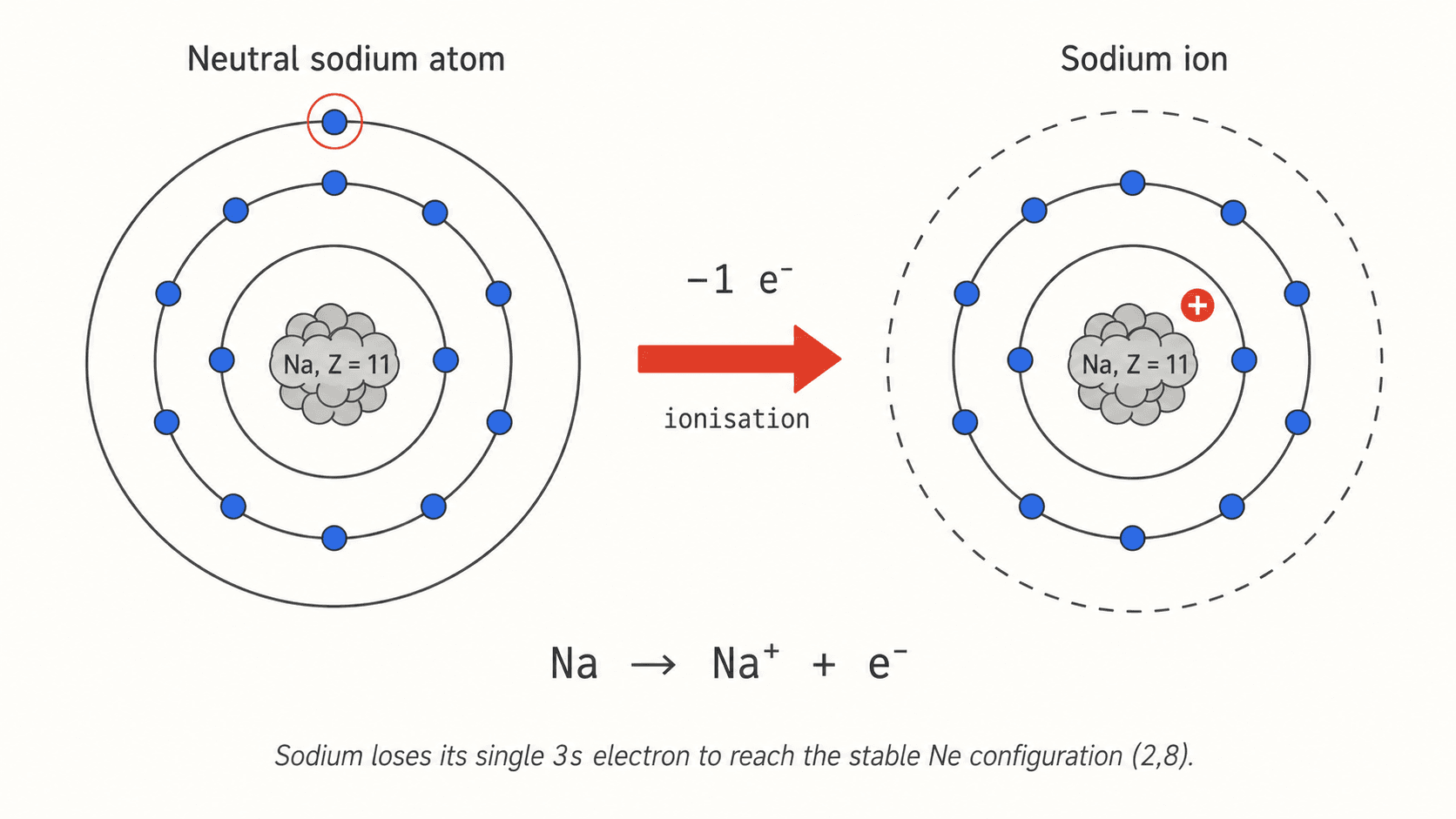
When an atom loses one or more electrons, it becomes positively charged: it is a cation. When an atom gains electrons, it becomes negatively charged: it is an anion.
| Ion | Name | Charge |
|---|---|---|
| Na⁺ | Sodium ion | +1 |
| Cl⁻ | Chloride ion | −1 |
| Ca²⁺ | Calcium ion | +2 |
| O²⁻ | Oxide ion | −2 |
The charge is written as a superscript after the symbol: Na⁺ means the sodium atom lost 1 electron.
Polyatomic ions
An ion can also be made of several atoms bonded together. This is called a polyatomic ion.
Examples: - OH⁻: hydroxide ion (found in bases) - SO₄²⁻: sulfate ion - NH₄⁺: ammonium ion
These ions remain stable and act as a single unit in chemical reactions.
Summary
- Atom = neutral particle (protons = electrons)
- Molecule = several atoms joined by covalent bonds
- Ion = atom or group of atoms that has lost or gained electrons (charged)
Finished this lesson?