Physical principle of NMR
Nuclear Magnetic Resonance (NMR) is based on the nuclear spin magnetic moment. Nuclei with spin I ≠ 0 (¹H, ¹³C, ¹⁹F, ³¹P…) behave like tiny magnets. Placed in a static magnetic field B₀, their spins populate 2I+1 energy levels; for I = 1/2 (¹H, ¹³C) there are two levels — α (parallel, lower energy) and β (antiparallel).
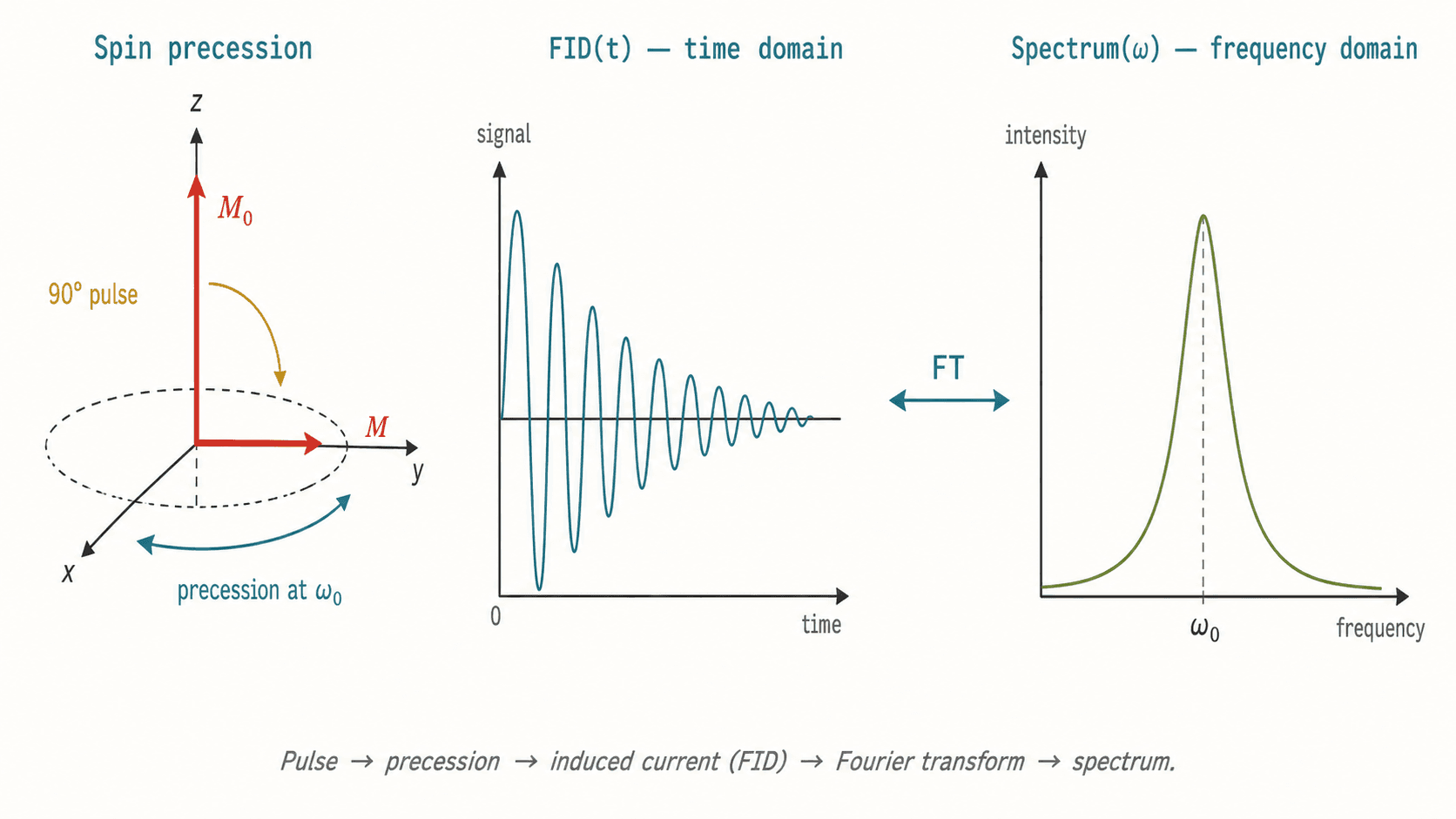
The energy gap is ΔE = h·γ·B₀ / (2π), where γ is the gyromagnetic ratio. For ¹H at 11.7 T (500 MHz), ΔE corresponds to a radiofrequency photon (~500 MHz). A 90° RF pulse tips the magnetization into the transverse plane; its free induction decay (FID) is recorded and converted to a spectrum by Fourier transform.
The field B₀ is never felt directly by the nucleus: the surrounding electron cloud partially shields it, generating the chemical shift δ.
Chemical shift δ
Chemical shift is defined as:
δ (ppm) = (ν_sample − ν_TMS) / ν_spectrometer × 10⁶
The universal reference is tetramethylsilane (TMS), δ = 0 ppm. The ppm scale is dimensionless and independent of spectrometer frequency, making spectra comparable across instruments.
| ¹H environment | δ (ppm) |
|---|---|
| TMS | 0 |
| Alkyl (–CH₃, –CH₂–) | 0.8–2.0 |
| Allylic/propargylic | 1.6–2.6 |
| α to C=O | 2.0–2.7 |
| Ether (O–CH) | 3.3–4.5 |
| Vinylic (=CH–) | 4.5–6.5 |
| Aromatic | 6.5–8.5 |
| Aldehyde (CHO) | 9.0–10.5 |
| Carboxylic (COOH) | 10–12 |
In ¹³C, shifts span 0–220 ppm: alkyls (0–50), alkenes/aromatics (100–160), carbonyls (160–220 ppm).
Scalar coupling (J)
Geminal and vicinal protons couple through bond electrons (scalar mechanism, most commonly ³J). Coupling manifests as a splitting of the signal: a proton H_A coupled to n equivalent H_X protons gives a multiplet of (n+1) lines with binomial ratios (n+1 rule). Examples: doublet (d, n=1), triplet (t, n=2), quartet (q, n=3).
The coupling constant ³J (in Hz) depends on the dihedral angle φ via the Karplus equation:
³J ≈ A cos²φ − B cos φ + C
Typical values: ³J_trans (alkene) ≈ 12–18 Hz; ³J_cis ≈ 6–12 Hz; ³J (cyclohexane axial-axial, φ ≈ 180°) ≈ 10–13 Hz. Analysing J values determines stereochemistry.
¹³C–H coupling is usually suppressed by broadband proton decoupling (BBD): each carbon gives a singlet. The DEPT experiment (Distortionless Enhancement by Polarisation Transfer) distinguishes CH, CH₂ and CH₃ from quaternary carbons (absent in DEPT).
Integration and proton count
In ¹H NMR, the integrated area of a signal is directly proportional to the number of contributing protons (provided a sufficient relaxation delay D1 ≥ 5·T₁ is used). Relative integration counts equivalent hydrogens per group.
Example: ethanol CH₃CH₂OH gives three signals in 3:2:1 ratio (CH₃ : CH₂ : OH). The OH signal may be broad or exchangeable (disappears on D₂O shake).
Strategy for complete assignment
Systematic ¹H/¹³C assignment follows this sequence:
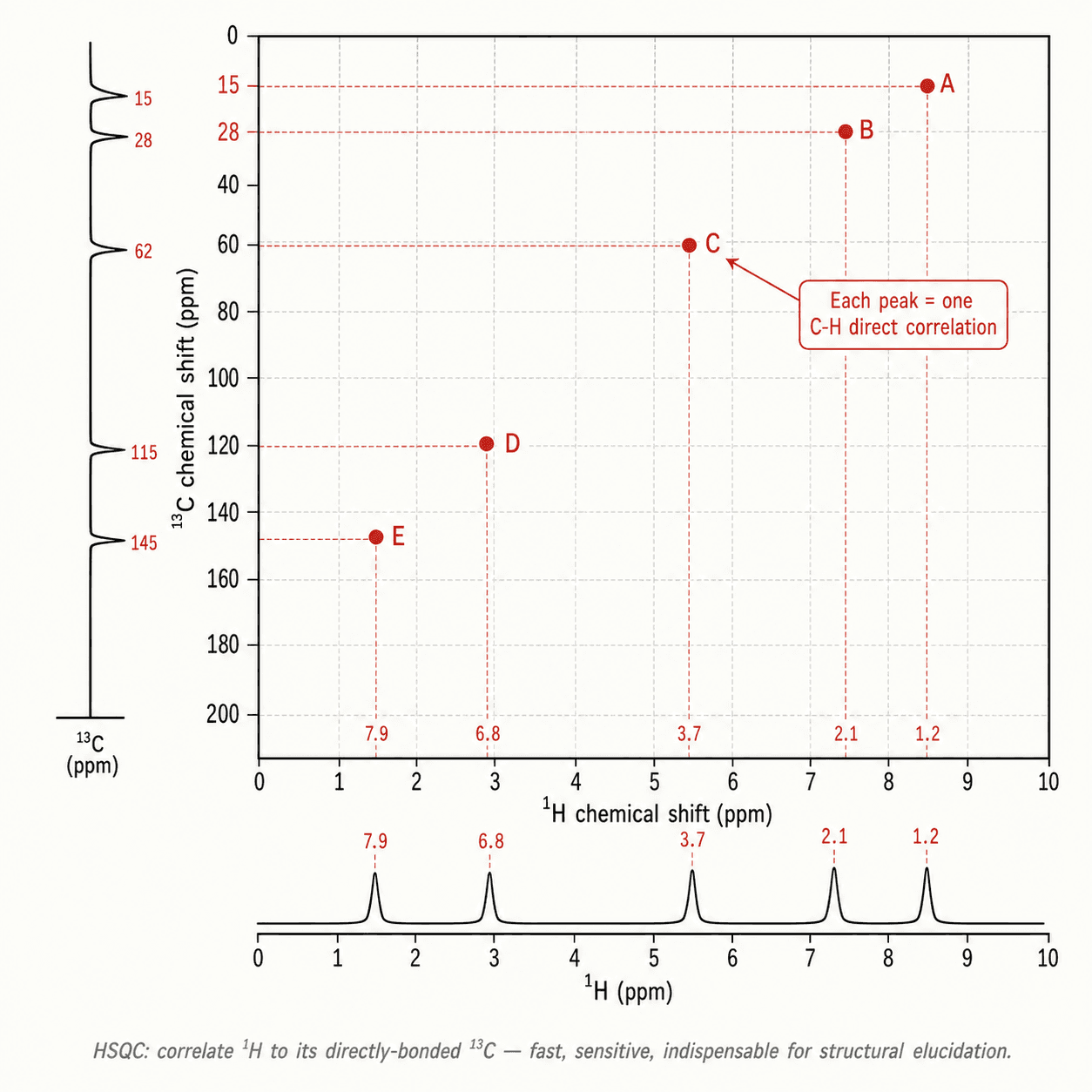
1. Molecular formula and degree of unsaturation (DU = (2C + 2 + N − H) / 2). High DU suggests aromatic rings or carbonyls. 2. ¹³C DEPT: catalogue carbon types (CH, CH₂, CH₃, quaternary C). 3. ¹H δ and integrations: identify characteristic groups. 4. Multiplicities and J values: chain fragments (CH₃ triplet → adjacent CH₂). 5. 2D correlations (COSY, HSQC, HMBC) for complex molecules: COSY links vicinal H–H; HSQC links H directly to C; HMBC links H to C over 2–3 bonds.
Practical aspects and deuterated solvents
Spectra are recorded in deuterated solvents to avoid the massive signal of protic solvent. Common solvents and their residual signals: CDCl₃ (δ_H = 7.26; δ_C = 77.0), DMSO-d₆ (δ_H = 2.50; δ_C = 39.5), D₂O (δ_H = 4.79). The residual solvent signal is often used as an internal reference when TMS is not added. Typical concentration: 10–50 mg in 0.6 mL solvent; excess solute degrades resolution through viscosity.
Finished this lesson?